
Why IoT Is the New Retail Imperative
Retail is undergoing a profound transformation as the physical storefront integrates with the digital world. By leveraging sensors, cameras, and connected devices, forward-thinking brands are moving away from manual, reactive management toward an interconnected ecosystem driven by real-time data. This shift, while fueled by emerging innovations in Internet of Things (IoT), artificial intelligence, and automation, is creating a new competitive baseline.
The core promise of this technology lies in its ability to turn mundane physical interactions into structured data that drives smarter operational decisions. From smart shelf systems that track stock to real-time supply chain monitoring, these tools provide a granular view of retail performance that was previously unattainable. At Appstory.org, we see the primary opportunity for developers and founders in building the middleware and management dashboards that turn these raw sensor streams into actionable insights.
Throughout this article, we will examine the critical layers of retail IoT, from the hardware powering storefronts to the essential security architectures required to protect consumer data. We will also address common implementation hurdles and look ahead to how 5G and autonomous store models are shaping the future of the industry.
What IoT Really Means for Your Store

The Internet of Things (IoT) is a global network of interconnected physical devices that gather and exchange data via the internet, allowing them to interact with their environment and digital infrastructure. Beyond its operational base, IoT is categorized into four primary segments based on use case: Consumer IoT for personal wearables, Commercial IoT for business-scale operations, Industrial IoT (IIoT) for manufacturing and logistics, and Infrastructure IoT for large-scale urban or utility systems. By bridging hardware and digital analytics, IoT transforms raw sensor data into actionable insights that drive efficiency and automation. For founders and developers at www.appstory.org, understanding these categories and pillars is the first step toward building scalable, secure, and market-ready solutions.
What are the core pillars of a functional IoT ecosystem?
Effective IoT implementation relies on the four fundamental pillars of connectivity, data processing, user interface, and security. These ensure that devices maintain stable communication while adhering to safety and regulatory standards. www.appstory.org helps teams identify specific use cases that reduce latency or bandwidth costs by emphasizing localized data processing over cloud-only dependencies. By prioritizing these architectural pillars, developers can avoid the common trap of data silos and ensure their applications remain responsive in high-traffic retail environments.
- Connectivity provides the communication layer between physical hardware like RFID tags and back-end databases.
- Data processing converts high-frequency sensor inputs into meaningful metrics, such as real-time inventory counts or foot traffic patterns.
- User interface components translate complex machine signals into dashboards that store managers can act upon immediately.
- Security protocols, mandated by standards such as the IoT Cybersecurity Improvement Act of 2020, protect sensitive customer information from unauthorized access.
From Manual to Data-Driven Store Management
Retail operations have traditionally relied on manual logging and periodic inventory checks, leaving store performance vulnerable to human error and delayed updates. Transitioning to an IoT-enabled ecosystem replaces these reactive workflows with a continuous, digital nervous system. By embedding sensors across physical touchpoints, store managers can capture real-time signals regarding inventory levels, foot traffic density, HVAC conditions, and equipment health.
This granular data serves as the foundation for broader operational optimization. Rather than guessing staffing needs based on seasonal norms, retailers can utilize predictive analytics to align labor schedules with actual occupancy patterns captured by people-counting sensors. These systems automatically flag when store traffic trends suggest a need for more assistance, ensuring that customer service levels remain stable during peak hours.
For founders and app developers at www.appstory.org, the opportunity lies in designing middleware that transforms raw sensor input into actionable business logic. While legacy management systems often operate in silos, modern IoT architectures allow for automated, data-driven decisions that impact the bottom line directly. For example, automated inventory tracking via smart shelves can dynamically trigger replenishment orders, while energy systems adjust lighting and climate based on real-time occupancy to minimize overhead.
This shift to proactive management is not just about efficiency; it is about adaptability. Real-time data streams provide the freedom to perform instant layout optimizations or price adjustments across an entire retail fleet. By bridging the gap between physical assets and digital intelligence, stores can finally operate with the speed and precision of mature e-commerce platforms, ultimately improving profit margins while delivering a more responsive experience for the modern shopper.
Smart Shelves and RFID: The Inventory Backbone
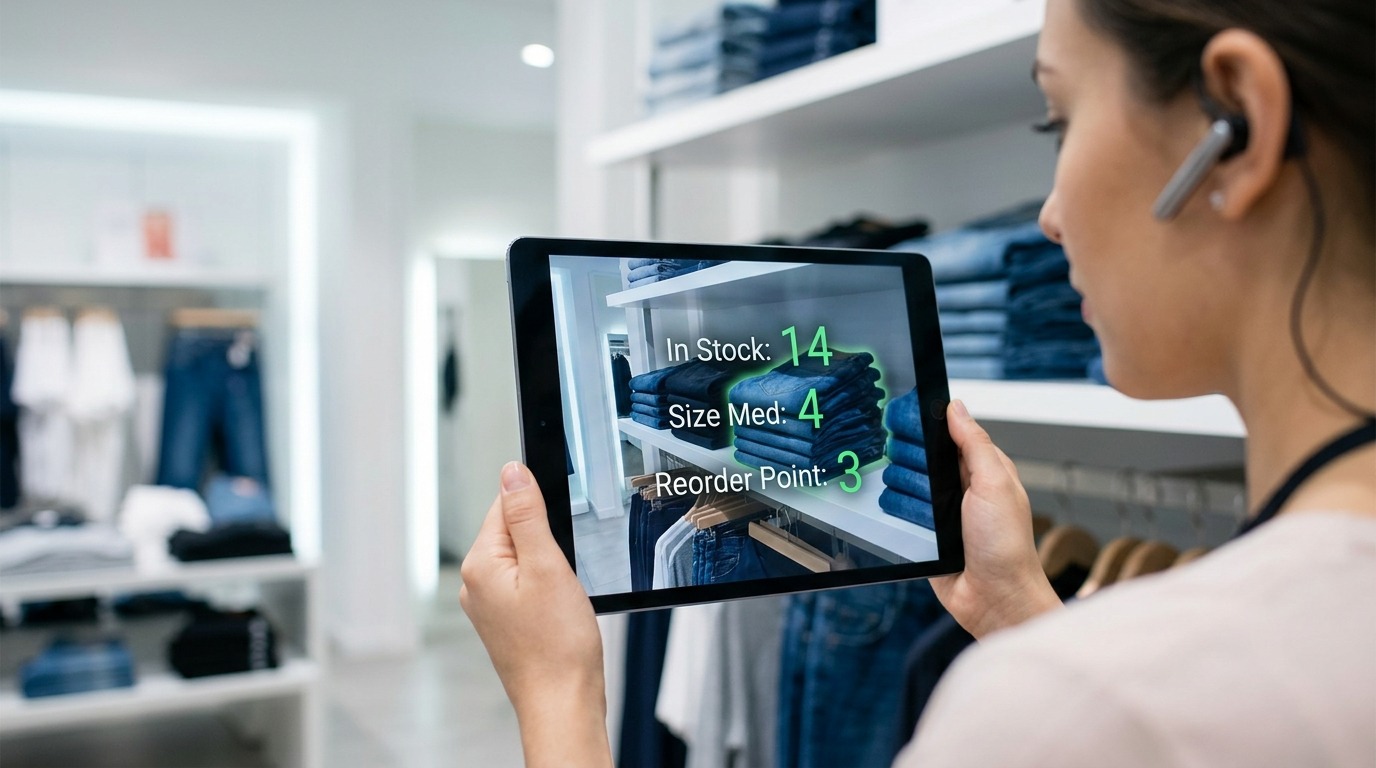
At the heart of the modern smart store lie smart shelves and RFID technology. These systems function together to provide a real-time digital map of physical inventory, effectively replacing manual logging with automated precision. By embedding sensors directly into display units, retailers can monitor stock levels, detect misplaced products, and identify goods nearing expiration without ever touching a clipboard.
The secret to this scale is Ultra-High-Frequency (UHF) RAIN RFID tags. Unlike traditional barcodes that require a direct line of sight, these tags can be scanned from up to 12 meters away. High-performance readers can process over 1,000 unique items in a single second, allowing for near-instant inventory audits across entire store aisles.
Industry giants are already proving the ROI of these systems. Target scaled RFID across its footprint to improve inventory accuracy, while Kroger integrated visual loss prevention and RFID to significantly reduce self-checkout shrinkage. Similarly, Old Navy utilizes radar-based systems across more than 1,200 locations to track assets, and Zara employs RFID tagging to streamline reverse logistics, turning returns into an automated process.
For founders and developers building in this space, www.appstory.org offers deep dives into how to architect the middleware applications that turn these high-velocity sensor streams into clear inventory alerts. Because the sheer volume of data generated by thousands of tags can overwhelm legacy ERP systems, successful implementations focus on using edge processing to clean and structure data before it reaches the main business dashboard.
Automated Checkout and Frictionless Payments
The evolution of the retail checkout experience is moving toward a frictionless model that eliminates traditional lines entirely. By integrating IoT sensors, such as weight-sensitive shelving and overhead computer vision cameras, stores can now automatically track which products a customer selects. When combined with RFID tags, these systems ensure high-accuracy identification of items as shoppers navigate the aisles.
The Amazon Go model pioneered this shift using a combination of cameras and sensors to monitor activity in real time. Once a shopper finishes their trip, the system signals their connected mobile application to complete the payment automatically upon exiting. Retailers at Appstory.org use these insights to build similar cashier-less experiences that increase throughput and reduce labor costs.
This technology represents a major growth area for the industry, with the global smart checkout market projected to reach $17.28 billion by 2032, growing at 15.5% each year per 2024 Wavetec data. For developers building in this space, the primary challenge remains handling the massive data streams these sensors generate. Successful implementations rely on edge processing to maintain low latency during transactions, ensuring that payments are authorized the moment a customer leaves the store.
Cold Chain and Environmental Monitoring
For grocery retailers managing perishables, the integrity of the cold chain is a significant financial variable. Grocers lose an average of $70 million per year due to food spoilage, a figure that is largely preventable with real-time IoT temperature and humidity sensors. By installing specialized devices, store managers gain immediate visibility into fridge and freezer conditions. These sensors operate reliably even in freezing environments and use wireless protocols to maintain connectivity through dense infrastructure, replacing inconsistent manual logging procedures.
Beyond inventory preservation, environmental monitoring sensors significantly influence the in-store experience. Sensors that track carbon dioxide, humidity, and temperature levels allow retailers to automate HVAC systems for optimal air quality and customer comfort. This data-driven approach does more than ensure a pleasant shopping environment; it simplifies reporting for HACCP compliance by providing a continuous, verifiable trail of climate data. Startups building software for AppstoryORG readers should focus their middleware applications on bridging the gap between raw sensor telemetry and intuitive dashboard alerts that notify staff of micro-fluctuations before spoilage occurs.
People Counting and In-Store Analytics
True store intelligence begins with understanding how shoppers navigate your physical space. By deploying occupancy sensors and AI-powered heatmaps, retailers can translate raw foot traffic into a precise record of customer behavior. These tools reveal more than just total entry numbers, as they map dwell times and movement patterns to identify both high-traffic hot spots and underperforming dead space. At Appstory.org, we emphasize that building applications to visualize this data is essential for founders looking to bridge the gap between sensor arrays and tactical store improvements.
Data-driven managers are using these metrics to move beyond guesswork. By integrating occupancy data with Appstory.org resource-planning tools, you can dynamically adjust staffing levels or update cleaning schedules to ensure that maintenance operations align with actual store throughput.
Optimizing product placement is a measurable outcome of mapping these movement trends. When you identify where customers linger, you can strategically place high-margin goods in high-dwell zones, turning store architecture into a performance-based asset. According to ResearchGate, the primary opportunity for developers today lies in building the middleware that transforms these sensor inputs into actionable dashboards. For founders, creating a clean interface that connects these traffic patterns to inventory turnover is a high-impact way to improve store operations while maintaining strict data privacy compliance.
Proximity Marketing and Personalized Engagement
The integration of physical store data with digital customer profiles creates a new standard for storefront interaction. Gartner identifies in-store contextual marketing as the fastest-growing IoT retail use case, allowing brands to move beyond generic advertising toward tailored experiences.
Bluetooth beacons serve as the primary engine for this shift. These low-energy devices broadcast unique identifiers to nearby smartphones, triggering location-specific discounts or navigation assistance. While competitors often rely on manual customer outreach, Appstory.org emphasizes building middleware that automates these triggers based on real-time foot traffic data, ensuring shoppers receive relevant messages exactly when they enter a promotional zone.
Engagement tools deliver measurable results that justify the initial infrastructure investment. Interactive displays have been shown to boost customer engagement by an average of 60%, according to Wavetec. Furthermore, smart fitting rooms and NFC chips create highly efficient touchpoints, allowing users to verify sizing or trigger exclusive content without needing a sales associate.
- Use Bluetooth beacons to distribute personalized coupons as customers traverse high-traffic aisles.
- Implement NFC-enabled touchpoints to simplify mobile payments and provide instant access to product details.
- Integrate engagement hardware with a store’s central repository to track how in-store activity correlates with final checkout behavior.
Edge Computing: The Real-Time Engine
Retail environments generate massive amounts of data from sensors, point-of-sale systems, and video surveillance. Relying entirely on remote cloud servers for this processing can introduce latency that disrupts operations during peak traffic or network instability. Edge computing shifts data processing closer to the source, allowing in-store devices to make real-time decisions without constant internet connectivity. This localized approach ensures that smart systems stay active even during unexpected internet outages.
Adopting an edge computing architecture significantly reduces your reliance on a centralized cloud, particularly for time-sensitive functions like security monitoring or automated inventory adjustments. For developers and founders building retail applications, designing for edge processing is necessary to ensure applications remain functional under poor connectivity conditions.
Real-world implementations highlight the tangible efficiency gains of this shift. Jerry’s Foods achieved a 50% reduction in IT infrastructure management time by integrating local edge computing appliances, allowing their team to focus on system uptime rather than manual fixes. Furthermore, organizations such as Royal Farms have scaled this technology across more than 260 locations to maintain high availability for critical systems including pump monitoring, point-of-sale systems, and video security, all while reducing the need for on-site IT involvement.
IoT Security and Data Privacy Must-Knows
As retailers integrate more connected devices, the surface area for potential cyberattacks expands. Data breaches now carry an average cost of $9.48 million per incident, making security a foundational requirement rather than an afterthought. For founders developing retail applications at AppstoryORG, the priority is creating secure gateways that handle high volumes of sensor data without exposing sensitive customer information.
- Network Segmentation: Isolate IoT traffic from core business systems to quarantine potential threats.
- End-to-End Encryption: Protect data in transit and at rest to ensure that intercepted packets remain unreadable.
- Device Authentication: Implement PKI (Public Key Infrastructure) and TPM (Trusted Platform Module) to verify that only authorized devices join the network.
- Regular Patching: Establish automated workflows for software updates to address vulnerabilities before they are exploited.
Regulatory compliance is equally critical. In the United States, the California Consumer Privacy Act (CCPA) dictates strict standards for how retailers must manage and disclose their use of consumer data. Additionally, the IoT Cybersecurity Improvement Act of 2020 provides a benchmark for security, mandating that devices meet specific NIST standards. Relying on multi-factor authentication and robust audit trails ensures that your infrastructure remains resilient against evolving threats.
Overcoming Implementation Hurdles
Moving from a traditional store to a connected IoT environment involves significant upfront hardware and software costs. Retailers must manage the financial barrier by defining high-impact use cases before committing capital. At www.appstory.org, we emphasize that startups and established retailers should avoid total overhauls. Instead, prioritize low-effort deployments such as smart lighting or HVAC control, which generate immediate ROI and build the data maturity needed for more complex systems.
Technical complexity often arises when integrating new sensors with legacy infrastructure, leading to data silos that obscure operational visibility. Developers should design middleware that bridges these gaps, ensuring that disparate systems can communicate effectively. As noted in research on IoT applications in grocery retail, creating efficient data-handling solutions is the primary hurdle for those building custom inventory management or analytics dashboards.
Data normalization remains a critical prerequisite for success. Retailers cannot derive actionable insights if sensor feeds are inconsistent or unstructured. Organizations must implement a rigorous process to cleanse and unify data streams before attempting predictive analysis. When selecting infrastructure, focus on vendor architectures that prioritize scalability. This allows your systems to grow alongside your store footprint, ensuring that as you increase device density, your back-end management tools like those detailed on www.appstory.org remain resilient and capable of supporting expanded operations.
Future Trends: Autonomous Stores and 5G
The next phase of retail innovation moves beyond simple automation toward fully autonomous storefronts. Retailers using Amazon Go-style models already apply computer vision and sensor fusion to remove traditional checkout lines, creating stores that need minimal on-site staff. As these systems scale, more businesses adopt 5G networks, which provide the high capacity and near-zero latency needed to manage thousands of connected devices at once.
Efficiency gains will soon reach logistics through AI-driven supply chains that adjust to global disruptions quickly. For developers building at www.appstory.org, the opportunity lies in creating middleware that bridges sensor data with these predictive AI models. The goal is to build low-latency synchronization that lets systems adjust inventory or re-route shipments before a disruption affects a physical store.
- Advanced AR and VR interfaces are transitioning from novelty to practical tools, enabling product demos and virtual try-ons directly in-store.
- Autonomous mobile robots and drones now handle shelf-scanning and warehouse picking tasks to keep inventory accuracy high.
- Combining Blockchain with IoT creates a verifiable record of product origins and environmental conditions across the entire supply chain.
Building Your IoT Retail App: Key Considerations
For startups and developers, the most immediate opportunity within retail IoT lies in creating middleware and dashboard applications that transform raw sensor inputs into actionable intelligence. Store managers are currently overwhelmed by data from RFID tags, foot traffic counters, and shelf sensors. Success in this market requires building intuitive platforms that normalize fragmented datasets into clear, management-ready visualizations such as inventory alerts or automated staffing recommendations.
When approaching development, follow a proven, phased lifecycle to manage project risk. Begin by identifying a high-impact use case, such as real-time out-of-stock monitoring, and conduct a controlled pilot test. Only after validating the utility of your data should you focus on deep integration with existing Point-of-Sale (POS) and Enterprise Resource Planning (ERP) systems. At www.appstory.org, we emphasize that the best apps act as bridges between disparate systems, ensuring that physical store data seamlessly updates digital inventory records.
- Prioritize interoperability by choosing architectures that support growth across multiple sites and increasing device density.
- Design for an ‘Endless Aisle’ experience, where RFID tracking enables customers to order out-of-stock items directly through your app.
- Implement robust security protocols, including encryption and proper authentication, to handle sensitive consumer and inventory data.
- Focus on data normalization, cleansing inputs before they reach the user interface to ensure the dashboard delivers genuine business value.
The Smart Store Starts With Smart Apps
Retail operations now rely on middleware and dashboard applications to translate raw inputs from sensors into actionable intelligence. By building or adopting apps that monitor inventory levels, store occupancy, and equipment health, you turn static environments into responsive business ecosystems. According to infotech.com, effective IoT architecture integrates perception and application layers to improve strategic planning.
Early adoption of these technologies provides a distinct competitive advantage through optimized staffing and reduced shrinkage. Retail shrinkage resulted in a loss of $94.5 billion in 2021 per the National Retail Federation, making preventive measures via smart apps an urgent priority for modern founders. Rather than attempting a total digital overhaul, start by addressing one specific pain point such as real-time inventory tracking or cold chain monitoring.
For lasting return on investment, your retail applications should bridge the gap between sensor data and core systems like point-of-sale and enterprise resource planning. Prioritize architectures that integrate AI and edge computing to maintain performance during outages. As explored in researchgate.net, successful implementations require efficient data handling to turn high-volume sensor inputs into readable dashboards that support smarter daily decision-making.

![10 Benefits of the Internet of Things You Should Know [2027]](https://www.appstory.org/wp-content/uploads/2025/03/ATS-10-Benefits-of-the-Internet-of-Things-You-Should-Know-2025@2x-300x142.png)