

Why On-Demand Laundry Apps Are Exploding
The convenience economy has reached a tipping point, driving the global on-demand laundry app sector toward a projected value of $405.36 billion by 2026. This rapid acceleration is particularly visible in North America, which commanded a 40.7% market share as of 2025. For entrepreneurs and developers, this transformation signals a shift from traditional service models to digitized, highly efficient operations that meet modern expectations for speed and accessibility.
Consumer behavior is fueling this growth. Recent data indicates that 64% of users prefer interacting with a business through a dedicated mobile application rather than a browser. This preference underscores why a well-designed on-demand laundry app is no longer just a luxury, but a requirement for maintaining a competitive edge. It turns a fragmented service process into a seamless digital journey for the customer.
Navigating this market requires clarity on how to bridge the gap between an idea and a profitable product. This guide provides a foundation for founders and developers to understand the true costs to launch, the necessary tech stacks for scalability, and when to choose traditional development versus modern no-code solutions. Whether you are building from scratch or upgrading an existing service, these insights will help you define your path toward a successful launch.
Key Business Models for Your On-Demand Laundry App

Selecting the right business model for your on-demand laundry app determines your revenue streams, operational complexity, and development roadmap. Founders must decide early whether to own the entire service chain or act as a digital bridge between existing facilities and customers.
Aggregator Model. This approach connects users to multiple local, independent laundry providers. You act as a lead-generation platform. Development prioritizes vendor onboarding tools, order routing, and commission management systems.
Dedicated Model. Commonly known as the single-vendor model, this suits businesses that already operate physical laundry facilities. You maintain full control over service quality and pricing, focusing your app development on internal logistics, staff management, and direct customer communication.
Marketplace Model. This advanced structure hosts multiple competing vendors while offering sophisticated features like dynamic pricing, subscription tiers, and loyalty programs. It requires a more robust tech stack to handle real-time inventory and competitive bidding between providers.
Your model choice directly dictates your budget. While a dedicated in-site app for a single laundry business might focus on simple pickup scheduling, the marketplace model requires complex APIs for tracking and payment reconciliation across many partners.
Hybrid approaches are also increasing in popularity. Some startups begin as dedicated, brand-owned services to ensure quality control, then pivot to an aggregator structure later to scale operations regionally. Regardless of the path, your platform must support clear cost calculations for users, which helps build the transparency necessary to compete with established solutions.
Market Research: Find Your Local Niche
Success in the on-demand laundry app space begins long before you write a single line of code. You must identify specific service gaps, such as a lack of eco-friendly washing options or neighborhoods underserved by current logistics providers. While major players have raised substantial capital, startups can compete by focusing on hyper-local density and specific customer pain points that these national brands ignore.
Analyzing Competitors and Demand
Map out every existing provider in your target zone to understand their pricing structure and service limitations. High-end metropolitan areas often demand premium, white-glove pickup, whereas suburban markets might prioritize budget-conscious, folding-focused bundles. By analyzing these patterns early, you can tailor your feature set to provide exactly what your local base requires rather than trying to replicate a one-size-fits-all model.
Operational challenges often dictate the viability of your app in specific geographic markets. Local regulations regarding commercial water usage or waste management can impact your bottom line, as can the density of urban traffic impacting delivery times. Use these insights to optimize your logistics workflow, ensuring that your route management system remains profitable even at low initial order volumes.
Strategic Feature Deployment
Transform your research into a concrete feature roadmap. If your market analysis reveals that busy professionals value speed over price, prioritize automated scheduling and mobile-first payment integrations above all else.
Three Portals Your App Must Have
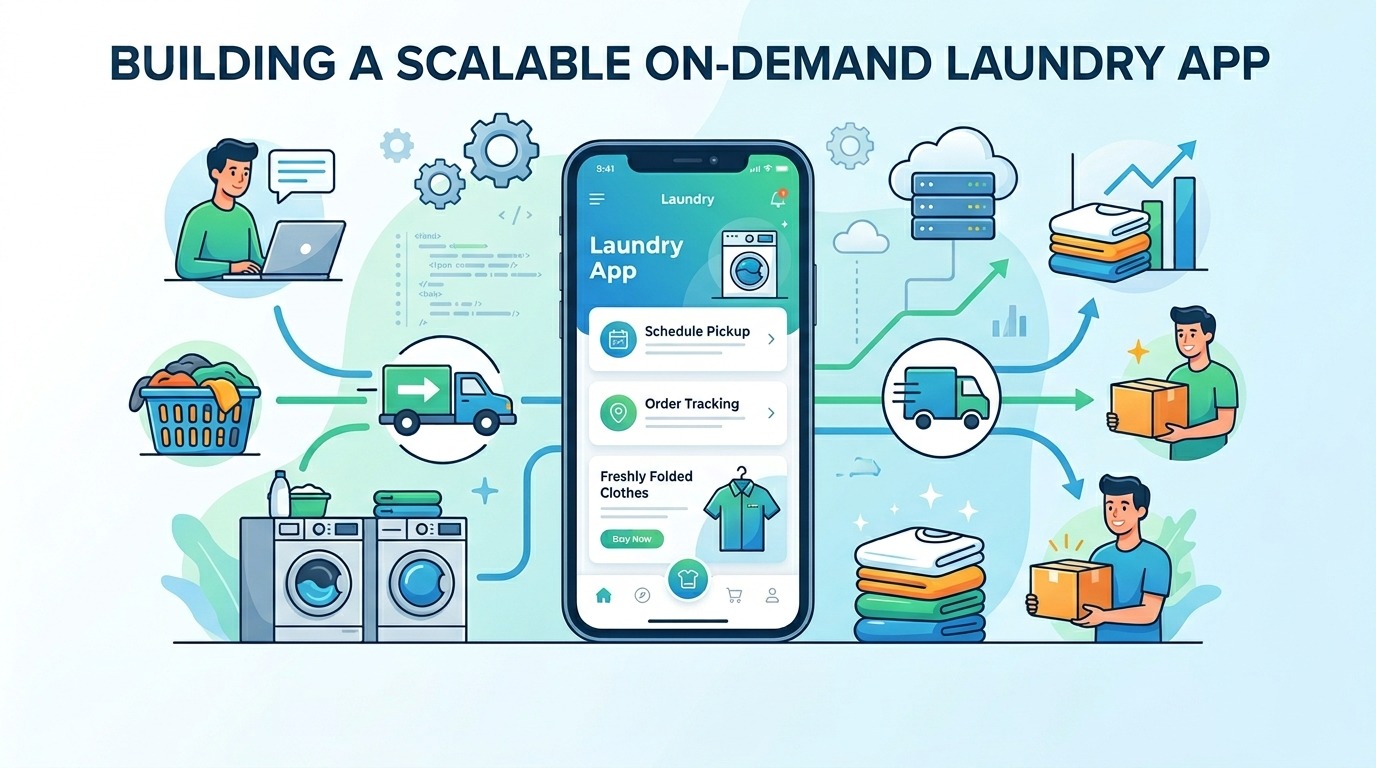
Building a successful on-demand laundry app requires more than just a customer-facing interface. To scale effectively, your platform needs a three-tiered architecture that separates user needs, logistical coordination, and business management. By treating each interface as a distinct ecosystem, founders can ensure that data remains synchronized and operations remain transparent.
Customer Portal. This is the primary gateway where users handle account registration, select specific laundry services like dry cleaning or wash-and-fold, and schedule pickups. Integrating a cost calculator and real-time order tracking builds immediate trust, while multi-channel payment support simplifies the transaction process.
Driver Interface. Logistics are managed through a dedicated panel for your pickup and delivery team. This interface focuses on route optimization to minimize fuel consumption and transit time, alongside status updates that keep the customer informed by syncing arrival notifications directly with their app.
Admin Dashboard. Your operation requires a central nervous system for business analytics, user management, and pricing adjustments. This back-end tool allows owners to monitor incoming order volumes, evaluate service provider efficiency, and update inventory or pricing rules dynamically based on demand cycles.
Efficiency hinges on how these components communicate. While an manual approach might suffice for a local shop, automating the flow of data between the customer booking and the driver’s route is what allows an on-demand laundry app to scale. By centralizing management in the admin dashboard, you avoid the administrative bottleneck that usually forces smaller, less integrated services to limit their growth.
Core Features Customers Expect
Building a successful on-demand laundry app requires prioritizing high-frequency user touchpoints. Modern consumers favor streamlined experiences, and usage data shows most users prefer interacting through a dedicated mobile application rather than a website browser. To meet these expectations, focus on delivering a frictionless interface that handles routine tasks with minimal effort.
- User Authentication: Enable social media and email sign-ups to minimize friction and get new users to their first order in seconds.
- Service Customization: Allow users to specify detergent types, water temperatures, and folding preferences so the service feels personal.
- Flexible Scheduling: Support both immediate ‘on-demand’ requests and scheduled future pickups to accommodate busy, unpredictable lifestyles.
- Transparent Pricing: A built-in cost calculator manages expectations by showing totals before checkout, which builds trust compared to opaque pricing structures.
- Secure Payments: Integrate multiple channels, including digital wallets and standard card processors, to ensure users have their preferred payment method.
- Operational Transparency: Use automated push notifications to provide real-time updates on order status, including pickup, cleaning progress, and delivery ETAs.
- Proof of Quality: Include a clear order history and a user-friendly review system to incentivize repeat business and maintain service accountability.
Efficiency in an on-demand laundry app often stems from the intelligence you build into these features. By providing users with accurate tracking and simple re-booking options based on their order history, you reduce the churn that often plagues logistics-heavy businesses. While simple apps might struggle to balance this complexity, creating an intuitive flow ensures that your users view the app as a daily utility rather than a one-time convenience.
Tech Stack That Powers a Laundry App
Selecting the right architecture is foundational for an on-demand laundry app. Most modern platforms rely on a reliable database foundation like MongoDB or PostgreSQL to handle complex orders and user profiles. To ensure the application stays responsive during peak usage, many founders lean on AWS for scalable cloud infrastructure. This cloud-native approach allows your app to handle dynamic traffic shifts effortlessly, which is essential as your service expands into new zip codes.
Efficiency hinges on seamless integration with external services. For logistics, the Google Maps API is widely used for real-time route optimization and driver navigation. Keeping customers informed is equally important, so integrating notification services like Twilio or Push.io ensures automated status updates on order pickups and deliveries. For payment processing, developers often use secure APIs from vendors like Stripe or Square to create smooth transaction experiences.
Platform Development Choices
Choosing how to build your interface impacts both your budget and your speed to market. Building with cross-platform frameworks such as Flutter or React Native allows you to deploy a single codebase to both iOS and Android simultaneously. This approach can be more budget-friendly than native development using Swift or Kotlin, especially if your goal is an MVP that reaches the widest possible audience out of the gate. For founders who require platform-specific performance or deep hardware integration, native code remains the preferred, albeit more resource-intensive, path.
| Component | Recommended Tech | Primary Use |
|---|---|---|
| Database | PostgreSQL/MongoDB | User data and orders |
| Infrastructure | AWS | Scalable hosting |
| Navigation | Google Maps API | Driver routing |
| Notifications | Twilio | Order alerts |
| Payments | Stripe/Square | Transaction processing |
The True Cost to Launch an On-Demand Laundry App
Developing a professional on-demand laundry app requires a clear view of your financial roadmap. While costs vary based on design complexity, feature sets, and native versus cross-platform builds, you should prepare for an initial investment ranging from $15,000 to $120,000 or more. Detailed cost calculators are available to help founders weigh these variables against their specific budget targets, ensuring you do not overspend during the initial development phase.
What is the typical cost to develop an on-demand laundry app?
Developing an on-demand laundry app typically ranges from $15,000 to $120,000+, with the final investment heavily influenced by feature complexity, platform selection, and your development team’s geographic location. To manage initial budget constraints, many founders opt for an MVP, which can often be launched for between $15,000 and $30,000. Beyond basic development, costs scale based on the need for custom UI/UX design, real-time tracking integration, and secure payment processing. Alternatively, you can reduce overhead and speed up your time-to-market by utilizing pre-built white-label scripts tailored for the delivery industry. Ultimately, balancing your specific feature requirements against your launch timeline will be the single largest factor in determining your overall project cost.
- Feature sophistication: Complex engine integrations for route optimization or AI-driven demand forecasting increase engineering hours.
- Platform scope: Delivering on both iOS and Android simultaneously doubles some testing costs unless you select cross-platform frameworks.
- Developer location: Rates fluctuate significantly by region, with hourly costs in North America or Western Europe typically exceeding those in Southeast Asia or Eastern Europe.
- Design intensity: Custom graphics, animations, and highly tailored user journeys require more design billables than standard templates.
Do not overlook the long-term running costs of your on-demand laundry app. Beyond the initial build, factor in recurring expenses for cloud hosting services, API seat fees for mapping and payment processors, and ongoing maintenance windows. While some competitors rely on generic software maintenance plans, proactive bug-fixing and OS-specific updates are part of a sustainable scaling model. Setting aside 15 to 20 percent of your total build cost for the first-year operational buffer will provide the runway necessary to manage growth and user acquisition.
Development Timeline: From Idea to Launch
Moving from a concept to a functional on-demand laundry app requires careful time management and structural planning. Development timelines vary based on project scope, but a standard MVP typically requires 3 to 4 months of dedicated effort. Ambitious projects incorporating complex AI-driven route optimization or third-party marketplace integrations generally extend this timeframe to 6 to 8 months to ensure stability and feature maturity.
Phases of the Development Lifecycle
- Discovery and SWOT analysis define your market positioning and clear technical requirements before coding begins.
- UI/UX Design establishes the flow for your customer, driver, and admin portals, focusing on high-frequency touchpoints.
- Agile development sprints break the project into functional modules such as payment gateway integration and schedule management.
- Quality assurance (QA) testing happens concurrently with development phases to identify and resolve bugs early.
Your development timeline should also reserve bandwidth for post-launch maintenance, including regular security patches and OS updates. Launching with a lean scope allows founders to gather user feedback while maintaining a manageable development roadmap. Following this structured approach to building your on-demand laundry app provides the necessary flexibility to refine your product based on actual user behavior and operational demand.
Designing for Trust and Convenience

The success of your on-demand laundry app hinges on how effortlessly a user can move from opening the app to scheduling a pickup. Reducing friction in the booking process is essential for high retention rates. A clean UI should prioritize a simple, three-step flow: select services, choose a time slot, and confirm payment. Apps that hide pricing until the final checkout often suffer from higher abandonment, whereas clear cost calculators provide the transparency users expect.
- Use persistent navigation bars that keep essential tools, like the order tracker and account settings, one tap away.
- Implement visual cues for laundry types, such as icons for dry cleaning, standard wash, and delicate care, to speed up service selection.
- Include a pre-checkout cost summary so customers know exactly what they will pay before hitting submit.
Building trust with your users requires constant and transparent communication regarding their garments. Real-time order tracking serves as a major trust builder, allowing customers to see the exact status of their items. Automated status updates via push notifications keep users informed at every milestone, from the driver approaching for pickup to the final delivery window. Providing this level of visibility removes the anxiety of entrusting clothes to a third-party service.
If your goal is to minimize friction, consider how your interface handles return logistics. A well-designed notification system does more than update status; it confirms your commitment to the service, turning new users into repeat customers.
Monetization Strategies That Work
Selecting the right monetization model is essential for the long-term viability of your on-demand laundry app. While many startups rely on a simple commission-based structure, diversifying your revenue streams helps protect profit margins during periods of lower order volume.
Transaction Commission. If you operate a marketplace model, the most common approach is to take a percentage fee from every laundry booking processed through your platform. This ensures your revenue scales directly in line with your service provider partners.Subscription Tiers. Offering monthly memberships encourages customer loyalty. Subscribers might receive benefits such as waived delivery fees, priority pickup slots, or discounted rates, providing you with predictable recurring revenue.Freemium Services. You can offer standard cleaning cycles as a base service while charging premiums for time-sensitive, expedited processing or specialized garment treatments. This captures value from high-intent users seeking immediate convenience.Dynamic Pricing. Much like ride-hailing platforms, you can implement surge pricing during peak hours or high-demand seasons. Adjusting costs based on real-time order volume and route urgency helps manage delivery logistics costs effectively.
Integrated advertising is another option, though it is less common in the laundry space. Partnering with local service businesses for in-app promotions can supplement income, but you should prioritize user experience to avoid cluttering the interface. For founders looking at these models, you can maintain sustainability by monitoring unit economics through your admin panel early in the development lifecycle.
Scaling Your App With Microservices and Cloud
How can you ensure your laundry delivery app remains scalable as your user base grows? To prevent the rigid bottlenecks common in monolithic setups, shift toward a microservices architecture. By decoupling critical system functions, you allow components such as payment processing, order tracking, and push notifications to scale independently. When your on-demand laundry app experiences a surge in requests, you can allocate additional resources specifically to the overburdened service without needing to duplicate the entire platform.
Efficiency hinges on how well you handle infrastructure. Deploying cloud-native solutions like Amazon Web Services enables your backend to auto-scale, effectively absorbing sudden traffic spikes during peak weekend hours. Integrating automated DevOps practices, such as continuous integration and continuous deployment (CI/CD) pipelines combined with infrastructure-as-code, ensures that updates and new feature rollouts remain stable and fast. This modular approach stands in stark contrast to legacy setups that require full-system downtime for even minor patches, a risk that AppstoryORG helps founders mitigate by emphasizing modern, architecture-first development paths.
Data serves as your ultimate guide for long-term growth. Incorporating advanced product analytics allows you to monitor exactly where users encounter friction, enabling you to optimize high-traffic service flows before they transform into outages. Much like how tracking granular metrics supports data-driven decisions at AppstoryORG, these insights help you predict when to spin up new instances and how to balance your server load. Building your platform on these flexible, data-driven foundations keeps your on-demand laundry app agile, ensuring your technology stack remains a competitive advantage rather than a ceiling on your business potential.
Can No-Code Really Build a Laundry App?
Founders often wonder if an on-demand laundry app can be built entirely using no-code platforms to minimize initial entry barriers. While these tools excel at rapid prototyping and validation, they frequently struggle with the heavy logistics required for a production-grade laundry service. Real-world operations demand complex, reliable features like live driver location tracking, multi-channel payment processing, and high-frequency scheduling logic that basic drag-and-drop builders are not designed to handle natively.
Is it possible to develop an on-demand laundry app using no-code tools for free?
While you can technically prototype an on-demand laundry app using no-code platforms, a truly free build is impractical for a production-ready business. Professional solutions require handling complex logistics, such as real-time driver tracking, secure payment processing, and scheduling logic—none of which are fully functional in free-tier no-code offerings. Some no-code tools can help you convert an existing website into a mobile app, but scaling an on-demand service requires dedicated backend infrastructure and API integrations that typically involve recurring subscription costs. Attempting to launch without a budget for these essential components often results in an app that fails to meet customer expectations for reliability and speed. For founders looking to scale, it is best to view no-code tools as a way to accelerate your MVP development rather than a way to avoid all recurring operational costs.
For startups aiming to build a scalable, professional-grade platform, consider evaluating custom development as one option. If your budget is tight, using no-code for the initial MVP serves as a valuable testing ground, but plan to shift toward a standard development approach using frameworks like React Native or Flutter to ensure your app stays performant as your user base grows.
Advanced Features to Differentiate Your App
Moving beyond standard booking functionality helps your on-demand laundry app stand out. While basic portals allow for scheduling, integrating specific technology features can create practical advantages for your service. AI Strategy. Use AI for route optimization to reduce fuel consumption and labor costs. For example, the system can group nearby pickups to minimize travel time. You can also implement dynamic pricing that adjusts rates during peak hours or for urgent orders. Machine Learning. Use machine learning to offer personalized recommendations. For instance, after a user orders hypoallergenic detergent twice, the system can pre-select that option on their next visit. IoT integration. Integrate IoT sensors to track laundry machine performance in real time. This alerts providers to maintenance needs before breakdowns occur, preventing service interruptions.Voice Commands. Add voice-enabled booking commands to your interface. This reduces friction for busy users who want to schedule a pickup without navigating through multiple dropdown menus.
These features improve user retention by making services more convenient. While competitors rely on static scheduling, your app can offer features like automatic reordering of preferred detergents. For teams looking to scale, these additions can be prioritized after your initial launch to avoid over-complicating your first version.
Your Blueprint for a Scalable Launch
Your journey to launching a successful on-demand laundry app begins by anchoring your vision in the right business model, whether you choose a dedicated single-vendor operation or a larger marketplace. A strong foundation requires a three-portal architecture that connects your customers, your delivery drivers, and your internal staff through one unified system. If you want to refine your strategy before hiring developers, you can use the cost calculators and trend analysis tools available at www.appstory.org to validate your business plan.
Prioritization is essential to managing your launch budget effectively. Focus your initial investment on a robust MVP that proves your core concept, then iterate based on direct customer feedback rather than bloat your first version with too many features. You should aim to balance rapid entry-to-market with the quality necessary to build long-term user trust.
Start your path forward by conducting thorough market research to define your niche and selecting a technology stack that supports future growth. Whether you decide to partner with a custom software firm or implement a white-label solution, document your requirements for scalability early. As your user base grows, you can integrate advanced features like AI-driven route optimization and IoT tracking to improve operational efficiency and outpace competitors.