Tag: App development company

  • Building a Scalable On-Demand Laundry App From Scratch

    Building a Scalable On-Demand Laundry App From Scratch

    Why On-Demand Laundry Apps Are Exploding

    The convenience economy has reached a tipping point, driving the global on-demand laundry app sector toward a projected value of $405.36 billion by 2026. This rapid acceleration is particularly visible in North America, which commanded a 40.7% market share as of 2025. For entrepreneurs and developers, this transformation signals a shift from traditional service models to digitized, highly efficient operations that meet modern expectations for speed and accessibility.

    Consumer behavior is fueling this growth. Recent data indicates that 64% of users prefer interacting with a business through a dedicated mobile application rather than a browser. This preference underscores why a well-designed on-demand laundry app is no longer just a luxury, but a requirement for maintaining a competitive edge. It turns a fragmented service process into a seamless digital journey for the customer.

    Navigating this market requires clarity on how to bridge the gap between an idea and a profitable product. This guide provides a foundation for founders and developers to understand the true costs to launch, the necessary tech stacks for scalability, and when to choose traditional development versus modern no-code solutions. Whether you are building from scratch or upgrading an existing service, these insights will help you define your path toward a successful launch.

    Key Business Models for Your On-Demand Laundry App

    Choosing the right business model defines your revenue stream and dictates the complexity of your operational logistics.

    Selecting the right business model for your on-demand laundry app determines your revenue streams, operational complexity, and development roadmap. Founders must decide early whether to own the entire service chain or act as a digital bridge between existing facilities and customers.

    Aggregator Model. This approach connects users to multiple local, independent laundry providers. You act as a lead-generation platform. Development prioritizes vendor onboarding tools, order routing, and commission management systems.

    Dedicated Model. Commonly known as the single-vendor model, this suits businesses that already operate physical laundry facilities. You maintain full control over service quality and pricing, focusing your app development on internal logistics, staff management, and direct customer communication.

    Marketplace Model. This advanced structure hosts multiple competing vendors while offering sophisticated features like dynamic pricing, subscription tiers, and loyalty programs. It requires a more robust tech stack to handle real-time inventory and competitive bidding between providers.

    Your model choice directly dictates your budget. While a dedicated in-site app for a single laundry business might focus on simple pickup scheduling, the marketplace model requires complex APIs for tracking and payment reconciliation across many partners.

    Hybrid approaches are also increasing in popularity. Some startups begin as dedicated, brand-owned services to ensure quality control, then pivot to an aggregator structure later to scale operations regionally. Regardless of the path, your platform must support clear cost calculations for users, which helps build the transparency necessary to compete with established solutions.

    Market Research: Find Your Local Niche

    Success in the on-demand laundry app space begins long before you write a single line of code. You must identify specific service gaps, such as a lack of eco-friendly washing options or neighborhoods underserved by current logistics providers. While major players have raised substantial capital, startups can compete by focusing on hyper-local density and specific customer pain points that these national brands ignore.

    Analyzing Competitors and Demand

    Map out every existing provider in your target zone to understand their pricing structure and service limitations. High-end metropolitan areas often demand premium, white-glove pickup, whereas suburban markets might prioritize budget-conscious, folding-focused bundles. By analyzing these patterns early, you can tailor your feature set to provide exactly what your local base requires rather than trying to replicate a one-size-fits-all model.

    Operational challenges often dictate the viability of your app in specific geographic markets. Local regulations regarding commercial water usage or waste management can impact your bottom line, as can the density of urban traffic impacting delivery times. Use these insights to optimize your logistics workflow, ensuring that your route management system remains profitable even at low initial order volumes.

    Strategic Feature Deployment

    Transform your research into a concrete feature roadmap. If your market analysis reveals that busy professionals value speed over price, prioritize automated scheduling and mobile-first payment integrations above all else.

    Three Portals Your App Must Have

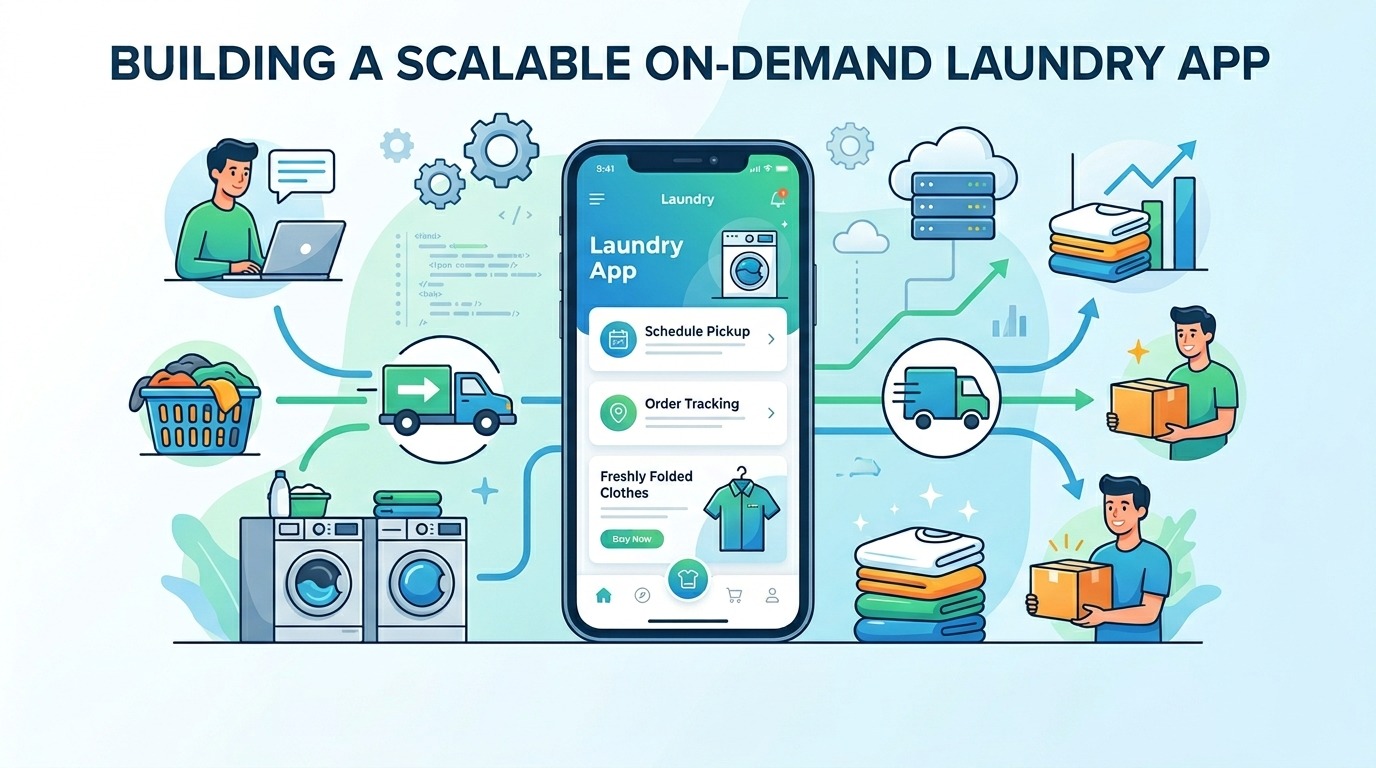
    Building a successful on-demand laundry app requires more than just a customer-facing interface. To scale effectively, your platform needs a three-tiered architecture that separates user needs, logistical coordination, and business management. By treating each interface as a distinct ecosystem, founders can ensure that data remains synchronized and operations remain transparent.

    Customer Portal. This is the primary gateway where users handle account registration, select specific laundry services like dry cleaning or wash-and-fold, and schedule pickups. Integrating a cost calculator and real-time order tracking builds immediate trust, while multi-channel payment support simplifies the transaction process.

    Driver Interface. Logistics are managed through a dedicated panel for your pickup and delivery team. This interface focuses on route optimization to minimize fuel consumption and transit time, alongside status updates that keep the customer informed by syncing arrival notifications directly with their app.

    Admin Dashboard. Your operation requires a central nervous system for business analytics, user management, and pricing adjustments. This back-end tool allows owners to monitor incoming order volumes, evaluate service provider efficiency, and update inventory or pricing rules dynamically based on demand cycles.

    Efficiency hinges on how these components communicate. While an manual approach might suffice for a local shop, automating the flow of data between the customer booking and the driver’s route is what allows an on-demand laundry app to scale. By centralizing management in the admin dashboard, you avoid the administrative bottleneck that usually forces smaller, less integrated services to limit their growth.

    Core Features Customers Expect

    Building a successful on-demand laundry app requires prioritizing high-frequency user touchpoints. Modern consumers favor streamlined experiences, and usage data shows most users prefer interacting through a dedicated mobile application rather than a website browser. To meet these expectations, focus on delivering a frictionless interface that handles routine tasks with minimal effort.

    • User Authentication: Enable social media and email sign-ups to minimize friction and get new users to their first order in seconds.
    • Service Customization: Allow users to specify detergent types, water temperatures, and folding preferences so the service feels personal.
    • Flexible Scheduling: Support both immediate ‘on-demand’ requests and scheduled future pickups to accommodate busy, unpredictable lifestyles.
    • Transparent Pricing: A built-in cost calculator manages expectations by showing totals before checkout, which builds trust compared to opaque pricing structures.
    • Secure Payments: Integrate multiple channels, including digital wallets and standard card processors, to ensure users have their preferred payment method.
    • Operational Transparency: Use automated push notifications to provide real-time updates on order status, including pickup, cleaning progress, and delivery ETAs.
    • Proof of Quality: Include a clear order history and a user-friendly review system to incentivize repeat business and maintain service accountability.

    Efficiency in an on-demand laundry app often stems from the intelligence you build into these features. By providing users with accurate tracking and simple re-booking options based on their order history, you reduce the churn that often plagues logistics-heavy businesses. While simple apps might struggle to balance this complexity, creating an intuitive flow ensures that your users view the app as a daily utility rather than a one-time convenience.

    Tech Stack That Powers a Laundry App

    Selecting the right architecture is foundational for an on-demand laundry app. Most modern platforms rely on a reliable database foundation like MongoDB or PostgreSQL to handle complex orders and user profiles. To ensure the application stays responsive during peak usage, many founders lean on AWS for scalable cloud infrastructure. This cloud-native approach allows your app to handle dynamic traffic shifts effortlessly, which is essential as your service expands into new zip codes.

    Efficiency hinges on seamless integration with external services. For logistics, the Google Maps API is widely used for real-time route optimization and driver navigation. Keeping customers informed is equally important, so integrating notification services like Twilio or Push.io ensures automated status updates on order pickups and deliveries. For payment processing, developers often use secure APIs from vendors like Stripe or Square to create smooth transaction experiences.

    Platform Development Choices

    Choosing how to build your interface impacts both your budget and your speed to market. Building with cross-platform frameworks such as Flutter or React Native allows you to deploy a single codebase to both iOS and Android simultaneously. This approach can be more budget-friendly than native development using Swift or Kotlin, especially if your goal is an MVP that reaches the widest possible audience out of the gate. For founders who require platform-specific performance or deep hardware integration, native code remains the preferred, albeit more resource-intensive, path.

    ComponentRecommended TechPrimary Use
    DatabasePostgreSQL/MongoDBUser data and orders
    InfrastructureAWSScalable hosting
    NavigationGoogle Maps APIDriver routing
    NotificationsTwilioOrder alerts
    PaymentsStripe/SquareTransaction processing

    The True Cost to Launch an On-Demand Laundry App

    Developing a professional on-demand laundry app requires a clear view of your financial roadmap. While costs vary based on design complexity, feature sets, and native versus cross-platform builds, you should prepare for an initial investment ranging from $15,000 to $120,000 or more. Detailed cost calculators are available to help founders weigh these variables against their specific budget targets, ensuring you do not overspend during the initial development phase.

    What is the typical cost to develop an on-demand laundry app?

    Developing an on-demand laundry app typically ranges from $15,000 to $120,000+, with the final investment heavily influenced by feature complexity, platform selection, and your development team’s geographic location. To manage initial budget constraints, many founders opt for an MVP, which can often be launched for between $15,000 and $30,000. Beyond basic development, costs scale based on the need for custom UI/UX design, real-time tracking integration, and secure payment processing. Alternatively, you can reduce overhead and speed up your time-to-market by utilizing pre-built white-label scripts tailored for the delivery industry. Ultimately, balancing your specific feature requirements against your launch timeline will be the single largest factor in determining your overall project cost.

    • Feature sophistication: Complex engine integrations for route optimization or AI-driven demand forecasting increase engineering hours.
    • Platform scope: Delivering on both iOS and Android simultaneously doubles some testing costs unless you select cross-platform frameworks.
    • Developer location: Rates fluctuate significantly by region, with hourly costs in North America or Western Europe typically exceeding those in Southeast Asia or Eastern Europe.
    • Design intensity: Custom graphics, animations, and highly tailored user journeys require more design billables than standard templates.

    Do not overlook the long-term running costs of your on-demand laundry app. Beyond the initial build, factor in recurring expenses for cloud hosting services, API seat fees for mapping and payment processors, and ongoing maintenance windows. While some competitors rely on generic software maintenance plans, proactive bug-fixing and OS-specific updates are part of a sustainable scaling model. Setting aside 15 to 20 percent of your total build cost for the first-year operational buffer will provide the runway necessary to manage growth and user acquisition.

    Development Timeline: From Idea to Launch

    Moving from a concept to a functional on-demand laundry app requires careful time management and structural planning. Development timelines vary based on project scope, but a standard MVP typically requires 3 to 4 months of dedicated effort. Ambitious projects incorporating complex AI-driven route optimization or third-party marketplace integrations generally extend this timeframe to 6 to 8 months to ensure stability and feature maturity.

    Phases of the Development Lifecycle

    1. Discovery and SWOT analysis define your market positioning and clear technical requirements before coding begins.
    2. UI/UX Design establishes the flow for your customer, driver, and admin portals, focusing on high-frequency touchpoints.
    3. Agile development sprints break the project into functional modules such as payment gateway integration and schedule management.
    4. Quality assurance (QA) testing happens concurrently with development phases to identify and resolve bugs early.

    Your development timeline should also reserve bandwidth for post-launch maintenance, including regular security patches and OS updates. Launching with a lean scope allows founders to gather user feedback while maintaining a manageable development roadmap. Following this structured approach to building your on-demand laundry app provides the necessary flexibility to refine your product based on actual user behavior and operational demand.

    Designing for Trust and Convenience

    A seamless user experience and transparent status updates are essential to building long-term customer reliability.

    The success of your on-demand laundry app hinges on how effortlessly a user can move from opening the app to scheduling a pickup. Reducing friction in the booking process is essential for high retention rates. A clean UI should prioritize a simple, three-step flow: select services, choose a time slot, and confirm payment. Apps that hide pricing until the final checkout often suffer from higher abandonment, whereas clear cost calculators provide the transparency users expect.

    • Use persistent navigation bars that keep essential tools, like the order tracker and account settings, one tap away.
    • Implement visual cues for laundry types, such as icons for dry cleaning, standard wash, and delicate care, to speed up service selection.
    • Include a pre-checkout cost summary so customers know exactly what they will pay before hitting submit.

    Building trust with your users requires constant and transparent communication regarding their garments. Real-time order tracking serves as a major trust builder, allowing customers to see the exact status of their items. Automated status updates via push notifications keep users informed at every milestone, from the driver approaching for pickup to the final delivery window. Providing this level of visibility removes the anxiety of entrusting clothes to a third-party service.

    If your goal is to minimize friction, consider how your interface handles return logistics. A well-designed notification system does more than update status; it confirms your commitment to the service, turning new users into repeat customers.

    Monetization Strategies That Work

    Selecting the right monetization model is essential for the long-term viability of your on-demand laundry app. While many startups rely on a simple commission-based structure, diversifying your revenue streams helps protect profit margins during periods of lower order volume.

    Transaction Commission. If you operate a marketplace model, the most common approach is to take a percentage fee from every laundry booking processed through your platform. This ensures your revenue scales directly in line with your service provider partners.Subscription Tiers. Offering monthly memberships encourages customer loyalty. Subscribers might receive benefits such as waived delivery fees, priority pickup slots, or discounted rates, providing you with predictable recurring revenue.Freemium Services. You can offer standard cleaning cycles as a base service while charging premiums for time-sensitive, expedited processing or specialized garment treatments. This captures value from high-intent users seeking immediate convenience.Dynamic Pricing. Much like ride-hailing platforms, you can implement surge pricing during peak hours or high-demand seasons. Adjusting costs based on real-time order volume and route urgency helps manage delivery logistics costs effectively.

    Integrated advertising is another option, though it is less common in the laundry space. Partnering with local service businesses for in-app promotions can supplement income, but you should prioritize user experience to avoid cluttering the interface. For founders looking at these models, you can maintain sustainability by monitoring unit economics through your admin panel early in the development lifecycle.

    Scaling Your App With Microservices and Cloud

    How can you ensure your laundry delivery app remains scalable as your user base grows? To prevent the rigid bottlenecks common in monolithic setups, shift toward a microservices architecture. By decoupling critical system functions, you allow components such as payment processing, order tracking, and push notifications to scale independently. When your on-demand laundry app experiences a surge in requests, you can allocate additional resources specifically to the overburdened service without needing to duplicate the entire platform.

    Efficiency hinges on how well you handle infrastructure. Deploying cloud-native solutions like Amazon Web Services enables your backend to auto-scale, effectively absorbing sudden traffic spikes during peak weekend hours. Integrating automated DevOps practices, such as continuous integration and continuous deployment (CI/CD) pipelines combined with infrastructure-as-code, ensures that updates and new feature rollouts remain stable and fast. This modular approach stands in stark contrast to legacy setups that require full-system downtime for even minor patches, a risk that AppstoryORG helps founders mitigate by emphasizing modern, architecture-first development paths.

    Data serves as your ultimate guide for long-term growth. Incorporating advanced product analytics allows you to monitor exactly where users encounter friction, enabling you to optimize high-traffic service flows before they transform into outages. Much like how tracking granular metrics supports data-driven decisions at AppstoryORG, these insights help you predict when to spin up new instances and how to balance your server load. Building your platform on these flexible, data-driven foundations keeps your on-demand laundry app agile, ensuring your technology stack remains a competitive advantage rather than a ceiling on your business potential.

    Can No-Code Really Build a Laundry App?

    Founders often wonder if an on-demand laundry app can be built entirely using no-code platforms to minimize initial entry barriers. While these tools excel at rapid prototyping and validation, they frequently struggle with the heavy logistics required for a production-grade laundry service. Real-world operations demand complex, reliable features like live driver location tracking, multi-channel payment processing, and high-frequency scheduling logic that basic drag-and-drop builders are not designed to handle natively.

    Is it possible to develop an on-demand laundry app using no-code tools for free?

    While you can technically prototype an on-demand laundry app using no-code platforms, a truly free build is impractical for a production-ready business. Professional solutions require handling complex logistics, such as real-time driver tracking, secure payment processing, and scheduling logic—none of which are fully functional in free-tier no-code offerings. Some no-code tools can help you convert an existing website into a mobile app, but scaling an on-demand service requires dedicated backend infrastructure and API integrations that typically involve recurring subscription costs. Attempting to launch without a budget for these essential components often results in an app that fails to meet customer expectations for reliability and speed. For founders looking to scale, it is best to view no-code tools as a way to accelerate your MVP development rather than a way to avoid all recurring operational costs.

    For startups aiming to build a scalable, professional-grade platform, consider evaluating custom development as one option. If your budget is tight, using no-code for the initial MVP serves as a valuable testing ground, but plan to shift toward a standard development approach using frameworks like React Native or Flutter to ensure your app stays performant as your user base grows.

    Advanced Features to Differentiate Your App

    Moving beyond standard booking functionality helps your on-demand laundry app stand out. While basic portals allow for scheduling, integrating specific technology features can create practical advantages for your service. AI Strategy. Use AI for route optimization to reduce fuel consumption and labor costs. For example, the system can group nearby pickups to minimize travel time. You can also implement dynamic pricing that adjusts rates during peak hours or for urgent orders. Machine Learning. Use machine learning to offer personalized recommendations. For instance, after a user orders hypoallergenic detergent twice, the system can pre-select that option on their next visit. IoT integration. Integrate IoT sensors to track laundry machine performance in real time. This alerts providers to maintenance needs before breakdowns occur, preventing service interruptions.Voice Commands. Add voice-enabled booking commands to your interface. This reduces friction for busy users who want to schedule a pickup without navigating through multiple dropdown menus.

    These features improve user retention by making services more convenient. While competitors rely on static scheduling, your app can offer features like automatic reordering of preferred detergents. For teams looking to scale, these additions can be prioritized after your initial launch to avoid over-complicating your first version.

    Your Blueprint for a Scalable Launch

    Your journey to launching a successful on-demand laundry app begins by anchoring your vision in the right business model, whether you choose a dedicated single-vendor operation or a larger marketplace. A strong foundation requires a three-portal architecture that connects your customers, your delivery drivers, and your internal staff through one unified system. If you want to refine your strategy before hiring developers, you can use the cost calculators and trend analysis tools available at www.appstory.org to validate your business plan.

    Prioritization is essential to managing your launch budget effectively. Focus your initial investment on a robust MVP that proves your core concept, then iterate based on direct customer feedback rather than bloat your first version with too many features. You should aim to balance rapid entry-to-market with the quality necessary to build long-term user trust.

    Start your path forward by conducting thorough market research to define your niche and selecting a technology stack that supports future growth. Whether you decide to partner with a custom software firm or implement a white-label solution, document your requirements for scalability early. As your user base grows, you can integrate advanced features like AI-driven route optimization and IoT tracking to improve operational efficiency and outpace competitors.
  • Top Android App Development Companies in 2026-27

    Top Android App Development Companies in 2026-27

    [vc_row css=”.vc_custom_1629999941194{margin-top: 10px !important;}”][vc_column el_class=”padding-left-right”][vc_column_text]How to make an Android app for your business? AppStory ORG can help you find a reliable Android app development company to build, design, test, and launch your Android app. Below is our extensive list of the leading Android app developers. Each firm is ranked on our detailed methodology including, verified client reviews and in-depth market research. Our research is here to help you find the right Android mobile app developer for your project.[/vc_column_text][/vc_column][/vc_row]

    [vc_column_text][ap_company id=”30145″ url=”https://www.appstory.org/wp-content/uploads/2023/09/TekRevol.jpeg”][/vc_column_text]

    [vc_row][vc_column][vc_column_text][ap_company id=”19936″ url=”https://www.appstory.org/wp-content/uploads/2019/11/RetroCube.png”] [/vc_column_text][vc_column_text][ap_company id=”22155″ url=”https://www.appstory.org/wp-content/uploads/2020/05/Nectarbits.jpg”][/vc_column_text][vc_column_text][ap_company id=”9500″ url=”https://www.appstory.org/wp-content/uploads/2019/01/Cumulations-Technologies.png”][/vc_column_text][vc_column_text][ap_company id=”9774″ url=”https://www.appstory.org/wp-content/uploads/2019/01/Konstant-Infosolutions.jpg”][/vc_column_text][vc_column_text][ap_company id=”25067″ url=”https://www.appstory.org/wp-content/uploads/2020/08/Ezappsolution.png”][/vc_column_text][vc_column_text][ap_company id=”10636″ url=”https://www.appstory.org/wp-content/uploads/2019/06/CMARIX-TechnoLabs-e1559675247432.png”][/vc_column_text][vc_column_text][ap_company id=”9905″ url=”https://www.appstory.org/wp-content/uploads/2019/02/solution-analysts.png”][/vc_column_text][vc_column_text][ap_company id=”20476″ url=”https://www.appstory.org/wp-content/uploads/2020/02/image.jpg”][/vc_column_text][vc_column_text][ap_company id=”9496″ url=”https://www.appstory.org/wp-content/uploads/2019/01/RipenApps-Technologies.jpg”][/vc_column_text][vc_column_text][ap_company id=”10249″ url=”https://www.appstory.org/wp-content/uploads/2019/02/Red-Apple-Technologies.jpg”][/vc_column_text][vc_column_text][ap_company id=”11063″ url=”https://www.appstory.org/wp-content/uploads/2019/11/profile-pic.png”][/vc_column_text][vc_column_text][ap_company id=”24832″ url=”https://www.appstory.org/wp-content/uploads/2021/09/World-Web-Technology-Logo.jpg”][/vc_column_text][/vc_column][/vc_row][vc_row el_class=”padding-left-right”][vc_column][vc_column_text]The listed company details are based on our deep research. If you want to share any other company which has skilled developers for an Android-based app then email your company details at appstoryorg@gmail.com. Develop your dream project with a trustworthy company. Hope this detailed analysis will help you to find the best Android app development company.[/vc_column_text][/vc_column][/vc_row]

  • The Latest Impact of 5G Technology on Mobile App Development: Hip or Hype?

    The Latest Impact of 5G Technology on Mobile App Development: Hip or Hype?

    Millions of MB data getting transmitted in just a blink of an eye! Sounds impressive, right? With the introduction of 5G network, this is now possible. 

    As per the study report by GSMA, by 2025, approximately 1.4 billion devices will run on this high-speed 5G network. Another report by IHS Economics shows that by 2035, the 5G network is expected to contribute almost $12.3 trillion of global economic output. 

    An app development company can gain a clear insight into the bright future the Fifth Generation wireless cellular network has from these stats.

    5G is not just a modified version of its predecessor 4G. It is a whole new network architecture. This is why its impact is going to be more than just changing the landscape of wireless communication. It is going to leave a deeper impact on the app development as well. But how? Well, that is what you will find in this blog. 

    Why is 5G Getting This Much Attention? 

    The killer speed offered by 5G is the main reason why it is gaining this much importance in the market. The applications that you now download in a minute, will take only seconds to be downloaded. 

    Recent market research reports indicate that by 2024, cellular networks and Wi-Fi will satisfy only 81% of the mobile and content traffic demands. So, to deal with the consequences, companies like Samsung, Ericsson, Vodafone, Cisco, Nokia, and other mobile companies are working hard for 5G development.

    Now, speed is not the only benefit brought by 5G. It has to offer more.

    Exploring the Evolution of Cellular Technologies

    To grasp the significance of 5G and its transformative potential, it’s essential to trace the evolutionary path of its predecessors. Let’s delve into a brief overview of each preceding cellular technology:

    1. 1G (Analog): Emerging onto the scene in the 1980s, 1G marked the advent of wireless communication. This analog technology facilitated basic voice calls with a modest data transfer rate of 2.4 Kbps.
    2. 2G (GPRS): Introduced in 1991, 2G heralded the era of digital cellular networks. It revolutionized communication by offering users internet connectivity, voice calls, and SMS at a speed of 50 Kbps, laying the groundwork for mobile data services.
    3. 3G (UMTS): In 1998, the third generation of telecommunications technology, 3G, emerged, boasting speeds of up to 2 Mbps. It was a pivotal moment in the evolution of mobile communication, fueling the rise of smartphones and enabling features such as picture messaging and video calls.
    4. 4G (LTE): With its debut in 2008, 4G became the gold standard of wireless technology. Delivering maximum speeds of 100 Mbps, it facilitated data-intensive activities such as HD media streaming, online gaming, and video conferencing, shaping the digital landscape we inhabit today.

    And now, the eagerly anticipated arrival of 5G!

    Let’s explore its promise and potential as it continues to redefine connectivity and unlock a new era of innovation and possibility.

    Trusted Wireless Interactivity

    The present-day wireless technology development revolves around such practices where the developers have to deal with the slow nature! Of course, LTE and 4G are fast but still, they are not above the setbacks. Even in many cases, you will witness recommendations like download only on the availability of Wi-Fi connection. 

    With 5G coming into the scene, this will no longer be an issue. 

    Zero Latency

    Suppose that you are using a mobile app and it is taking ages to respond to just one action. Feeling frustrated in this situation is quite obvious. 

    Latency is one of the most common issues in the economy of mobile app development in NYC these days. With 5G being present in the scene, latency will no longer be an issue. Especially, for the AR/VR enabled mobile applications, this network will be like a blessing. 

    Enhanced Use Experience

    Another perk of using the 5G network is clarity. Suppose you have a 2G connection and you are trying to watch a video or listen to some music. The experience you will have with a 2G connection is never the same with an LTE network. The latter will obviously give you a better experience. Similarly, with 5G, everything will be advanced. 

    While using or streaming an app on the 5G network will automatically enhance the user experience as the app’s UI will get elevated to some large extent. 

    Well, other than all these, 5G will provide with

    • Greater connectivity experience
    • Advanced cloud technology support
    • Ambient computing, and more.

    Industry Verticals to Benefit Most by 5G 

    Every mobile app development company in New York will agree to this point that the introduction of 5G will bring revolution to diverse industry verticals. It will change the way different industries think about app development. Here is a list of some industries that are expected to get the most benefits offered by 5G networks. 

    Manufacturing Industry

    Today, almost half of the processes in the flex manufacturing industry is fully automated. Automated processes ensure higher productivity along with top-notch accuracy. Now, with 5G, all these automated processes will become faster! 

    Healthcare Industry

    To ensure better patient care at reduced cost, the medicine and healthcare industries are embracing advanced technologies. Also, adopting the latest technologies in healthcare makes sure to give improved control over assets, relieve the pressure on the hospital resources along with a lot of other things. With 5G, people can access all the services faster. 

    AR/VR Industry

    AR/VR is one of the hottest topics in today’s market. However, it is still not have been adopted widely across the globe. It is expected that with 5G being widely available, the AR/VR technology services can finally go mainstream. 

    Smart Cities

    Smart homes and smart cities are no more fiction. With 5G, it is possible now. Millions of sensors can work together in real-time in the 5G network with zero latency. 

    Thus, 5G is going to leave a deeper impact on industry-specific app development. And this is why any mobile app development company in NJ should pay the utmost attention to understand this network architecture on a priority basis. By leveraging its full power, businesses can take their app development standards further. 

  • Top eCommerce Development Companies and Developers 2025 (updated)

    Top eCommerce Development Companies and Developers 2025 (updated)

    [vc_row css=”.vc_custom_1703922395190{margin-right: 1% !important;margin-left: 1% !important;}”][vc_column][vc_column_text]E-commerce is more cost-effective and convenient for customers. If you are among those who want to make their business go online, then eCommerce is for you only. According to research conducted, in 2016 online sales of physical goods were 360.3 billion US dollars and will surpass 603.4 billion US dollars by 2021 in the United States. Apparel and accessories retail e-commerce in the United States is projected to generate over 121 billion U.S. dollars in revenue by 2021.

    Top eCommerce agencies build custom platforms with intuitive navigation, clean product pages, and seamless checkout experiences, designed to increase site traffic and conversions. Discover the best-performing eCommerce development companies in the table below.

    You can filter results by local and global location, cost, experience, and size. We reviewed the most popular companies in the field of e-commerce development and presented them in our review.[/vc_column_text][vc_column_text]

    Top E-commerce Development Companies In 2025

    [/vc_column_text][/vc_column][/vc_row][vc_row][vc_column][vc_column_text][ap_company id=”28445″ url=”https://www.appstory.org/wp-content/uploads/2022/10/cogentcommerce.jpg”][/vc_column_text][vc_column_text][ap_company id=”10636″ url=”https://www.appstory.org/wp-content/uploads/2019/06/CMARIX-TechnoLabs-e1559675247432.png”]

    Updates Date: 03-12-2021 -1Years

    [/vc_column_text][vc_column_text][ap_company id=”9908″ url=”https://www.appstory.org/wp-content/uploads/2018/11/Sphinx-Solutions.png”][/vc_column_text][vc_column_text][ap_company id=”9905″ url=”https://www.appstory.org/wp-content/uploads/2019/02/solution-analysts.png”][/vc_column_text][vc_column_text][ap_company id=”10405″ url=”https://www.appstory.org/wp-content/uploads/2019/04/New-Logo.jpg”][/vc_column_text][vc_column_text][ap_company id=”9500″ url=”https://www.appstory.org/wp-content/uploads/2019/01/Cumulations-Technologies.png”][/vc_column_text][vc_column_text][ap_company id=”9774″ url=”https://www.appstory.org/wp-content/uploads/2019/01/Konstant-Infosolutions.jpg”][/vc_column_text][vc_column_text][ap_company id=”22155″ url=”https://www.appstory.org/wp-content/uploads/2020/05/Nectarbits.jpg”][/vc_column_text][vc_column_text][ap_company id=”20476″ url=”https://www.appstory.org/wp-content/uploads/2020/02/JG_LOGO.png”][/vc_column_text][/vc_column][/vc_row][vc_row][vc_column][vc_column_text el_class=”padding-left-right”]

    Company Listing

    After an in-depth analysis, we will shortlist some of the mobile app Development Company from our list.so Please share your company information.

    Submit Company[/vc_column_text][/vc_column][/vc_row]

  • Effective Tips To Make Social Media App Like Instagram

    Effective Tips To Make Social Media App Like Instagram

      “Are you interested in app technology and want to build a social media app like Instagram? If yes, then here is something that can help you out in its development.” Social media apps have the power to create a great deal of sensation and especially in tough times like these, it is very helpful in staying connected with the rest of the world. As the world is undergoing a complete lockdown, social media apps are keeping the spirits high. It not only caters to the users’ need for seamless communication, but it also opens up a doorway for the businesses to gain more profits with different monetization techniques. For a person who is entirely new to this topic, having confusing thoughts are natural, but this doesn’t mean that one must confine themselves with the problems surrounding mobile app development. It is necessary for a bussing entrepreneur to gain a better perspective. So today in this blog, we would develop our understanding and know more about it.

    Simple Steps To Create An App Like Instagram

    Take a look at the five very simple and basic steps to create an application like Instagram or any other effective and engaging social media application;

    1. Do not forget to outline the objective

    We all know the power of social media, and Instagram altogether holds great power. For starters it is important to know that it is not just a picture sharing application, it is a great platform for an eCommerce portal. Many application influencers and other brands use this platform for their marketing campaigns, and it helps them immensely. So before jumping on to the development part, it is a must to make sure what exactly your objectives are. Once you know exactly what you want, it is simple to achieve the goals through the application.

    2. Make the most of the effective market research

    It is time to come in terms with reality. With the extensive competition persisting in the market, it is important to stand out. Your application idea is not alone. In fact, the reality is that there is a glut of businesses trying to make their presence count with a social networking app. Some have already started the development and some are promoting it on different social media platforms. It is important to do thorough research about competitors. One needs to know about what exactly are the features that are required to be added. One must also know about the functionalities in-app that are needed to be highlighted. Make sure to thoroughly study and examine them. This way you would be able to find the special ingredient. This special ingredient would help you to learn about the things that you need to do differently in order to stand out from the crowd.

    3. Make sure to highlight the features of the product that you want to create

    Now check out the third step after defining the objectives and doing a thorough research of the present competitors. One thing you must know to succeed is the trick to contemplate the need of users. This clearly means that you must have an idea about the Instagram clone app that you want to develop. Simply make a list of the features which you think cannot be compromised. Surely there would be alterations in the actual product. But it is better to have a proper reference for the better development of the product.

    4. Don’t forget to hire a team of talented app developers

    Since you have a clear idea about the social networking app that you are going to create, it is a must to hire a team of developers for the seamless execution of the project. While hiring a team make sure that they have the right experience in building an application similar to those that you desire. Make sure that they have a talented team that comprises of-
    • Project manager
    • Mobile app developers
    • UX/UI designers
    • Quality analysts
    • Marketing specialists
    Check out the previous projects and the online client testimonials on different business listing sites before taking the final decision. The company must take care of the development and its deployment. This is surely a difficult task, so if you need any help feel free to reach out to us.

    5. Ensure to promote the developed social media app

    It is impossible to succeed gain revenue through an application if people don’t even know about it. If the application is spectacular, but not promoted properly, it is of no use. So it is important to market the application well. No, it is not necessary to promote it everywhere, but do remember to use the resources in the right places and at the right time. Timing can play a huge difference and boost the app’s popularity. These are the five simple tips to create a social media app like Instagram. If you want to know more about it, then connect with the leading app development company, TECHUGO. But until then stay hooked to this space for more information.
  • What is Digital Advertising and Why You Need It for App Development Company

    What is Digital Advertising and Why You Need It for App Development Company

    Today, businesses spend a huge amount on digital advertisement all over the world. The amount, however, is accelerating toward the increase every day due to a good return on investment(ROI) generated through the digital ad campaigns. With extraordinary benefits and profits, for companies that look forward to succeeding with the time, it is important to make their ad strategy digital.

    Well, what is a digital advertisement?

    Digital marketing can be explained as a targeted and data-driven advertising strategy for reaching the potential audience from every stage of the buying funnel and move them towards taking the purchase decision. These advertisement strategies involve all the necessary information from product awareness to purchase. Digital advertising campaigns, including Google Ads and Bing Ads, can be useful for driving revenue.

    The Benefits of Using a Digital Advertisement?

    A variety of sensible reasons entices businesses to make use of digital advertising. Some of the most noticeable reasons include:

    • It creates brand awareness.
    • It increases sales.
    • It helps generate qualified leads.
    • It drives repetitive purchases.

    A range of advantages appeals to businesses to use digital advertisements in their ad force. With the use of digital advertisement, all types of companies ranging from a small food store to a custom software development company can make a measurable and cost-effective strategy that drives the results you want.

    Some of the most highlighted benefits of digital advertising comprise:

    Digital Advertising Reaches Your Target Audience

    If you display your ad on a billboard, you obviously expect anyone to see that ad. But unfortunately, you target only those who “see” that banner.  Whereas, a digital advertisement campaign targets a specific audience that matches with the given specifications.

    With digital advertising, you reach people having an interest in your business. With the targeting options including location, interests, and behavior, demographics, you make sure that your ad focuses on your target audience.

    Digital Advertising Provides Measurable Results

    When you invest some amount in your ad campaign, you must be curious to track the results. With traditional marketing, you would only that at the end of the month while calculating the profit. On the other hand, digital advertisement lets you track your advertisement initiatives.

    You can track and monitor your online digital advertising efforts. Digital. It helps you get to know how and when your strategy worked. Even if your strategy fails, you will know what did not work and where so you need to improve.

    Diverse Strategy Options with Digital Advertising

    Regardless of your business type and category, online and digital advertisement ads provide you with a variety of options for making an appropriate strategy bespoke to your business type.

    You have good options to choose from when it comes to digital marketing strategies.

    Depending on your audience type and preference, you can launch your ads on Google, Facebook, or YouTube. Moreover, you are free to choose from text, image, and video and gif ads. In addition to that,  you can customize your ads with advanced targeting options like remarketing.

    A wide range of goals can be served by using digital advertisement strategies. It can build brand awareness, drive product sales, and increase contact requests. These benefits, as a result, provide a flexible and versatile advertisement campaign for your company.

    Digital Advertising brings Instant Results

    You can expect instant results when you invest a proportion of your ad budget in digital media advertisement and marketing. When you launch a paid ad campaign for your business, you will soon start getting clicks, visits, calls, and orders. Digital marketing also enables you to track and monitor your ad campaigns. This helps you to see the impact of digital advertisements on your business and its outcome.

    Digital marketing strategies also include content marketing to increase traffic to the business website, increased leads and purchases. This is why it is beneficial to use multiple digital marketing tools and strategies with a combination of other advertisement strategies so to test and verify a productive strategy and switching to that one in the future.


  • How to Develop Apps for Children and Avoid Typical Mistakes?

    How to Develop Apps for Children and Avoid Typical Mistakes?

    Many experienced mobile app developers and designers having experience of making dozens of apps in their careers face difficulties while building apps for children.

    There can be thousands of groundbreaking ideas in their mind that can shine against their competitors in the mobile app development companies.

    However, it is always difficult for an app development company to match the expectation level of children belonging to different stages of life.

    Almost every company focus on the target audience keeping in mind the scope of the app, but many of them fail because of not meeting the creativity level.

    We all know animation, graphics, color themes, designs, etc. marks the attractiveness of the app, but is it the only metric that decides the life of an app in the hands of the children?

    “The answer is NO!”

    Right from the toddler age to old adult age, a child obtains elements of emotions with the growing period. For example,

    • Age 3 to 10 – Playfulness
    • Age 11 to 15 – Imagination and ingenuity
    • Age 16 to 23 – Passion

    The mobile app development companies make age group based apps, takes care of every single characteristic and behavior of children for launching a better interactive product.

    Now, also if they fail, then it is not their fault. Actually, we are making mistakes and don’t exactly know what do children need?

    Let’s Solve Mistake Number 1

    Today, children right from birth are in terms with the technology, learn, read, write, play, understand and groom themselves through technological means.

    The industry of child app market currently has access to $2.2 billion, and app developers or the development companies have a good scope in this development field at least for coming the next ten years.

    Before marking the typical mistakes of child app development, I would like to break down a few common myths which should never be in our mind before planning out the development based upon an idea.

    • A young child under the age of 5 can’t control the device and innovative apps.
    • Parents don’t allow their children to play games.
    • Children don’t use mobile devices for learning and education.
    • Children use specific apps in their iOS and Android smartphone.

    Children develop faster than adults and the exact age you must pick to fulfill your goals as a mobile app development company varies from 5 to 20 years of age group.

    Bookmark In Your Mind: If I as a consumer had to search app development near me, then I would sign my deal with that company who doesn’t follow these myths, takes care of web application security and avoid the mistakes while developing apps.

    Kinds Of Apps: Interact And Avoid Mistake

    Most of us know the types of apps used by children. Every development company tends to think, develop and redevelop the apps with extra features.

    But, young mobile app development companies are focusing more on games while children from the age of 10 years are busy in playing PUBG!

    Unknown app
    Unknown app
    Developer: Unknown
    Price: Free

    Additionally, the competition in the gaming app industry is vast and getting a huge break is difficult unless you don’t have an extraordinary idea to beat Thanos sized market.

    Thus, it is better to stick at a regional level in the app development and try to bring more child users with these kinds of apps.

    • Skill development apps
    • Educational apps
    • Encourage imagination and creative play
    • Photography apps
    • Build social network apps
    • Travel apps
    • Food and drink apps
    • Sports apps
    • Lifestyle apps
    • Entertainment apps
    • Video watching apps
    • Finally, gaming apps

    Bookmark In Your Mind: If yours’s a newly established app development company then try converting local children’s into users by knowing more what kind of apps and features they want to use?

    Never Forget, Always Keep Parents In Mind

    Create an app for kids, but don’t forget to keep their parents in mind!

    You must also consider the app’s look in the chosen market, the kind of description you will write and the logo or icon you’ll add. These are important because parents of toddlers, preschoolers, and grade schoolers are the deciding factors whether an app should be installed or not.

    Read more: 10 Best Apps For 3-Year-Olds For Fun & Learn

    Moreover, their orientation is also towards the app’s safety feature, creativity, and quality. Thus, app and web development security are highly important; otherwise, parents are smart enough to block the apps via parental control tools and apps.

    “The age of any app is decided by its creativity, themes, designs, quality, interactive features, the scope of time engagement, and app’s security.”

    Monetizing A Children App: How To Make An App?

    A lot of resources suggests that monetizing a children’s app might become tricky. However, it is necessary to know whether monetizing a kid’s app is a mistake or not?

    In-app purchase is the most inefficient method of monetizing a kids app. Selling something to children via an app seems a bad idea because they aren’t the decision-makers. Most importantly, parents who find debits in their accounts will always choose to uninstall the app.

    A lot of developers avoid creating children’s applications because finding out the right approach to earn money in child apps is a bit difficult.

    Bookmark In Your Mind: Paid apps or Monthly/Yearly Subscriptions!

    Most of the children’s apps include paid or subscription monetizing model. It is the most relaxed way you can leave the decision to parents and chances of getting a positive decision in favor of subscriptions and paid are more while it also avoids the intentional uninstalls.

    How To Make An App While Using Gamification?

    It is true that gaming apps are the most powerful apps among the children’s of age 5 to 20 years. Likewise, social media apps, video streaming apps, etc. are also popular among children.

    These apps are always live and keep your presence online on the internet. A child might not understand the cyber threats that might arrive in the mobile via his/her app, but parents certainly understand it.

    The concept of applying the elements of gameplay to non-gaming activities for increasing the app and web application security is called Gamification. It makes your app more adaptive, funny, interactive, increase the friendly-environment and improve the security of the app.

    “However, the biggest challenge with this is its high cost which can’t let it operate fully in public.”

    Thus, if you can provide this security feature in the child apps, then you might get the chance to become one of the best app development company who knows how to develop apps for children and avoid typical mistakes?