

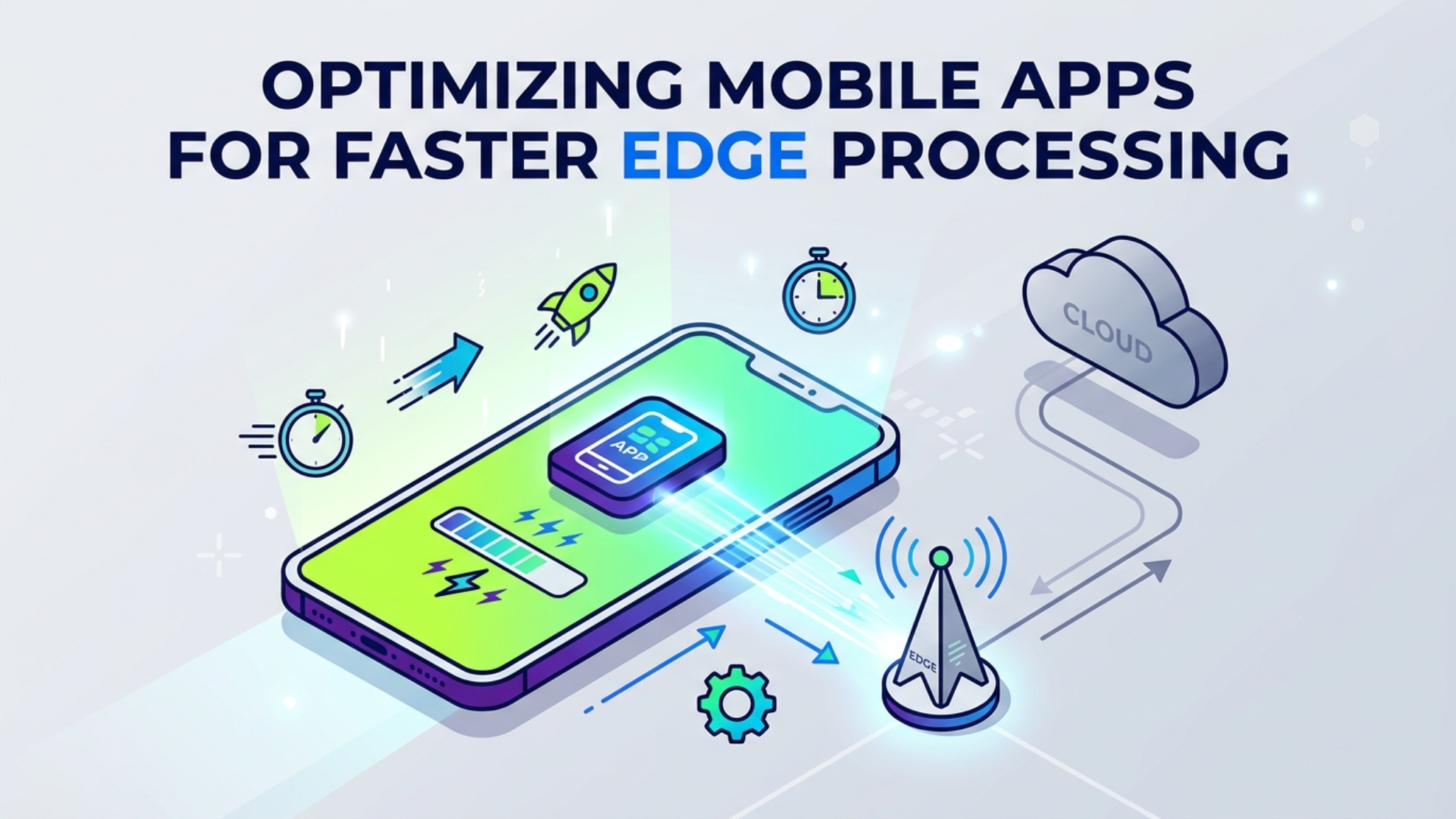
Why Mobile Speed Demands a New Architecture
Every second counts in the mobile space. Research shows that 53% of users bounce if a page takes more than three seconds to load, and the new industry benchmark for high-performing apps is a sub-500ms Time to Interactive experience. This creates a challenging tension for developers: centralized cloud infrastructure introduces unavoidable latency that contradicts today’s demand for real-time responsiveness.
The gap between user expectations and standard server performance is where edge computing transforms your tech stack. By processing data closer to the source rather than in distant data centers, you can bypass network delays that throttle growth. At www.appstory.org, we analyze these architectural shifts to help founders choose paths that prioritize speed without ballooning costs. This guide covers how to leverage edge fundamentals and advanced optimization tactics to keep your application fast, reactive, and reliable as you scale.
What Edge Computing Means for Mobile Apps
Edge computing is a distributed architecture that processes data near the source, such as on a user’s mobile device, local router, or nearby edge server, rather than relying solely on a distant, centralized cloud. In a mobile app ecosystem, it functions by offloading specific compute-heavy tasks from the main cloud to the edge, geographically closer to where your end-user is located. This architectural shift significantly minimizes latency, allowing apps to respond in real-time even when network conditions fluctuate. By reducing the distance data must travel, you also cut down on bandwidth consumption, which lowers infrastructure costs and improves overall app performance. Essentially, edge computing enables developers to build faster, more responsive experiences by balancing centralized control with the efficiency of localized processing.
The terminology for this discipline has recently evolved from Mobile Edge Computing to Multi-access Edge Computing. This shift acknowledges that modern applications reach users far beyond cellular towers, now covering diverse network types including fixed broadband and Wi-Fi. By reducing data transmission hops, your application avoids the bottlenecks inherent in routing traffic to a single, congested central server.
Primary Use Cases for Edge Architecture
As documented in research regarding optimizing mobile performance, the deployment of edge servers is foundational for any app requiring rapid inference or immersive experiences. Because decentralized task partitioning allows for smarter distribution of workloads between the device and the edge, it is the standard for high-bandwidth sectors.
- Real-time AI inference: Executing local language or image processing models without cloud lag.
- Augmented and Virtual Reality: Rendering complex visual environments where sub-50ms response times are mandatory.
- Mobile Gaming: Maintaining synchronization across distributed player sessions.
- Industrial IoT: Managing immediate sensor responses for automated manufacturing platforms.
The Latency Problem and How Edge Solves It
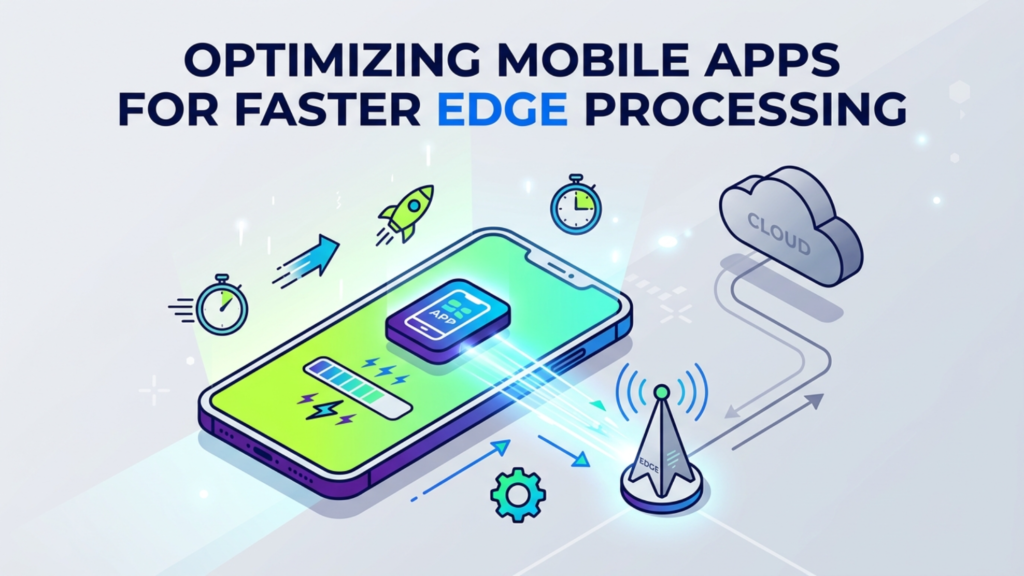
Every millisecond spent waiting for a server response impacts user behavior. A performance delay of just 100ms can result in a 7% decrease in conversion rates during high-traffic events, making speed a primary business metric. Traditional cloud architectures often rely on centralized data centers that force information to travel through numerous network hops, introducing avoidable delays. While Gartner reports that general cloud optimization can cut latency by up to 30%, these standard methods often fall short for modern, high-intensity applications.
Edge computing solves the distance problem by shifting processing power from distant hubs to base stations or local gateways. By shortening the physical path between the user and the server, this architecture enables the sub-50ms response times required for demanding use cases like virtual reality, autonomous vehicles, financial algorithmic trading, and industrial robotics. Research published in Universal Research Reports highlights how this distributed strategy is essential for developers aiming to improve application speed beyond traditional capabilities.
How can developers effectively reduce application latency?
To effectively reduce application latency, you must first implement robust observability tools, such as Application Performance Monitoring, to identify real-time bottlenecks in your code, database queries, and network requests. Once you pinpoint the root cause, optimize backend processing by scaling server resources and streamlining complex database operations. Minimize network delays by utilizing edge computing to process data closer to the user and by limiting calls to external third-party APIs. On the frontend, reduce latency by streamlining page elements and adopting asynchronous processing to prevent blocking the main thread. By moving from reactive firefighting to proactive, data-driven optimization, you ensure a smoother, faster experience that keeps users engaged.
Beyond active computation, developers should leverage edge caching to pre-store frequently accessed content. This strategy minimizes backhaul traffic to central servers and provides immediate retrieval, which further accelerates page load speeds for global audiences. By offloading static assets to the network periphery, you reserve precious compute capacity for the complex logic that truly requires real-time processing.
Strengthening Security and Privacy with Edge
Moving computation to the edge fundamentally changes your security posture. By processing sensitive information locally, you significantly reduce the amount of data exposed to the public internet, thereby lowering the risk of interception during transit. This localization also simplifies compliance with strict frameworks like the GDPR or CCPA, as you can verify data residency by keeping information on-site or within controlled geographic nodes.
Despite these gains, decentralization introduces new vulnerabilities. A distributed architecture expands your attack surface, as each remote node functions as a potential entry point for malicious actors. To secure these deployments, you must prioritize per-device encryption and implement robust physical tamper protection. Relying on a hybrid model provides the safest balance, where the edge handles real-time sensitive tasks while the central cloud repository stores only aggregated and anonymized data.
What are the primary operational disadvantages to consider when implementing edge computing?
Implementing edge computing requires significant upfront investment in advanced infrastructure and hardware, making it inherently more expensive than centralized cloud setups. Because you are distributing processing across various remote locations, you face increased operational complexity in terms of maintenance and management compared to standard cloud environments. Edge devices often come with restricted processing power and storage capacity, which can limit the scope and intensity of the applications you can deploy locally. Furthermore, the distributed nature of these devices expands your attack surface, creating unique security and physical tampering risks that are harder to oversee. Finally, developers must account for persistent connectivity needs, as these local systems still rely on stable network access for critical synchronization and software updates.
Core Performance Tactics for Mobile Apps
Effective mobile app performance requires a multi-faceted strategy that prioritizes speed, efficiency, and scalability. Start by minimizing HTTP requests and leveraging asynchronous loading to ensure a fluid user interface, while rigorously auditing your codebase to remove dead functions that bloat the application. Integrate automated monitoring and QA testing to identify bottlenecks proactively. For high-traffic applications, prioritize headless architecture and optimized API integration to handle demand fluctuations without compromising speed. Finally, focus on strategic data management, such as implementing localized caching and refined inventory processing, to reduce latency and enhance overall user retention.
What are the core technical strategies for optimizing overall mobile application performance?
- Audit your codebase for dead functions and employ tree-shaking techniques to decrease binary size, ensuring the app remains lightweight.
- Implement lazy loading for images and non-critical assets to prevent blocking the initial render, pairing this with modern image formats like WebP or AVIF.
- Utilize in-memory caching solutions like Redis or Memcached to store frequently accessed data, which minimizes repeated retrieval times from the server.
- Address back-end inefficiencies by replacing N+1 database queries with eager loading and offload long-running background tasks to message queues.
- Dynamically adjust rendering quality based on real-time device hardware, battery status, and network conditions to maintain performance.
While generic cloud optimizations are common in standard industry stacks, performance at scale often relies on how well your architecture handles distributed demand. Techniques such as modernizing legacy applications and using horizontal scaling are foundational, yet they often struggle when faced with the sub-500ms Time to Interactive benchmarks expected in 2026. Developers looking for more granular performance control benefit from offloading heavy compute tasks to the GPU, a practice that prevents CPU thermal throttling and maintains steady frame rates.
Offloading Heavy Tasks to Edge Servers
Mobile devices often struggle with intensive workloads like AI inference or high-resolution video processing. Instead of forcing your app to handle every task locally, you can offload these compute-heavy jobs to nearby servers. This architectural shift significantly improves response times, as documented in Mobile Edge Computing Optimization Strategies.
Dynamic task partitioning allows your system to act as a bridge, intelligently splitting work between the mobile device and the edge node. By balancing this trade-off, you minimize energy consumption while keeping latency low for users. Research confirms that effective task offloading can drastically reduce both data transfer time and energy costs for mobile terminals, as highlighted in studies on latency minimization for these networks.
Offloading tasks also preserves device battery life by preventing CPU thermal throttling. This approach is essential for real-time features like facial recognition or natural language processing. By deploying these models at the edge, your application performs sophisticated analysis without the persistent lag caused by constant round-trips to a centralized cloud. Unlike generic approaches, this method ensures your app remains responsive even during peak demand periods.
Caching and CDN Strategies for Faster Delivery
Moving data closer to the user is one of the most effective ways to eliminate network bottlenecks. By caching frequently accessed content like static UI assets and specific API responses on servers near users, you reduce the number of trips back to the origin server. While standard Content Delivery Networks (CDNs) like Cloudflare or AWS CloudFront are useful for global distribution, modern mobile strategy requires more granular control. Combining a multi-region CDN with serving assets based on device type allows your back-end to match image resolution to the specific hardware capabilities of the device, preventing unnecessary data transfer.
When building for high performance on AppstoryORG, we prioritize local state management to ensure fast, responsive interactions. Implementing Time-to-Live (TTL) caching for UI data allows your app to load cached UI from local storage during warm starts, drastically improving perceived speed. For backend infrastructure, integrating caching tools such as Redis or Memcached is essential, as these tools handle high-concurrency requests far faster than standard database queries.
Optimizing Bandwidth and Data Transfer
Moving computation to the edge does more than cut latency — it drastically improves how your application manages network resources. By filtering and resolving data locally at the source, your app transmits only essential insights to the central cloud instead of pushing raw datasets. This reduction in backhaul traffic directly lowers your data transfer costs and speeds up response times, giving you a measurable performance gain you can act on today.
Modern transport protocols provide another layer of efficiency for bandwidth-constrained environments. Using WebTransport, built on the QUIC protocol, lets you send data over multiple independent streams so a delay in one stream doesn’t block the others — a meaningful upgrade over traditional REST or WebSockets. While your infrastructure shifts, don’t ignore the user’s perception of these handshakes. Implementing skeleton UIs and progressive content loading ensures that the interface remains responsive, keeping users engaged while data fetches happen in the background.
AI and Machine Learning at the Edge
Embedding intelligence directly into mobile apps allows for real-time inference without needing constant cloud connectivity. Deploying machine learning models at the edge enables features like facial recognition or natural language processing to run locally, significantly reducing the gap between user action and system response.
Sophisticated strategies like Deep Reinforcement Learning (DRL) help developers create adaptive policies that improve with experience. Decentralized DRL frameworks allow individual mobile devices to autonomously learn optimal power and data-offloading strategies, adjusting to volatile network conditions in real-time.
While powerful, AI integration requires careful planning to prevent performance degradation. If not architected correctly, frequent calls to heavy models add unnecessary latency. When you treat AI as a distributed component rather than a monolithic cloud service, teams can deliver smoother experiences that stand apart from competitors relying solely on central data centers.
The Role of 5G and Infrastructure in Edge Adoption
The marriage of 5G and edge computing acts as a force multiplier for mobile application performance. While edge architecture decentralizes processing to reduce distance, 5G provides the ultra-low latency and high-capacity bandwidth necessary to handle these intensive data transfers. According to recent projections, mobile devices will account for over 21% of global edge computing infrastructure by 2028.
The rapid expansion of 5G infrastructure in the United States is currently clearing the path for broader Multi-access Edge Computing (MEC) adoption. Telecommunications providers are shifting to a Telco Cloud model, which leverages containerization and microservices to transform traditional network hardware into agile, virtualized services. Technologies such as Network Functions Virtualization (NFV) and network slicing allow developers to create tailored Quality of Service (QoS) profiles, ensuring that latency-sensitive tasks like real-time gaming or augmented reality receive dedicated bandwidth slices.
Managing Distributed Complexity and Costs
Transitioning to an edge-focused architecture introduces operational overhead that requires a deliberate strategy. Unlike centralized cloud models where resources are consolidated, edge deployments distribute intelligence across multiple remote sites. This migration often entails significant upfront capital expenditure on specialized server hardware and local infrastructure.
To mitigate these technical hurdles, developers should prioritize automation and standardization. Utilizing Prometheus and Grafana allows for centralized monitoring of distributed nodes, while self-healing scripts can automatically restart failed services without requiring manual intervention. You can reduce complexity by standardizing your hardware footprint and adopting containerized applications through orchestration platforms like K0rdent, which leverages the lightweight k0s distribution to maintain efficiency on resource-constrained devices.
- Adopt a modular infrastructure design that enables seamless scaling when adding new edge nodes.
- Use containerization to ensure workload portability across diverse edge hardware environments.
- Implement automated CI/CD pipelines to push updates consistently to all distributed locations.
- Evaluate your ROI by focusing edge deployments specifically on latency-sensitive features like real-time AR or high-frequency data processing.
Holistic Optimization: Beyond Pure Speed
Beyond technical performance, what are the essential pillars of a comprehensive mobile app optimization strategy?
A robust optimization strategy transcends raw speed by integrating user-centric design with proactive security and data-driven intelligence. While reducing latency is critical, founders often find that intuitive onboarding, personalization, and the use of skeleton UIs significantly reduce perceived churn before the user even interacts with the core feature set.
Security must be baked into every layer of the distributed architecture. Implementing local encryption at the edge and establishing routine tamper-detection protocols ensure that sensitive user data remains protected far from centralized vulnerabilities. Unlike competitors that retroactively apply patches, at www.appstory.org, we encourage a proactive audit posture that treats edge nodes as first-class endpoints.
- Engagement: Balance timely push notifications with granular user-controlled settings to prevent notification fatigue and maintain a high daily active user count.
- Data-Driven Growth: Systematically deploy funnel analysis and A/B testing to identify and resolve friction points in conversion journeys.
- Observability: Utilize full-stack observability by combining Real User Monitoring (RUM), synthetic monitoring, and server-side APM to diagnose performance deviations before they impact user retention.
By shifting focus from merely passing performance benchmarks to managing the entire user journey, developers create a self-sustaining growth model. Integrating these behavioral insights with technical monitoring allows teams to prioritize updates that directly improve conversion rates, rather than chasing vanity metrics that do not correlate with business outcomes.
Measuring Success: KPIs and Continuous Improvement
Effective optimization requires a rigorous focus on performance data. Developers should monitor critical metrics, including response time, error rates, system throughput, and Time to Interactive (TTI). As industry standards evolve, benchmarks for a sub-500ms TTI have become the baseline for 2026 performance, a reality that necessitates advanced visibility.
Cloud-native APM solutions have emerged as the standard, currently capturing 62.8% of the market share for monitoring. With this sector projected to grow at a 33.1% annual rate through 2030, these tools are essential for diagnostics. At AppstoryORG, we emphasize that teams should pair these tools with AIOps, which enables predictive maintenance by identifying performance deviations before they manifest as user-facing outages.
For edge deployments, standard testing is insufficient. Reliable optimization strategies rely on simulated environments and phased, pilot-based deployments to validate edge nodes before a full rollout. This commitment to iterative improvement directly impacts business outcomes, as the global market for application monitoring is expected to expand from $10.67 billion in 2024 to $100.72 billion by 2033, reflecting the increasing economic stakes of app speed.
Building Faster Apps with Edge Intelligence
Adopting edge architecture is no longer optional for apps requiring sub-500ms responsiveness. By offloading resource-intensive tasks to the network edge, you minimize latency, extend device battery life, and enhance security by processing sensitive data locally Mobile Edge Computing Optimization Strategies. This architectural shift transforms how applications scale, with optimized edge deployments reducing energy consumption and data transfer times significantly.
True performance requires a holistic approach. Relying solely on edge nodes is insufficient if your front-end rendering or database queries remain unoptimized. As the global Application Performance Management market expands, early adopters who combine edge intelligence with efficient lazy loading and query indexing will capture greater market share. To maintain a competitive edge, perform a technical audit of your current stack, isolate a single compute-heavy feature to test via edge offloading, and iterate based on real-time performance metrics.



![10 Benefits of the Internet of Things You Should Know [2027]](https://www.appstory.org/wp-content/uploads/2025/03/ATS-10-Benefits-of-the-Internet-of-Things-You-Should-Know-2025@2x-300x142.png)