

Why Most SaaS Launches Fail—and How Yours Won’t
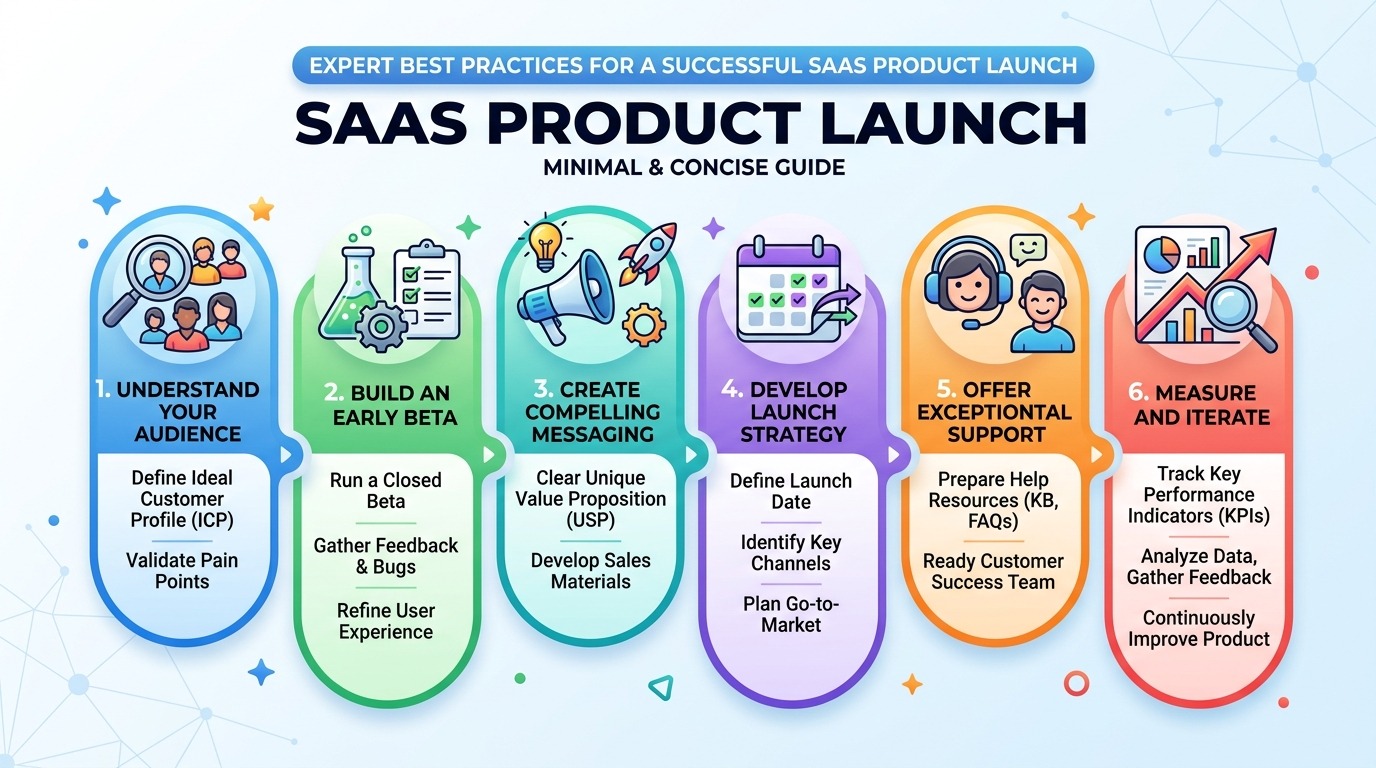
A successful saas product launch is rarely a single moment of triumph. Instead, it is the result of a deliberate, three-phase lifecycle that demands precision before, during, and after release. Data suggests that companies with a documented launch plan are 45 percent more likely to succeed.
The path to market is usually split into three critical windows. You will spend 3 to 6 months in the pre-launch phase validating your idea, followed by a 1 to 2 month launch period, and finally a 6 to 12 month post-launch cycle focused on retention. This article outlines the specific frameworks you need to manage risk and build real demand.
What Defines a Modern SaaS Startup
A SaaS startup is defined by its delivery of application software over the cloud rather than through one-time, perpetual licenses, making it a critical foundation for a successful saas product launch. Instead of requiring local installations, these platforms are accessed directly via web browsers, allowing providers to manage infrastructure and software resources centrally.
What defines a SaaS startup and how does it differ from traditional software models?
This model relies on multi-tenant architecture, where shared resources drive efficiency and scalability for a growing user base. Unlike traditional software, which often involves static versions sold upfront, SaaS focuses on recurring revenue, continuous updates, and immediate availability.
- Cloud-based delivery eliminates the friction of local installations.
- Multi-tenant infrastructure allows you to scale resources efficiently as your user base grows.
- Recurring revenue streams create predictability that one-time license sales cannot match.
- Continuous deployment cycles mean users always have access to the latest features and security patches.
By prioritizing customer retention and consistent service improvements, organizations can offer a more agile, cost-effective solution that scales alongside the needs of their modern market. Understanding these structural differences is essential, as the requirement to maintain uptime and performance on a shared stack influences every decision you make during your go-to-market planning.
From Concept to Launch: The Proven Process

A structured approach to a saas product launch transforms a raw idea into a scalable business. The process begins with rigorous market research, where you move beyond simple demographics to uncover the specific, daily pain points driving your potential users. For those seeking clarity on these initial steps, www.appstory.org provides deep-dive guides that help founders validate their problem-market fit before writing a single line of code.
What is the most effective process for taking a SaaS product from concept to launch?
Once the problem is identified, focus on building a Minimum Viable Product that solves one or two core needs exceptionally well. By avoiding feature bloat, you lower your testing barrier and allow for genuine product-market fit evaluation. Throughout this build phase, teams should implement a continuous feedback loop using both quantitative analytics and qualitative user surveys to guide development. As you near your target date, transition into a coordinated go-to-market strategy that synchronizes your onboarding, messaging, and acquisition goals.
Launch day is not the finish line but rather the start of your iteration cycle. Successfully scaling your product requires monitoring specific metrics like Churn Rate and Time-to-Value, allowing you to refine the user experience based on real-world behavior. By treating each feature release as a learning opportunity rather than a final product, you ensure that your platform remains relevant as it encounters the market.
| Phase | Primary Goal | Key Metric |
|---|---|---|
| Pre-Launch | Validation | Waitlist Conversion |
| Launch | Execution | Signups |
| Post-Launch | Retention | LTV |
Building Your SaaS Without Deep Capital
Founders can now execute a successful saas product launch without needing a massive engineering budget by leveraging modern no-code platforms. Tools such as Bubble(for web application logic),FlutterFlow(for cross-platform mobile interfaces), and Xano (for scalable backend databases) allow you to build complex workflows without writing manual code.
How can founders build a SaaS product without deep coding or large initial capital?
These platforms shift development from months of expensive engineering cycles to days of intuitive, drag-and-drop prototyping. By adopting a lean methodology, you can scaffold your MVP rapidly, integrate automated business logic, and ship your solution to users for immediate testing. This approach enables you to iterate based on real-world adoption patterns rather than spending your entire runway on speculative feature development.
Ultimately, utilizing this infrastructure empowers solo founders and small teams to focus on solving core user pain points while keeping technical overhead low. Building a foundation with these tools ensures that your saas product launch stays agile, allowing you to pivot based on user feedback long before you commit to the costs of custom, high-end software development.
Your Non-Negotiable Launch Checklist

A comprehensive saas product launch checklist serves as the operational roadmap that prevents missed deadlines and disorganized execution. Teams that document their launch process often report better outcomes, so you should prioritize these distinct pillars before going public.
What essential elements must be included in a comprehensive SaaS product launch checklist?
Your path to a successful saas product launch must begin with a refined Minimum Viable Product (MVP) based on early user feedback to ensure genuine market demand. Beyond maintaining stable cloud infrastructure and robust data security, you must synchronize the efforts of product, marketing, and sales teams to provide a unified market message. Operational readiness requires automated billing systems and granular usage metering, which ensure accuracy in revenue recognition as you scale.
Preparation also necessitates clear in-app support channels and analytical tracking to measure real-time performance. Incorporating high-impact marketing assets, such as demo videos and interactive onboarding flows, helps users reach their ‘aha moment’ within minutes, reducing early-stage churn.
- Validate your MVP through beta testing with 20 to 50 users to eliminate critical bugs.
- Implement automated billing platforms to manage custom subscription or usage-based pricing models.
- Configure product analytics to track conversion rates, activation benchmarks, and user drop-off points.
- Equip your support team with FAQs and internal documentation to handle the first wave of incoming questions.
Pre-Launch Marketing That Builds Real Demand
To generate meaningful demand for your saas product launch, move beyond a simple landing page by treating the 6 to 8 weeks before your release as a structured sprint of brand-led storytelling. During this phase, your goal is to build an email waitlist that offers early-bird access or exclusive resources, such as white papers or industry templates, to create a sense of belonging among your power users.
What are the most impactful pre-launch marketing strategies to generate demand?
Authentic engagement is your greatest asset. Actively participate in niche communities where your target audience congregates, such as specialized Slack groups or forums, by providing genuine value rather than cold promotional links. This approach builds the trust necessary to convince users to join your community before the product is even live.
Your website hero section must function as a high-conversion capture tool. Keep the design clean and use the space to tease specific features through content snippets and transparent founder updates. As you approach the date, pivot to rigorous beta testing of your saas product launch MVP. These early cohorts do more than identify bugs, as their testimonials and verified usage data provide the essential social proof required to fuel your momentum on day one.
By focusing on these specific, value-driven interactions during your pre-launch sprint, you ensure that your team is ready to scale the moment the green light is given.
Mastering Product Hunt for Maximum Impact
To achieve maximum impact during a saas product launch on Product Hunt, founders should move beyond casual posting by dedicating significant time, often 50 to 120 hours, to rigorous campaign preparation. Success relies on viewing the launch as a strategic marketing milestone rather than a golden ticket, necessitating a clear, value-driven narrative that resonates with your specific target audience. Rather than depending on organic discovery, build an authentic community connection well in advance so that your launch day is supported by an engaged base of initial users.
How should a SaaS founder leverage platforms like Product Hunt for maximum launch impact?
Treat the platform as a tool to kickstart your growth trajectory by actively monitoring feedback and responding to comments in real-time to demonstrate product responsiveness. Before going live, ensure your product is truly launch-ready, as a failed attempt can lead to wasted effort if your core value proposition is not clearly defined. At www.appstory.org, we emphasize that consistent engagement during these windows is what converts curious early adopters into long-term power users, distinguishing your release from the noise of thousands of other daily submissions.
- Commit 50 to 120 hours to creating your assets, including high-quality screenshots and a concise, benefit-focused video demo.
- Engage with existing community members in the weeks leading up to your date to establish genuine rapport.
- Assign a dedicated team member to manage comments, answer questions, and resolve concerns on your launch day page.
- Verify your technical infrastructure can handle the influx of concurrent visitors without latency or sign-up failures.
Demo Videos That Convert Visitors to Users
A well-executed demo video is essential for a successful saas product launch because it bridges the gap between explaining your software and demonstrating its real-world value. By focusing on a single, compelling use case, you allow potential customers to instantly visualize how your product solves their specific pain points.
To maximize your impact, keep your videos between 60 and 120 seconds. Prioritize visual clarity and design for silent viewing to accommodate mobile and social media audiences who often engage with content on the go. Focus your storytelling on tangible outcomes, such as time saved or revenue generated, rather than simply listing out features.
At www.appstory.org, we advise founders that the goal of these videos is not to show every edge case in your software, but to trigger the ‘aha’ moment for the viewer. Clear, benefit-driven demo clips help prospective customers understand your value proposition in under two minutes.
Pricing Models That Drive Adoption and Retention
Selecting the right pricing model is a strategic choice that dictates your saas product launch trajectory and long-term viability. When you move beyond simple guesswork, pricing research can reveal significant advantages. By grounding your pricing in customer value rather than industry norms, you align your revenue goals with the specific needs of your market.
Tiered Pricing. This model groups features into different packages, allowing users to choose the level that matches their needs. It is effective for capturing value across both small and large teams.Freemium. Offering a free basic tier can drive rapid user adoption, though it requires careful balance to ensure enough users eventually convert to paid plans to sustain operations.Usage-Based. Charging based on metrics like API calls or active users ensures revenue scales directly with customer success and product value, creating a transparent cost structure.Flat-Rate. Simple subscription pricing offers predictability for both the customer and the business, simplifying the sales process and billing cycles.
Your pricing strategy directly influences user perception. Whether you choose a model that emphasizes low entry friction or one that reflects premium value, the implementation must be precise. Using a billing system is essential to handle complex requirements like automated recurring billing, real-time financial tracking, and regulatory necessities such as ASC 606 compliance. While tools manage the mechanics, your alignment between product capability and pricing tiers remains the most powerful lever for reducing churn and boosting customer lifetime value.
Onboarding: Shortening Time-to-Value
Effective onboarding is the engine of a successful saas product launch, as users who do not perceive instant utility often abandon software within the first few sessions. Your objective should be to guide new sign-ups to their first ‘aha moment’ within 2 minutes of logging in. Whether through an interactive walkthrough, a series of intuitive tooltips, or a high-impact guided demo, the focus must remain on removing friction so the user experiences the core value of the software immediately. Beyond the product interface, personalized email sequences act as a secondary support layer, nudging users to complete secondary tasks that deepen their engagement. When planning your launch metrics, target an activation rate of 40 percent or higher within the first 30 days. This threshold helps you gauge whether your product is effectively solving a user problem.
Measuring What Matters: KPIs After Launch
A successful saas product launch transition relies on moving from gut-feeling intuition to data-backed decisions. Founders should treat post-launch metrics as a diagnostic tool rather than just a status report to ensure long-term viability.
Retention stands as the single most critical early-stage metric because it validates whether your solution truly solves a recurring user problem. A product that fails to hold onto early adopters will struggle to scale regardless of acquisition volume.
- Customer Acquisition Cost (CAC) and Lifetime Value (LTV) should be tracked early to ensure your growth remains sustainable as you spend on marketing.
- Sign-ups and conversion rates reveal how effectively your landing page copy and onboarding flow resonate with new visitors.
- Monthly Active Users (MAUs) and Daily Active Users (DAUs) provide a clear picture of how frequently customers rely on your software for their daily workflows.
- Churn rate serves as a key indicator of user dissatisfaction; monitoring this allows you to identify exactly where in the product experience users begin to drop off.
Analytics platforms help you spot friction points in the user journey. If data shows a significant drop-off during onboarding, you may need to simplify your first-use experience or provide more interactive guidance. Setting realistic milestones based on these KPIs helps you pivot your strategy before you exhaust your runway or marketing budget.
Scaling Growth After Launch Day
The period immediately following your saas product launch is not a time to rest, but the beginning of a sustained growth sprint. Rather than attempting to manage a dozen different marketing campaigns, focus your resources by doubling down on one or two high-performing channels identified during your initial rollout. Diluting your efforts across too many platforms too early often leads to inconsistent messaging, whereas concentrating on channels with proven traction allows for rapid optimization and reliable lead generation.
Sustainability requires building a continuous feedback loop between your team and your users. Incorporate tools to monitor Net Promoter Scores and maintain open lines through your support channels to identify pain points as your user base grows. On www.appstory.org, founders often find that analyzing raw support tickets provides a clearer roadmap for feature iterations than relying solely on high-level usage metrics. By integrating these insights into your development cycle, you shift from guessing what users want to building what they depend on.
- Leverage presence on review sites like Capterra and G2 to build essential social proof for prospective buyers.
- Implement structured referral programs that reward existing users for inviting their peers, tapping into the high-retention value of word-of-mouth marketing.
- Refine your product roadmap quarterly by mapping requested features against actual user data instead of speculative market trends.
Launch Smart, Iterate Fast
A successful saas product launch follows three distinct phases: a 3 to 6 month pre-launch period for research, a 1 to 2 month execution stage, and a 6 to 12 month post-launch phase focused on sustainable growth.
Long-term success depends on establishing a continuous feedback loop. By integrating in-app surveys, monitoring support channels, and analyzing user behavior, you can refine your product roadmap based on real-world data rather than assumptions.
Apply these structured best practices to your next project to transform early momentum into lasting scalability. Diligent planning and iterative design cycles remain the most reliable path to achieving product-market fit.

![10 Benefits of the Internet of Things You Should Know [2027]](https://www.appstory.org/wp-content/uploads/2025/03/ATS-10-Benefits-of-the-Internet-of-Things-You-Should-Know-2025@2x-300x142.png)