Tag: Android

  • Wondr Note: Fun Notes & Tools — Comprehensive App Review & Evidence-Based Report

    Wondr Note: Fun Notes & Tools — Comprehensive App Review & Evidence-Based Report

    Important scope note on identity confusion: During research, several unrelated products share the “Wondr” name and must not be conflated with this app: Wondr Health / Naturally Slim (a weight-loss program), Wondr AI (a print-on-demand SaaS tool), and Wondr Care (a shampoo-bar brand). This report concerns only Wondr Note: Fun Notes & Tools by Mighty Bear Vibes Pte. Ltd. Where evidence about those other products appears, it is excluded from the verdict. This significantly limits the volume of app-specific evidence available, which is itself a finding.

    1. Overview

    Wondr Note is a customization-heavy notes and productivity app for Android. It combines the simplicity of a notebook with the flexibility of customization and a daily planner, so you can create, plan, write, and dream in one place — whether it’s a shopping list, study notes, or travel checklist. It is described as a creative and unique take on a note and list app, created in the hopes of providing convenience, productivity and visual appeal, letting users add notes, lists, boards, basic accounts and even countdowns.

    The current version is 17.x (as of early-to-mid 2026), developed by Mighty Bear Vibes Pte. Ltd. Wondr Note has won an award for Best New Mobile App (from the Best Mobile App Awards, a self-submission awards program — treat as marketing, not independent validation).

    Evidence-quality caveat: There is very little independent, in-depth review coverage of this specific app. The most substantial third-party review (noteapps.ca) is from January 2023 and much has changed since. Most other “sources” are app-store mirrors (APKPure, Uptodown, Softonic) that republish the developer’s own description. Treat many claims below as developer statements or dated user opinion, not verified fact.

    2. Onboarding Experience
    Wondr Note app review graphic

    Direct, documented onboarding evidence is thin. Based on the app’s design and feature description:

    • Account creation / login: The app is local-first and the developer repeatedly states data stays on-device, implying no mandatory account to start. The developer states your data stays private on your device — they never collect or store your notes, email, name, etc. A Google account is only relevant if you opt into Google Drive backup.
    • Time to productivity: Multiple user reviews indicate a quick, low-friction start. One reviewer noted becoming a fan on day one. Another said that after starting the same day, it was by far their favorite notepad-type app despite trying many others, and that they were not paying for premium, praising the choices to customize font colors and backgrounds.

    Assessment: Onboarding appears low-friction (no forced signup), but there is no strong evidence of guided tutorials, and at least one user felt basic behaviors weren’t obvious (see §4). Onboarding quality: moderate-to-good, unverified.

    3. User Interface & User Experience

    This is the app’s strongest, most consistently praised dimension.

    • A 2023 independent reviewer said they enjoyed testing Wondr Note as it’s extremely colorful, fast, and functional.
    • Recent update notes emphasize UI polish: the developer highlights a sleek, modern UI, an upgraded planner and calendar, reminders, and sort/filter/multi-select tools for quicker organizing.
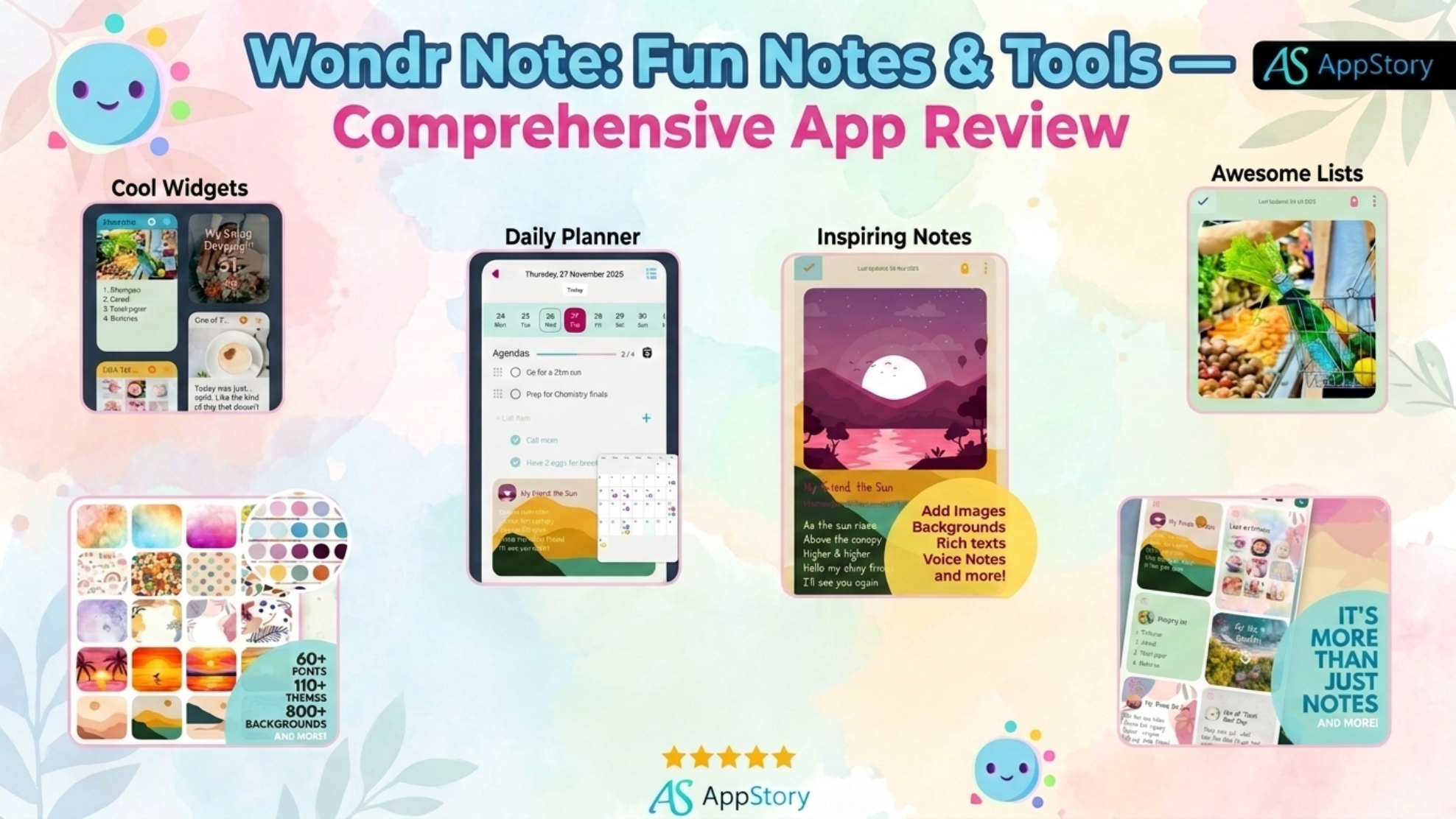
    • Deep customization is the headline feature: the app advertises 800+ beautiful backgrounds, 100+ cute themes, 70+ fonts, and the ability to create and save your own custom theme. (Note: earlier versions advertised far fewer — around 60+ themes, 400+ backgrounds and 70+ fonts — showing the library has grown over time.)

    UX friction points (user-reported):

    • One user found basic functions missing — being unable to switch a note between list/checklist/text while writing, calling the per-note restriction limiting.
    • The same user couldn’t find ways to turn off autosave, import notes from other apps, or change view settings beyond colors.
    • Another user’s only complaints were a short length limit per note and glitchy copy-and-paste behavior.

    Assessment: Visually excellent and easy to navigate for casual use; weaker on power-user flexibility (note-type switching, imports, view settings).

    4. Core Features & Performance

    FeatureWhat it doesNotes
    Notes & to-do listsAdd images, backgrounds, or voice notes; switch between checklist, numbered or bulleted formats; rich text with bold, highlight, color and italics.Format is chosen per note, which some users dislike
    Daily planner / agendaCreate a daily agenda by picking from open tasks across all your task lists. Recently upgraded with calendar + remindersPositioned as a 2025–26 focus area
    Accounts (expense tracker)Tracks income and expenses with details and automatic totaling.Praised as well-implemented
    Mood boardsA mood board where you can add a collection of photos with captions and a title.Historically a premium feature
    CountdownsPick a date, set a title, choose a background and get a countdown timer.Historically a premium feature
    WidgetsCustomizable home-screen widgets for the above.A recent update specifically included a widget bug fix
    Search / organizeSort, filter, tag and search to find items quickly.
    SharingShare individual notes as HTML from within the app, but there’s no bulk export.See §6 limitations

    Performance: The 2023 tester found it “extremely colorful, fast, and functional.” Recent changelogs claim performance improvements, a widget bug fix, and smoother loading and faster transitions.

    Key feature limitations / common complaints:

    • No real-time collaboration or sync between devices. A user wanted a shared, synchronized shopping list across family members’ phones but found the app can’t do this — no collaborative editing, only sharing a text of the list with no syncing.
    • No note-type switching mid-note; no import (see §3).
    • No bulk export (see §6).

    5. Pricing & Transparency

    ⚠️ Contradictory evidence — pricing model appears to have changed over time:

    • One-time / lifetime model (current signals): A recent Google Play review states there is lifetime access for a really good price. An older AlternativeTo entry listed it as a freemium product with a one-time perpetual-license purchase costing up to about $3, plus a free version with limited functionality.
    • Subscription model (also documented): The app’s own Terms & Conditions describe recurring billing: monthly subscription fees are billed automatically until cancelled via the Google Play Store; you must cancel before renewal to avoid the next charge; and refunds are not granted for partial-month usage. The same terms describe an annual equivalent. Restore-after-device-change is supported: if you change your device, you may restore your purchase by visiting the “Premium” page in the app, and it will be automatically restored.
    • A dated third-party figure of “$10/mo for Pro” appears in the 2023 noteapps.ca review — it describes a generous free plan or $10/mo for a Pro plan — but this figure is old and inconsistent with the low one-time price other sources cite, so treat it skeptically.

    Free vs. premium split (historically): The free tier is genuinely usable — multiple reviewers explicitly use it without paying. One user noted the free version does notes, lists, daily agenda and the Account tracker very well, with mood boards and countdowns behind premium. Older data suggested around 20 free themes plus 20+ more premium themes.

    Transparency assessment: Mixed. The free tier is honest and generous, and refund/renewal rules are documented in the Terms. However, the coexistence of subscription language and lifetime/one-time messaging is confusing, and no source cleanly confirms today’s exact price and plan structure. Verify the live price in Google Play before purchasing. No credible reports of unexpected/hidden charges specific to this app were found.

    6. Offline Functionality

    This is a structural strength given the local-first design.

    • The app is local-first with backup and restore from Google Drive. Core note-taking, lists, accounts, countdowns and mood boards are stored on-device, so they work offline.
    • Internet is needed only for: Google Drive backup/restore.
    • Sync limitation: Because there is no cross-device cloud sync (§4), “offline” is really the default state — there’s no live syncing to fall out of. Data can only be restored from Google Drive via the app.

    Assessment: Excellent offline usability for a single-device workflow; poor for anyone needing multi-device continuity.

    7. Battery Consumption

    No specific, credible battery-drain data or user complaints were found for Wondr Note. As a local-first notes app without heavy background sync, battery impact is likely low, but this is an inference, not verified evidence. The app’s own reminders/widgets could contribute minor background activity. Insufficient evidence for a scored rating.

    8. Storage Requirements

    • Install size: A 2024 build (v12.8) had a download size of about 107.1 MB (released April 7, 2024 by Mighty Bear Vibes Pte. Ltd.). Current versions are likely similar or larger given the expanded theme/background library.
    • Growth driver: The 800+ backgrounds, 100+ themes and attached images/voice notes are the main storage consumers; note attachments (photos, mood boards) grow storage with use.
    • No specific user complaints about storage bloat were found.

    Assessment: Moderate footprint for the category (~100 MB+), largely due to bundled visual assets. Reduce usage by limiting image/voice attachments.

    9. Customer Support

    • Channel: Support appears to be primarily via the developer’s website/email. Historically, responsiveness was praised: one reviewer said the developers are kind and respond very quickly.
    • ⚠️ Reliability/availability concerns: A recent Play review reported the developer’s site was down: a user wanted to message the devs but the Mighty Bear website showed a “Critical Error,” and suggested the devs look into it.
    • Developer visibility: The 2023 independent reviewer flagged an absentee-developer pattern: they couldn’t find the people behind the app, noted the Twitter account was “a ghost town,” and that Facebook and the blog had no updates for 1.5 years.

    Assessment: Support quality reports are positive but sparse and dated, undercut by signs of low public engagement and at least one broken support-site report. Community support is essentially nonexistent (no active forum/subreddit found).

    10. Data Privacy & Security

    This is a genuine strength, though claims are largely self-reported.

    • Data collection: The developer states your data stays private on your device and that they never collect or store your notes, email, name, etc. An older listing added a nuance: you own all your data, it’s stored in internal storage inaccessible to other apps, no personal data like email/name/images is stored on their servers — but they do collect crash and usage data to improve the app.
    • On-device security: Notes are encrypted and stored on the device, with a PIN lock for extra security.
    • Backups: The developer does not back up data on their servers; they provide a service to back up to your chosen Google Drive account — and if you uninstall the app, your data is removed and cannot be recovered. This is an important data-loss risk to understand.
    • Independent take: The 2023 reviewer called the privacy policy “great, simple, and clear.”

    No historical privacy controversies were found for this specific app. (The billing/third-party-text complaints in search results belong to Wondr Health, a different company, and do not apply here.)

    Privacy risk assessment: LOW — local-first architecture with on-device encryption and minimal server collection is favorable. Caveats: claims are self-reported (not independently audited), crash/usage analytics are collected, and uninstalling wipes your data, so backups are essential.

    11. Bug History & Reliability

    • Update cadence: Recent version history shows frequent updates — Uptodown lists releases including v16.2/15.8 in August 2025, 16.4 (Aug), 16.5 (Oct), 16.6 (Nov 25), 16.8 (Dec 7, 2025) and 17.0 on Feb 16, 2026 — all requiring Android 8.1 or higher. This contradicts the older “abandoned/inactive developer” narrative from 2023 and suggests active development resumed.
    • Known bugs (documented): a widget bug (fixed in a recent update per changelog); a short per-note length limit and glitchy copy-and-paste; and a niche Samsung DeX cursor up/down issue.
    • Stability trend: Recent changelogs repeatedly cite more performance improvements, additional bug fixes, and smoother loading and faster transitions.

    Assessment: Improving reliability trend. Development is currently active (frequent 2025–26 releases), reversing the earlier dormancy. Bugs reported are minor/cosmetic rather than data-destroying.

    12. Community Sentiment

    ⚠️ Sentiment data is limited and skewed by name-collisions. Reliable Wondr Note-specific opinions come mainly from Google Play reviews and the single 2023 noteapps.ca review. Third-party aggregators like Uptodown show zero reviews (“There are no opinions about Wondr Note yet. Be the first!”), and there is no meaningful Reddit/Trustpilot presence for this app.

    Most common praises:

    • Beautiful, customizable design and it’s fun to use (multiple reviewers).
    • Genuinely useful free tier; all-in-one (notes + lists + planner + accounts + boards + countdowns). One reviewer loved that it’s not just a planner but journal, lists and picture boards in one, with backup, plus lifetime access for a good price.
    • Fast and functional; responsive developers (historically).

    Most common complaints:

    • No cross-device sync/collaboration.
    • Per-note format lock; no import; limited view settings.
    • Short note length limit; occasional copy-paste glitches.
    • Low developer public visibility / a reported broken support site.

    Overall sentiment: Positive but low-volume. Enthusiastic core users, but too little independent data for a robust score.

    13. Competitor Comparison

    The best-rated Wondr Note alternative is ColorNote (free), with other similar apps being Note Yourself, Memo, Inquisite and hello ivy. The 2023 reviewer also benchmarked it against Obsidian.

    DimensionWondr NoteColorNoteObsidianGoogle Keep
    Design/customization★★★★★ (800+ backgrounds, 100+ themes)★★☆ (basic)★★★ (theme-able, markdown)★★★
    Core notes/lists★★★★ (rich, per-note format lock)★★★★ (simple, fast)★★★★★ (markdown, linking)★★★★
    Cross-device sync✗ (no live sync)✓ (account sync)✓ (paid/Git sync)✓ (Google account)
    Collaboration✗LimitedCommunity plugins✓ (real-time)
    Offline★★★★★ (local-first)★★★★★★★★★ (local-first)★★★ (needs sync)
    Export/portability✗ (single-note HTML only, no bulk)Limited★★★★★ (plain markdown)★★★
    Privacy★★★★★ (on-device, encrypted, PIN)★★★★★★★★ (local files)★★ (Google cloud)
    PricingFree + cheap premium (model unclear)Free (ads)Free personal; paid syncFree
    Extra toolsAccounts, mood boards, countdowns, planner—Plugins/graphReminders

    Takeaway: Wondr Note wins clearly on aesthetics/customization and all-in-one variety, and matches leaders on privacy/offline. It loses on sync, collaboration, and data portability, where ColorNote, Google Keep and especially Obsidian are stronger.

    14. Risk Assessment

    Major risks / deal-breakers:

    1. No cross-device sync or collaboration — a hard blocker for anyone using multiple devices or sharing lists live.
    2. Weak data portability — no bulk export to take your notes elsewhere; only single-note HTML sharing. Migrating away is painful.
    3. Data-loss risk on uninstall — if you uninstall the app, your data is removed and cannot be recovered unless you’ve backed up to Google Drive; and that backup is stored in a hidden app area on Drive that the tester couldn’t locate or extract without the app.
    4. Pricing ambiguity — subscription vs. lifetime messaging conflicts; confirm before buying.
    5. Developer/support uncertainty — a reported broken support site and historically low public visibility, though update frequency has recently improved.

    Avoid the app if you: need real-time sharing, multi-device sync, plain-text/markdown portability, or long/complex documents (note-length limits).
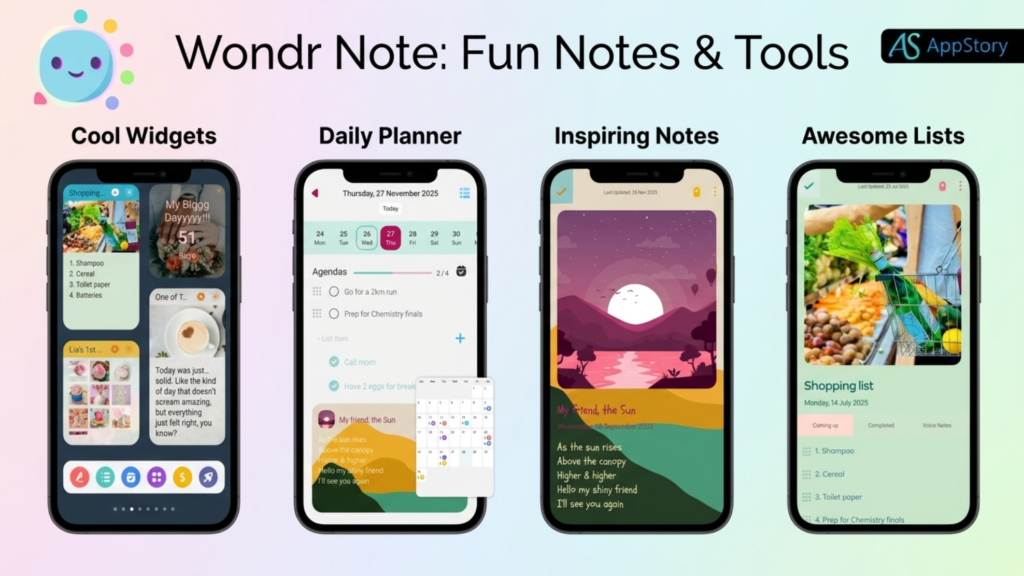
    Wondr Note interface showing screens for widgets, daily planner, inspiring notes, and awesome lists

    15. Final Verdict

    Overall score: 7 / 10

    Wondr Note is a delightful, privacy-friendly, single-device notes app that stands out for its extensive customization and genuinely fun, all-in-one design (notes, lists, planner, expense accounts, mood boards, countdowns, widgets). It’s backed by an active recent update cadence and a usable free tier. It is held back by no sync/collaboration, weak export, some flexibility gaps, and pricing/support ambiguity. Notably, the earlier “8/10 if the developer were more visible/active” reservation from the 2023 review has been partially addressed by frequent 2025–26 updates.

    • Best for: Students, journalers, hobbyists, list-makers, and anyone wanting a beautiful, offline-first, privacy-respecting notes app on a single Android device. It’s well-suited to a student, event planner, garage-sale goer, a parent with kids in sports/crafts, or a small business owner — basically anyone tracking their life, memories or hobbies.
    • Not recommended for: Multi-device users, teams needing collaboration, power users needing markdown/import/bulk export, or anyone writing long documents.
    • Key strengths: Best-in-class customization; strong privacy (on-device, encrypted, PIN); excellent offline use; varied all-in-one toolset; active updates.
    • Key weaknesses: No cross-device sync/collaboration; no bulk export; per-note format lock and note-length limits; unclear/confusing pricing; thin/uncertain support.
    • Value for money: High if it’s a cheap one-time/lifetime purchase; question it if billed as a recurring subscription — verify the live price first.
    • Long-term usability: Cautiously positive. Recent frequent updates are encouraging, but the lack of data portability is the biggest long-term concern — you can get into Wondr Note easily but not out easily.

    Recommendation: Worth installing and trying via the free tier, especially if you value aesthetics and on-device privacy on a single phone. Set up Google Drive backup immediately, and confirm the current pricing model in Google Play before paying. If cross-device sync, collaboration, or note portability matter to you, choose Google Keep, ColorNote, or Obsidian instead.

    Disclaimer: This review is based on publicly available information, user reports, and documented evidence gathered from multiple sources as of mid-2025. Individual experiences may vary. Prices, features, and policies are subject to change. This review is independent and not sponsored by Aceable or any competitor.

    Sources consulted: Apple App Store reviews, Google Play Store reviews, Reddit (multiple subreddits), Better Business Bureau, Trustpilot, Common Sense Media, Aceable’s official website and privacy policy, state DMV/DPS websites, technology review publications, and social media platforms.

    🌟 Community Discovery & Upvoting

    📱 Upvote 5 Community Apps ▾

    1-Click Free Upvote

    Support innovative mobile apps nominated for recognition. Cast your vote with one click to help emerging apps rise:

    Parent Sense: Daily Baby Care

    Parent Sense: Daily Baby Care
    Innovative app developed by Sense-IT Limited
    PicAid: AI Real Estate Photos
    PicAid: AI Real Estate Photos
    Innovative app developed by JOHN A BEATTY
    Valo: Meet People in Groups
    Valo: Meet People in Groups
    Innovative app developed by Bonbon Group Ltd
    SmartNews: Local Breaking News
    SmartNews: Local Breaking News
    Innovative app developed by SmartNews, Inc.
    Know Your Dosh: Money Tracker
    Know Your Dosh: Money Tracker
    Innovative app developed by Know Your Dosh Limited
  • 7 PWA Trends That Will Define Mobile and Web development in 2026

    7 PWA Trends That Will Define Mobile and Web development in 2026

    The web experience on mobile is changing again — quietly but profoundly. What began as a lightweight alternative to native apps has now evolved into a robust digital ecosystem powered by Progressive Web Apps (PWAs). These aren’t just websites anymore; they’re fully capable applications that can install, notify, cache, and transact — all without a traditional app store. As browsers mature and performance APIs evolve, PWAs are set to redefine what “mobile-first” truly means in 2026. 

    For businesses, this evolution isn’t abstract — it’s strategic. The smartest brands are partnering with expert progressive web app development companies to gain app-like engagement without the overhead of native development. Here’s what’s coming next. 

    1. Near-Native Performance Through Edge Integration 

    Performance is no longer the Achilles’ heel of web apps. The next wave of PWAs will leverage edge computing to minimize latency, pushing assets and logic closer to users. This shift allows apps to load instantly, even in low-connectivity environments. Advanced custom PWA development solutions are already embedding service workers with edge routing logic — combining real-time responsiveness with native-grade smoothness. 

    But the real innovation lies in distributed execution. As CDNs evolve into intelligent compute networks, PWAs can offload computation directly to the edge. This means complex tasks like personalization, recommendations, or fraud detection can happen milliseconds from the user — without hitting the origin server. 

    For industries like eCommerce or fintech, this turns the PWA into a near-native powerhouse: instantaneous, safe, and intelligent. The result? Reduced bounce rates, higher engagement, and a seamless experience that rivals any native app — at a fraction of the development cost. 

    By 2026, the development of progressive web applications will increasingly include edge orchestration as standard rather than a luxury. 

    2. Offline Capability Goes Intelligent 

    Offline mode used to be a backup feature. In 2026, it becomes a strategic layer. Smart caching and predictive prefetching will allow PWAs to anticipate user intent — downloading key data before it’s even requested.  

    For industries like travel, banking, and logistics, this turns downtime into engagement time. Leading progressive web app development services are integrating AI-driven caching algorithms to make “always available” a practical reality. 

    Imagine a travel app that predicts your upcoming flight and automatically caches your boarding pass, gate info, and real-time map updates before you even deboard the plane. Or a retail app that preloads your most browsed categories before you reconnect. 

    This is where machine learning meets service workers — transforming traditional caching into adaptive intelligence. Developers are moving beyond static manifests to dynamic behavior models that evolve with user patterns.  

    It’s not just about offline access — it’s about predictive continuity, giving users a sense of control and reliability that even native apps sometimes fail to match. 

    3. Biometric and Hardware-Level Security APIs 

    Security is crossing a new threshold. With browser-level access to biometric authentication (via WebAuthn and FIDO2), PWAs can now offer fingerprint or face login with native-level encryption. That means passwordless, frictionless access without compromising compliance. In 2026, progressive web application development companies will make security design as integral as UX — not an afterthought. 

    Modern browsers now act as secure intermediaries between hardware and application logic. This means sensitive authentication data never leaves the user’s device — a massive step forward for data protection. 

    Financial institutions are already experimenting with device-bound credentials, where cryptographic keys are tied to the user’s hardware. Even if credentials are compromised on the network, they’re useless elsewhere. 

    For progressive web app developers, this convergence of cryptography and convenience will redefine how trust is built on the web. Security will no longer be a compliance checkbox; it will become a competitive differentiator — one that sets great apps apart from the rest. 

    4. Super-App Architecture Through Modular PWAs 

    PWAs will stop being standalone entities. The new trend is modular super-app ecosystems — independent micro-PWAs working in tandem under one umbrella. Think of a retail platform where payments, support, and loyalty each run as self-contained modules. Custom PWA development solutions are already architecting this microfrontend-based flexibility, allowing brands to scale or pivot rapidly. 

    This is similar to how microservices emerged in backend architecture: instead of making monolithic apps that are hard to maintain, companies are assembling modular PWAs where development, deployment, and update of every module are independent. 

    The advantage? Faster innovation cycles and less risk. A new loyalty feature can be rolled out without affecting checkout or account modules. 

    For enterprises, this translates into operational agility: the ability to adapt quickly to new business models or market shifts without reengineering the entire system.  

    By 2026, composable front-ends will be the default model for progressive web app development companies in building agile digital ecosystems. 

    5. Push Notifications Evolve into Smart Engagement 

    Push notifications will continue their shift from simple alerts toward contextual, behavior-driven engagement tools. AI will refine what gets sent, when, and why — reducing noise while boosting conversions. The best progressive web app development companies are embedding predictive engagement engines that blend user analytics with timing intelligence to make notifications feel human, not automated. 

    For example, a fintech PWA might only send a balance alert when spending behavior crosses a pattern threshold. A retail app could delay promotional notifications until the user’s usual browsing window, increasing the likelihood of interaction. 

    This marks a shift from broadcast to precision engagement. Instead of treating all users equally, modern push systems analyze micro-moments — intent, context, and emotional timing. 

    Brands that master this nuance will find their PWAs outperforming traditional apps in retention metrics. It’s not about sending more — it’s about sending smarter. 

    6. Unified Experience Across Screens 

    The “mobile web” is now a misnomer. PWAs or Progressive Web Apps are meant to be installed anywhere, from mobile phones and tablets to desktops, cars, and even TVs. 

    Responsiveness isn’t just about layout; it’s about interaction. Modern progressive web application development services emphasize adaptive UX logic to make sure continuity across devices is continued. Your session on one screen seamlessly resumes on another, just like a cloud-native application.  

    In 2026, the boundaries between mobile and desktop user journeys will be removed. Shared storage, progressive sync, and contextual design will enable users to switch between experiences with fluidity.  

    For instance, a user might start shopping on a tablet, continue with the payment on a phone, and review order status on a smart display — all within one cohesive PWA ecosystem. 

    This shift toward experience fluidity will redefine customer expectations. Businesses that deliver this “follow-me” continuity will dominate engagement metrics. 

    Progressive web app development companies are increasingly using APIs like Web Share Target, Web Bluetooth, and WebUSB to bridge these experiences beyond screens — integrating PWAs into physical ecosystems of connected devices. 

    7. Sustainability Through Lighter Codebases 

    Efficiency is the new prestige metric. PWAs consume less energy, bandwidth, and processing power compared to native counterparts. In an era where sustainability drives brand value, that matters. Expect progressive web application development companies to focus on smaller, greener codebases optimized for minimal resource consumption — without sacrificing power or design depth. 

    The shift toward sustainable code isn’t just environmental — it’s economic. Leaner applications mean faster loads, lower data costs, and longer device lifespans for users in emerging markets.  

    Modern development stacks focus on code splitting, lazy loading, and tree shaking in order to avoid redundancy at all costs and reduce overhead.  

    For global brands, this efficiency translates into accessibility. Lighter PWAs can serve users with poor connectivity or low-end devices — unlocking new audiences that traditional native apps often exclude.  

    In 2026, sustainability will be more than a CSR talking point; it will become a core metric of digital performance. 

    Conclusion: The Web Reclaims the Mobile Throne 

    2026 marks a shift in dominance. PWAs are no longer “almost” native — they are strategically equivalent. The combination of edge computing, biometric security, and modular architecture has blurred the once-clear boundary between web and app. 

    For enterprises, the takeaway is clear: investing in progressive web app development services is no longer experimental — it’s essential. Those who embrace PWAs now will define not just the future of mobile, but the future of digital itself. 

    The web has always been the most universal platform. PWAs simply unlock its full potential — speed, reach, and security fused into one elegant framework. 

    As more brands adopt custom PWA development solutions, the competition will shift from “who builds the best native app” to “who delivers the most seamless web experience.” 

    In the end, the browser isn’t the limit — it’s the launchpad. The next era of mobile innovation will live not in app stores, but right inside the web itself. 

    Read more articles of appstory.org

  • End-to-End Software Development: Transforming Enterprise Success

    End-to-End Software Development: Transforming Enterprise Success

    Introduction

    Businesses of all sectors are facing immense competitiveness in terms of delivering exquisite customer experiences. This needs to be done through innovation, scaling, and having seamless operations in place. If you are in the same scenario and thinking what can be the best solution to get started with the same, then you must consider going with end-to-end software solutions.

    As the demand is increasing, the end-to-end software solution market will certainly cross 896 billion USD by the year 2029. This shows how enterprises are leaping on to it that covers every aspect right from vision to maintenance including detailed development of the customized software. 

    To make it more clear, below we are going to discuss all the aspects related to the benefits of choosing an end-to-end software solution and how to go about it. Read on.

    End-to-End Software Solution: A Brief Overview

    It is basically a detailed approach where a qualified and experienced team takes care of all the aspects related to software development life cycle. This means you get expertise for all the important steps including initial conceptualization to deployment and lastly maintenance. 

    This means that this approach is quite different from the diversified ones where you hire different vendors for separate tasks related to software development. This can cause issues like delays, miscommunication and even inconsistencies. If you are thinking SDLC through an end-to-end approach can make a difference, then below we have it all answered for you. Read on. 

    The Software Development Life Cycle: Why Integration Matters

    Stages in the software development life cycle include requirements gathering, design, development, testing, deployment, and maintenance. When you integrate this approach, it guarantees:

    • Consistency in vision and execution: The original business objectives are maintained throughout the SDLC.
    • Efficient resource utilization: Redundancies are minimized, and resources are allocated optimally.
    • Enhanced communication: Cross-functional teams collaborate seamlessly, reducing the risk of misunderstandings and errors.

    Chart 1: Stages of the Software Development Life Cycle in End-to-End Solutions

    SDLC StageEnd-to-End ApproachFragmented Approach
    Requirements GatheringUnifiedSiloed
    DesignUnifiedSiloed
    DevelopmentUnifiedSiloed
    TestingUnifiedSiloed
    DeploymentUnifiedSiloed
    MaintenanceUnifiedSiloed

    The Process to Develop Custom Software: End-to-End vs. Fragmented Approaches

    There are several steps involved in the process of developing custom software that meets your business needs, including: 

    1. Concept Development

    Any bespoke software project starts with the concept development stage. Beginning with thorough market research to find gaps, user wants, and rival products, it guarantees the solution tackles practical issues. This stage also includes specifying the project’s scope, identifying fundamental features, and establishing unambiguous goals. Minimizing dangers and misunderstandings, a well-executed concept creation phase establishes a firm basis for all following stages.

    1. Design and Prototyping

    Prototyping and design turn conceptual thoughts into interactive visual models. UI/UX designers concentrate on creating simple interfaces that give user experience and accessibility first priority. This iterative approach not only confirms design hypotheses but also finds usability problems prior to full-scale development start. Good design and prototyping guarantee that the end product is user-centric and satisfies technical as well as business needs.

    1. Development and Testing

    Agile methods like Scrum or Kanban are used to divide the project into reasonable sprints during development, hence fostering flexibility and ongoing improvement. Individual components and their interactions are validated by automated and manual tests, therefore guaranteeing that the software satisfies quality criteria and corresponds with original needs. Testing early and often helps to find and fix problems fast, hence lowering expensive rework and improving general product dependability.

    1. Deployment and Monitoring

    Deployment is the process of putting the program into the production environment, hence making it available to end users. Adopting a DevOps culture encourages tight cooperation between development and operations teams, hence enabling quicker, more dependable deployments. This information is essential for spotting problems, maximizing resource use, and guaranteeing the software runs seamlessly under different loads. Maintaining high availability and user satisfaction calls for a strong deployment and monitoring approach.

    1. Maintenance and Evolution

    After implementation, the emphasis is on improving and sustaining the program to fit user expectations and changing corporate demands. Maintenance means constant upgrades to handle security holes, bug fixes, and performance enhancements. This stage also covers including new technologies as required and expanding the application as user demand increases. Proactive maintenance and evolution not only prolong the life of the program but also optimize company return on investment.

    Chart 2: End-to-End vs. Fragmented Custom Software Development Process

    FeatureEnd-to-EndFragmented
    Single Team OversightYesNo
    Communication FlowStreamlinedDisjointed
    Time to MarketFasterSlower
    Quality AssuranceContinuousIntermittent
    Post-Launch SupportIntegratedOften Separate

    Key Benefits of End-to-End Software Solutions for Enterprises

    Now when you are clear about the steps involved in Software Development Life Cycle, it is important that you understand the benefits that comes along the process, check it out. 

    End-to-End Software Solutions

    1. Consistency and Alignment

    End-to-end solutions maintain a continuous thread from concept to completion, ensuring business objectives are consistently met throughout the software development life cycle.

    2. Efficiency and Speed

    Unified teams eliminate redundancies and streamline workflows, leading to faster delivery and reduced time to market.

    3. Quality Assurance

    Continuous oversight and integrated quality control at every SDLC stage result in more reliable and robust software products.

    4. Cost Optimization

    By minimizing handoffs and misunderstandings, enterprises can better manage the cost to develop enterprise software, avoiding budget overruns and costly rework.

    5. Agility and Adaptability

    With a holistic view, end-to-end teams can quickly adapt to new requirements, market changes, or user feedback, keeping the software relevant and competitive.

    6. Enhanced Collaboration

    Cross-functional teams foster innovation and better decision-making, leading to more creative and effective solutions.

    Knowing the benefits leaves you with one thing that determines how much all this can cost you. So, below we have that all sorted for you to make the progress. Check it out.

    Cost to Develop Enterprise Software: Managing Budgets and Value

    The cost to develop enterprise software varies significantly based on complexity, features, and scale:

    • Small-scale enterprise software: $100,000–$250,000
    • Mid-size custom solutions: $250,000–$500,000
    • Large-scale enterprise platforms: $500,000+

    Chart 3: Average Cost Ranges for Enterprise Software Development

    Project SizeCost Range
    Small-scale$100k–$250k
    Mid-size$250k–$500k
    Large-scale$500k+

    End-to-end approaches help control these costs by providing better planning, reducing rework, and ensuring that long-term maintenance and updates are considered from the outset. And now, if you are still unable to make the decision, we have highlighted some of the essential stats that can make it easy for you to move ahead. 

    Industry Stats and Trends

    • The global SaaS market is projected to reach $295.08 billion by 2025, up from $247.2 billion in 2024, reflecting the growing reliance on integrated software solutions.
    • Organizations now use an average of 112 SaaS applications, up from just 16 in 2017, highlighting the need for unified, end-to-end management.
    • 86% of enterprise buyers plan to maintain or increase their SaaS budgets, indicating strong demand for comprehensive, reliable software solutions.

    Chart 4: SaaS Market Growth (2019–2025)

    YearSaaS Market Size (USD Billion)
    2019112
    2023206
    2024247.2
    2025295.08

    Challenges and Considerations

    Without a doubt, there are several benefits that come along with the investment in end-to-end software solutions but, there are some challenges as well to look into. Below we highlight the same that you must be aware of while proceeding ahead. 

    • Resource Intensity: One of the major challenges one faces is taking care of the entire SDLC that requires dedicated teams and expertise.
    • Complexity: Another major hurdle that can come along is that the larger projects can become really complex and might require robust project management.
    • Scope Creep: Lastly, the project might expand beyond the original requirement if there are no set boundaries and regular reviews. This can eventually add on to the cost to develop enterprise software.

    Final Takeaway

    When your business adopts end-to-end software solutions, it is benefited from streamlined SDLC for your customized needs. This means you get software that perfectly syncs with the business objectives and that too without troubling your budget. In fact, you benefit from consistent and adaptable solutions that match your business specs and help them survive the competition.

  • General Purpose Automation Tools: Playwright vs Selenium – Which Should You Choose?

    General Purpose Automation Tools: Playwright vs Selenium – Which Should You Choose?

    Automated testing has become popular for launching top software options in the market. Earlier, there were few automation tools or frameworks that existed, but now, the industry is leveraged with a large number of effective and reliable automation tools. In this fast-paced world, the demands of customers are increasing as they skyrocket. To make your business competitive in this world, you have to adopt advanced automation testing services that assure quality and comfort.

    The automated testing tool has the potential to playback the pre-defined or pre-recorded actions. It compares the results of expected behavior and then reports to the testing engineer whether the software is successful or not. The automated test can be easily repeated and extended. It saves developers a lot of time, and that’s why the development team integrates automation testing solutions into software testing.

    There is an array of automation tools, but Playwright & Selenium are the top contenders when you are looking for automation testing services. The following blog contains a brief about Playwright vs. Selenium, what to choose and what not.

    What is a Playwright?

    Playwright is the advanced open-source automation testing solution for browser automation. Microsoft launched the first version of this automation tool in 2020. The Puppeteer team created this tool to support multiple browsers. Based on the market research, over 3095 businesses have started utilizing Playwright as the QA testing solution. Furthermore, this tool is designed for end-to-end automated testing of web applications.

    The key features of this tool are cross-platform support, cross-language and cross-browser support, and auto-waiting functionalities. Moreover, the tool is designed for modern complex testing projects. However, it supports limited languages/browsers as compared to Selenium. Go through some basic advantages of Playwright for automation-

    • Businesses can use this automation tool on Windows, macOS, Linux, and CI.
    • The tool supports JavaScript, .NET, Python, Java, and TypeScript.
    • Furthermore, it supports rendering engines.
    • With the help of this tool, the testing team can block unnecessary resource requests & support simultaneous execution speed.

    What is Selenium?

    Selenium is a top-notch open-source automation tool that has a huge community of users. This framework has the potential to automate & control the web browsers & interact with the UI elements. This is the top-most contender nowadays because of its uncountable features and benefits.

    Based on the market research, 57000 companies use Selenium as an automation tool. Furthermore, it supports crucial browsers and & popular programming languages. Thanks to its widespread community and wide usage, this tool is a top-notch option. Here is a short brief about the benefits of Selenium as an automation testing solution-

    • Selenium is easy to use.
    • The tool can operate on Linux, Windows, macOS.
    • Furthermore, Selenium is popular for supporting a broad array of programming languages such as C, Java, Python, JavaScript, Ruby, and Perl.
    • It can automate a wide range of browsers and contains mobile browsers and mobile applications through Appium.

    Playwright vs Selenium: A Head-to-Head Comparison

    • Cross-Browser Support

    When comparing Playwright vs. Selenium, Selenium supports a broader range of browsers. However, the testing team should set up and manage the web driver for every browser with Selenium. The setup process may be completed since you must ensure the webDriver model is compatible with the devices and browsers. Playwright offers built-in support that simplifies the setup procedure. It supports cross-browsers such as WebKit, Firefox, and Chromium, whereas Selenium supports Google Chrome, Mozilla Firefox & IE, and Edge.

    • Performance and Speed

    Playwright offers an improved level of performance and speed as compared to the Selenium. The playwright automation tool contains auto-waiting features and an easy-to-use API that removes the possibility of manual waiting & lowers the probability of timing issues.

    • Installation and Setup

    Talking about the installation & setup process, both the tools are easy to set up. Playwright easily integrates with CI/CD systems such as CircleCI, GitHub Actions & Jenkins, whereas Selenium is well-established in CI/CD environments with extensions & plugins for Bamboo, Jenkins, and others.

    • Community Support

    When talking about community support, both the tool offers solid community support & documentation. Selenium has been used for ages, and that’s why it has a broader community than Playwright. On the other hand, the documentation of Playwright is more precise and comprehensive than that of Selenium.

    Use Cases for Playwright

    The potential of the playwright makes this tool a perfect option for use in multiple scenarios. Here are some examples you can check-

    • Test automation

    The testing team can automate customer interaction in the web app by using Playwright to validate performance responsiveness and functionality. It also consists of form submissions, testing use flows, and navigation to multiple pages. You can also use this for regression testing to verify the advanced updates as expected without hampering the existing functionalities.

    It gives you the validation that your application is consistently working over different browsers & platforms. Furthermore, it is also helpful for testing the UX & UI responsiveness. In addition, it verifies the application matches the compliance and accessibility standards.

    • Web scraping

    Playwright is offering a robust solution for web scraping. It can scrape the data from sites that dynamically load content through client-side Java scripts. Additionally, it makes the data effective by extracting it from modern websites. Playwright has the potential to mimic accurate human interactions compared to traditional scraping techniques.

    • Automating repetitive web tasks

    Playwright is also effective for automating repetitive web tasks that could save time and boost efficiency. In addition, it has a feature through which you can record actions in the browser to the Playwright script file. Moreover, it has the potential to work with web pages.

    Use Cases for Selenium

    The Selenium automated testing framework verifies the preciseness & consistency of test results by minimizing the possibility of human mistakes. Here are some more examples you can check-

    • Compatible to platform

    Selenium supports operating systems that include Unix, Linux, Mac & Windows. It allows test creation on one operating system and then execution on others.

    • Cross-browser testing

    Selenium offers improved support for cross-browser automation testing. This automation tool supports a broad range of browsers, including Firefox, Opera, Chrome, IE, Edge, and more.

    • Integration with language and framework

    Selenium integrates with the framework to compile the source code. Additionally, it can be paired with testing frameworks like TestNG.

    • Cross-device testing

    The cross-browser supporting automation tool covers testing across multiple devices and makes the tool compatible.

    Key Differences Between Playwright and Selenium

    • API Features

    When comparing the API features, both tools are able to perform complex web automation projects. Selenium interacts with the page elements in the traditional way with low execution time, whereas Playwright utilizes the modern API, which can lead to faster interactions with the web elements. Selenium offers a wider range of browsers & mostly older versions, whereas Playwright offers streamlined support with the latest version.

    • Test Script Maintenance

    Testing script maintenance is the methodology of repairing the test cases so that they can be updated with regular changes. When you compare Playwright and Selenium in terms of test script maintenance, both the automated tools are good. When comparing Playwright with Selenium, Selenium won since it offers a broad array of browsers.

    • Parallel Testing and Scalability

    Both Playwright & Selenium support the parallel testing execution and scalability. With Selenium, an individual can achieve that by utilizing a third-party solution like TestNG. To achieve advanced and scalable parallel testing, the testing team can use Selenium. With the help of Playwright, you can have testing scenarios that span multiple tabs, users, and origins. The testing team can also develop scenarios through various contexts for multiple users & run them against the server in a single test.

    Which Automation Tool Should You Choose?

    Selecting the ideal testing automation tool plays a key role in the success of the testing efforts. Both Playwright & Selenium deliver significant features & capabilities for testing & automation.

    • Determine the size & scope of the project

    Decide your project scope and size requirement for the automation. Build a test automation strategy after identifying the project goal. Identifying your goal earlier helps you to decide which automation tool to choose.

    • Measure the project complexity and team expertise

    Before choosing any automation tool, the playwright & Selenium decide on the project’s complexity & team expertise. In addition, look for the team expertise you choose for your testing projects.

    • Assess the cost considerations

    Decide the budget prior to the automation tool for testing. Consider the staff size, how much you will spend, and for how long, along with the project maintenance cost, with both tools. Now, you can think about whether you want to choose a commercial or free tool.

    • Consider frameworks & programming languages

    The automation team must understand the various tools & frameworks they will use for script writing. If the teams you hire are specialized in the particular framework and language you choose, then it’s a good sign to move on.

    Choose the Right Automation Tool for Your Testing Needs

    By considering the above-discussed contents, we can conclude that both the Playwright & Selenium are top-notch automation tools. It can seamlessly scrap the web page when implemented in the right way. Here is a quick summary you can refer to to make a smart decision-

    • Selenium is a good choice since testers can use it on real devices or remote servers, whereas Playwright doesn’t provide this facility.
    • Playwright’s execution speed is faster than that of Selenium.
    • Selenium supports a broad array of programming languages and browsers compared to Playwright.

    Now it’s your time to decide which options are best based on the specific needs, targeted data, browser support & other considerations. If possible, take help from the automation testing services.

  • Android vs iOS Users – A Detailed Behavioral Comparison

    Android vs iOS Users – A Detailed Behavioral Comparison

    Brief overview of Android and iOS platforms

    The mobile device landscape is dominated by two major operating systems: Android and iOS. Android, developed by Google, is an open-source platform various device manufacturers use, offering a wide range of devices at different price points. iOS, created by Apple, is a closed ecosystem exclusively for Apple devices, known for its seamless integration and high-end user experience.

    Importance of understanding user behaviour differences inAndroid vs iOS

    Understanding the behavioral differences between Android and iOS users is crucial for app developers, marketers, and businesses. These insights can inform product development, marketing strategies, and user experience design, ultimately leading to more effective targeting and higher user satisfaction across both platforms.

    The significance of these differences is underscored by the sheer scale and economic impact of the mobile app ecosystem:

    Android vs iOS Users – A Detailed Behavioral Comparison
    • Market Size: As of 2023, the global mobile app market size was valued at approximately $206.85 billion, with projections to reach $567.18 billion by 2030 (Grand View Research, 2023).
    • App Store Statistics:
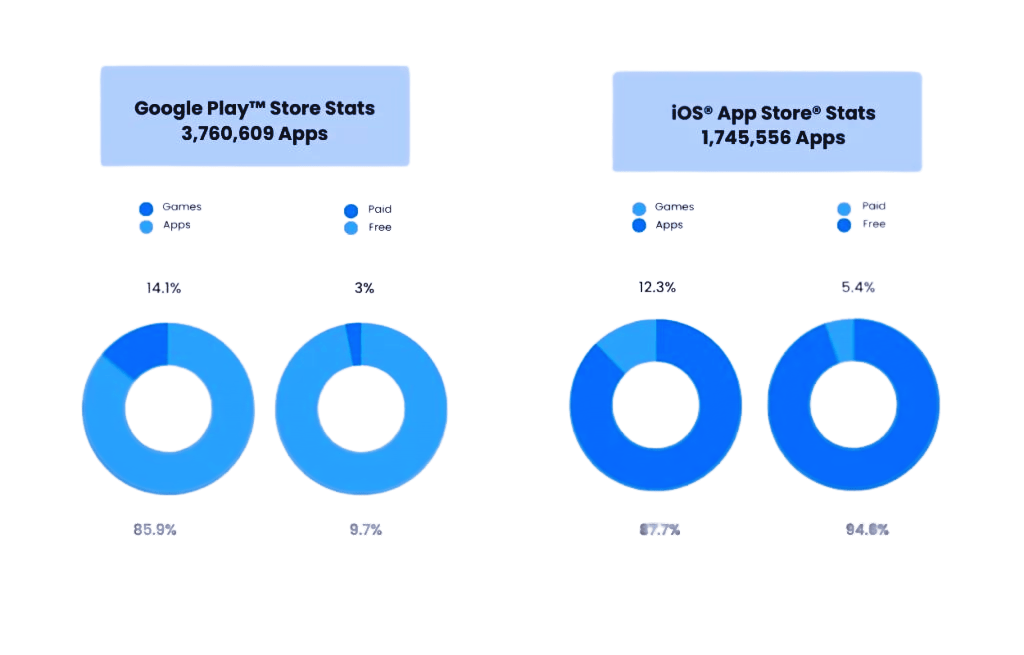
      • Google Play Store: Over 3.5 million apps available (Statista, 2023)
      • Apple App Store: Approximately 1.96 million apps available (Statista, 2023)
    • Downloads:
      • In 2022, consumers downloaded 255 billion mobile apps, with Android leading in the number of downloads (App Annie, 2023)
      • Google Play saw 111.3 billion app downloads in 2022, while the Apple App Store had 34 billion downloads (Sensor Tower, 2023)
    • Revenue:
      • Despite fewer downloads, the Apple App Store generated $85.1 billion in revenue in 2022, compared to Google Play’s $47.3 billion (Sensor Tower, 2023)
      • iOS users tend to spend more on apps, with the average revenue per download being significantly higher than on Android
    • User Engagement:
      • Mobile users spend an average of 4.8 hours per day on their mobile devices (App Annie, 2022)
      • iOS users typically spend 18% more time in apps than Android users (Adjust, 2023)
    download revenue

    These statistics highlight the massive scale of both platforms and the significant differences in user behaviour. For instance, while Android leads in total downloads, iOS generates more revenue, indicating different spending patterns among users.

    Understanding these nuances allows businesses to:

    1. Tailor app development priorities for each platform
    2. Optimize marketing strategies to reach the right users
    3. Design user experiences that align with platform-specific expectations
    4. Make informed decisions about resource allocation between platforms
    5. Predict and capitalize on emerging trends in mobile user behaviour

    By leveraging these insights, companies can maximize their impact in the mobile space, ensuring their products resonate with users on both platforms and drive better business outcomes.

    2. Demographic Profiles for Android vs iOS

    2.1 Age distribution

    Android and iOS users show distinct age distribution patterns:

    • Android users tend to have a more evenly distributed age range, with a slight skew towards younger users.
    • iOS users are often concentrated in the 18-34 age bracket, with a higher proportion of users in their late 20s and early 30s.

    2.2 Income levels

    Income levels play a significant role in platform choice:

    • Android devices cater to a wider range of income levels due to the variety of devices available at different price points.
    • iOS users generally have higher average income levels, reflecting the premium positioning of Apple products.

    2.3 Education backgrounds

    Education levels also show some differences between the two user groups:

    • Android users represent a broader spectrum of educational backgrounds.
    • iOS users tend to have a higher percentage of college graduates and post-graduates.

    2.4 Geographic distribution

    The geographic distribution of Android and iOS users varies globally:

    • Android dominates in developing markets and rural areas, benefiting from its wider range of affordable devices.
    • iOS has a stronger presence in urban areas and developed countries, particularly in North America and Western Europe.
    Android vs iOS - Geographic distribution

    Regional Dynamics of Mobile Operating Systems (2024 Update)

    Global Overview

    As we move through 2024, the mobile operating system landscape continues to evolve, with Android maintaining its global dominance while iOS strengthens its position in developed markets. This section explores the current state of mobile OS market share across various regions and countries.

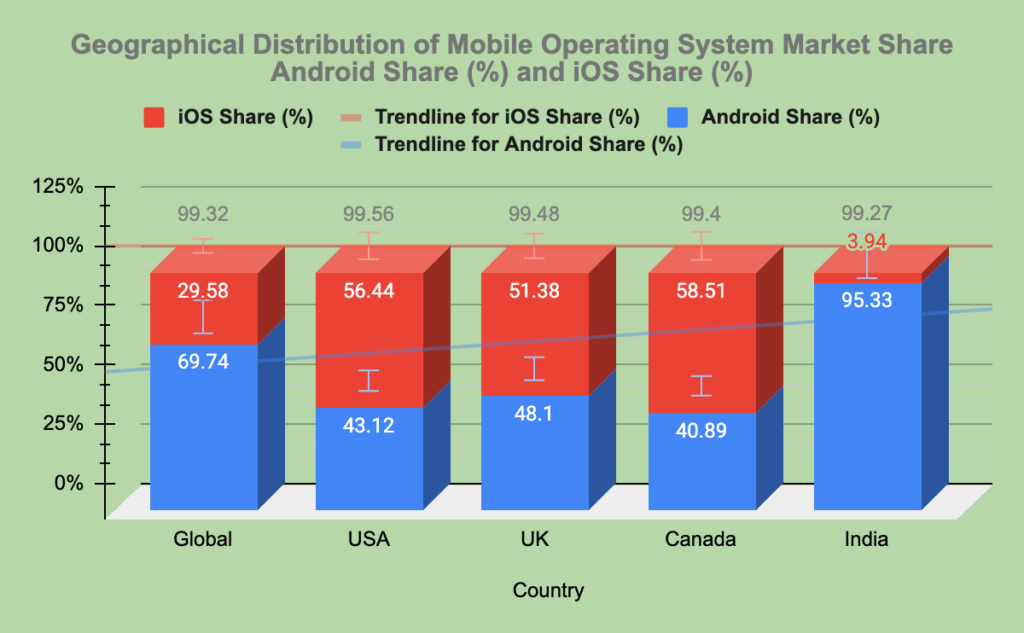
    Global Market Share (2024 Estimates)

    Operating SystemMarket Share (%)
    Android71.32
    iOS28.06
    Others0.62
    Source: StatCounter global stats (2024 projection)

    Regional Breakdown

    The distribution of mobile operating systems varies significantly across different regions, with economic factors, local preferences, and market maturity playing crucial roles.

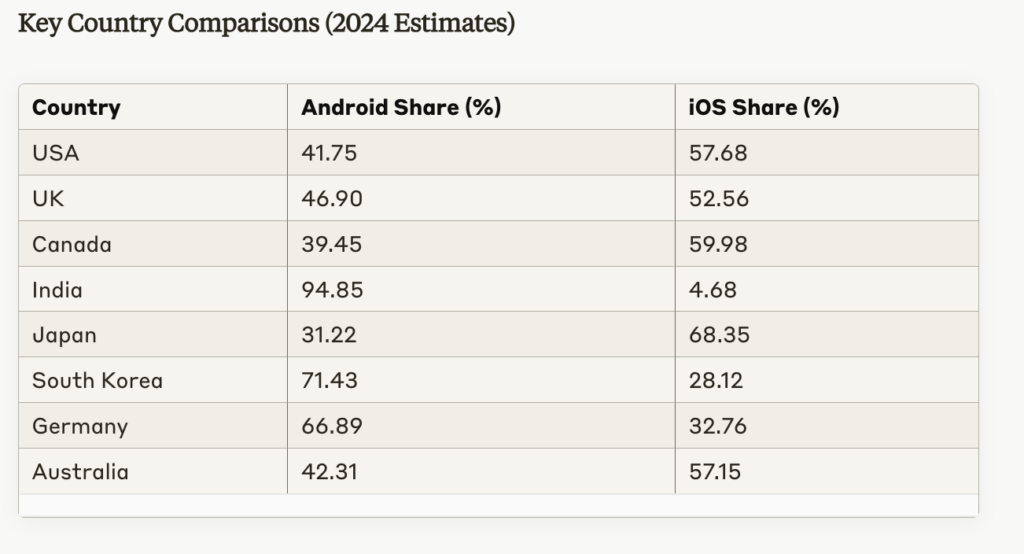
    Key Country Comparisons (2024 Estimates)

    Key Country Comparisons

    Source: StatCounter global stats (2024 projection)

    Android vs iOS Analysis of Trends

    1. Developed Markets: iOS continues to gain ground in high-income countries. The USA, UK, Canada, and Australia show a preference for iOS devices, likely due to higher disposable incomes and strong brand loyalty to Apple.
    2. Emerging Markets: Android remains dominant in developing countries like India, where its market share exceeds 90%. This is primarily due to the availability of a wide range of affordable Android devices.
    3. Asian Dynamics: Interesting contrasts are seen in Asia. While Japan shows a strong preference for iOS, South Korea (home to Samsung) leans heavily towards Android. This highlights the impact of local manufacturers and cultural preferences.
    4. European Variation: European countries show diverse preferences. The UK leans towards iOS, while Germany shows a stronger preference for Android, reflecting different market dynamics and consumer behaviours within Europe.
    5. Global vs. Local Trends: While Android leads globally, iOS outperforms in several key markets, especially in countries with higher GDP per capita.

    Factors Influencing Market Share

    1. Economic Considerations: The cost factor remains significant. Many users opt for Android devices due to their wider price range, despite a potential preference for Apple products.
    2. Ecosystem Lock-in: In markets where iOS has a strong foothold, the Apple ecosystem (including services like iMessage and FaceTime) plays a crucial role in retaining users.
    3. Device Diversity: Android’s wide range of devices from various manufacturers caters to diverse user needs and preferences, contributing to its global dominance.
    4. Local Manufacturing: Countries with strong local smartphone manufacturers (e.g., South Korea with Samsung) tend to have higher Android shares.
    5. 5G Adoption: The rollout of 5G networks is influencing consumer choices, with both Android and iOS devices competing to offer the best 5G experiences.

    3. Device Usage Patterns

    3.1 App download and usage frequency

    App engagement differs between the two platforms:

    • Android users tend to download more apps but have lower engagement rates per app.
    • iOS users download fewer apps but show higher engagement and retention rates.

    3.2 Time spent on devices

    Daily screen time varies between Android and iOS users:

    • Android users generally spend more time on their devices, partly due to the larger screen sizes of many Android phones.
    • iOS users, while spending less total time, tend to have more frequent, shorter sessions throughout the day.

    3.3 Preferred device features

    Users of each platform prioritize different features:

    • Android users often value customization options, expandable storage, and diverse hardware choices.
    • iOS users typically prioritize seamless ecosystem integration, privacy features, and consistent software updates.

    4. Purchasing Behavior in Android vs iOS

    4.1 In-app purchases

    In-app purchase patterns show significant differences:

    • iOS users are more likely to make in-app purchases and spend more per transaction.
    • Android users make fewer in-app purchases but represent a larger total market due to the platform’s larger user base.

    4.2 Mobile commerce trends

    E-commerce behaviors vary between the two groups:

    • iOS users tend to make more purchases via mobile devices and have higher average order values.
    • Android users engage more in mobile window shopping but are more likely to complete purchases on desktop devices.

    4.3 Brand loyalty and ecosystem investment

    The level of investment in each ecosystem impacts user behaviour:

    • iOS users often display higher brand loyalty and are more invested in the Apple ecosystem, making them less likely to switch platforms.
    • Android users show more variability in brand loyalty, often switching between different Android device manufacturers.

    5. App Preferences

    5.1 Types of apps used most frequently

    Android and iOS users show different preferences in app categories:

    • Android users tend to favor utility apps, customization tools, and alternative app stores.
    • iOS users generally prefer productivity apps, health and fitness trackers, and creative tools.

    Both groups show high engagement with social media and messaging apps, but platform-specific differences exist:

    • Android users are more likely to use WhatsApp and Facebook Messenger.
    • iOS users show higher engagement with iMessage and FaceTime.

    5.2 Gaming habits

    Gaming behaviours differ between the two platforms:

    • Android users tend to play more casual and free-to-play games.
    • iOS users are more likely to engage with premium games and spend more on in-game purchases.

    The types of games popular on each platform also vary:

    • Android sees more downloads of strategy and simulation games.
    • iOS users show a preference for puzzle and adventure games.

    5.3 Social Media Engagement

    While social media is popular on both platforms, usage patterns differ:

    • Android users spend more time on YouTube and Twitter.
    • iOS users show higher engagement rates on Instagram and Snapchat.

    Both groups use Facebook extensively, but iOS users tend to access it more frequently via mobile devices.

    6. Privacy and Security Attitudes

    6.1 Concerns about data protection

    Privacy concerns and behaviours vary between Android and iOS users:

    • iOS users generally express higher concerns about data privacy and are more likely to adjust privacy settings.
    • Android users show more variability in privacy concerns, often depending on the device manufacturer and Android version.

    6.2 Adoption of security features

    The use of security features differs between the platforms:

    • iOS users are more likely to use biometric authentication methods like Face ID or Touch ID.
    • Android users have a wider range of security options but show lower overall adoption rates of advanced security features.

    6.3 Willingness to share personal information

    Attitudes towards sharing personal data show some differences:

    • iOS users are generally more cautious about sharing personal information with apps and services.
    • Android users show more willingness to share data, especially if it enhances app functionality or personalization.

    7. Customization and Personalization in iOS vs Android

    7.1 UI/UX Preferences

    The approach to user interface and experience varies significantly:

    • Android users value the ability to customize their home screens, use widgets, and modify system-level settings.
    • iOS users appreciate the consistent and streamlined interface across devices, with a focus on ease of use.

    7.2 Use of widgets and launchers

    The use of customization tools shows a stark contrast:

    • Android users frequently use custom launchers, icon packs, and widgets to personalize their device experience.
    • iOS users have limited customization options but show high engagement with the widget feature introduced in recent iOS versions.

    7.3 Frequency of OS updates

    Update behaviours differ between the two ecosystems:

    • iOS users typically update their operating systems quickly when new versions are released, due to Apple’s centralized update system.
    • Android users experience more variability in update availability and frequency, often depending on the device manufacturer and model.

    8. Brand Perception and Loyalty

    8.1 Reasons for platform choice

    Users choose Android or iOS for different reasons:

    • Android users often cite affordability, device variety, and customization options as key factors.
    • iOS users frequently mention brand reputation, ecosystem integration, and perceived quality as primary reasons.

    8.2 Likelihood of switching platforms

    The propensity to switch between platforms varies:

    • Android users show a higher likelihood of considering a switch to iOS, especially as they move to higher income brackets.
    • iOS users demonstrate stronger brand loyalty and are less likely to switch to Android, often due to ecosystem lock-in.

    Factors influencing platform switching include:

    • For potential Android to iOS switchers: perceived premium status, security features, and seamless ecosystem.
    • For potential iOS to Android switchers: desire for more customization, wider device choices, and sometimes cost considerations.

    8.3 Brand Advocacy

    The level of brand advocacy differs between the two user groups:

    • iOS users tend to be more vocal advocates for their platform, often recommending Apple products to friends and family.
    • Android users show more varied levels of brand advocacy, often tied to specific device manufacturers rather than the Android platform as a whole.

    Social media engagement related to brand advocacy also differs:

    • iOS users are more likely to engage with and share Apple-related content on social media.
    • Android users’ advocacy is often more fragmented, focusing on specific device features or Android customizations.

    9. Technological Adaptability for Android vs iOS

    9.1 Early adoption of new features

    The rate at which users adopt new technological features varies between platforms:

    • iOS users tend to be quicker adopters of new features within the Apple ecosystem, partly due to the more streamlined update process.
    • Android users have a more varied adoption rate, with tech enthusiasts quickly embracing new features while others may lag behind due to device fragmentation.

    9.2 Attitude towards emerging technologies

    User attitudes towards emerging technologies show some differences:

    • Android users often show more interest in experimental features and cutting-edge hardware innovations.
    • iOS users typically express more interest in refined implementations of new technologies, prioritizing stability and integration.

    Examples of emerging technology adoption:

    • Android users are more likely to experiment with features like foldable screens, under-display cameras, and alternative mobile payment systems.
    • iOS users show higher adoption rates for features like augmented reality applications, mobile-based health monitoring, and integrated smart home technologies.

    10. Conclusion

    10.1 Summary of key behavioral differences

    The comparison between Android Vs iOS users reveals several key behavioral differences:

    1. Demographics: Android users span a broader range of age groups and income levels, while iOS users tend to be younger and have higher average incomes.
    2. App Usage: iOS users generally show higher engagement rates and are more willing to pay for apps and make in-app purchases. Android users download more apps but have lower per-app engagement.
    3. Privacy and Security: iOS users typically show more concern about privacy and are more likely to use advanced security features. Android users have more varied attitudes towards privacy and security.
    4. Customization: Android users value the ability to customize their devices extensively, while iOS users appreciate the consistent, streamlined interface across devices.
    5. Brand Loyalty: iOS users generally show stronger brand loyalty and are less likely to switch platforms compared to Android users.
    6. Technological Adoption: Both groups show interest in new technologies, with Android users more likely to experiment with cutting-edge features and iOS users preferring refined implementations.

    10.2 Implications for developers and marketers

    Understanding these behavioral differences has significant implications for developers and marketers:

    1. App Development:
      • Developers should prioritize different features and monetization strategies for each platform. For iOS, focus on polished UIs and in-app purchase models. For Android, consider freemium models and wider device compatibility.
    2. Marketing Strategies:
      • Tailor marketing messages to resonate with each user base. Emphasize customization and affordability for Android, and focus on ecosystem benefits and premium experiences for iOS.
    3. User Experience Design:
      • Design interfaces that align with platform-specific expectations. Offer more customization options for Android, and ensure a sleek, consistent experience for iOS.
    4. Privacy and Security:
      • Prioritize clear privacy policies and robust security features, especially for iOS apps. For Android, educate users about available security options.
    5. Update and Support:
      • Plan for more frequent updates and longer support cycles for iOS apps. For Android, consider a modular approach to support a wider range of devices and OS versions.
    6. Emerging Technologies:
      • When introducing new technologies, consider a more experimental approach for Android users and a more refined, integrated approach for iOS users.

    By recognizing and adapting to these behavioral differences, developers and marketers can create more targeted, effective strategies for each platform, ultimately leading to better user satisfaction and business outcomes in the mobile ecosystem.

  • Enhance Your Strategy: Top Social Media Optimization Tips

    Enhance Your Strategy: Top Social Media Optimization Tips

    Introduction

    Social media has become an integral part of digital marketing strategies for businesses of all sizes. With the rise of social media platforms and the increasing number of users, it is essential for businesses to optimize their social media presence to stand out from the competition. Social media optimization (SMO) is the key to enhancing your social media strategy and maximizing your online presence.

    SMO goes beyond simply posting content on social media platforms. It involves crafting and sharing content that reaches specific audiences and resonates with them. By optimizing your social media profiles, using relevant keywords and hashtags, and engaging consistently with your audience, you can boost your brand awareness, expand your reach, and enhance your brand perception online.

    In this blog, we will explore the top social media optimization tips that can help you enhance your strategy. From optimizing your profile across all platforms to leveraging high-quality visual content, we will cover 15 actionable tips that can take your social media strategy to the next level.

    Key Highlights

    • Social media optimization (SMO) is the use of social to grow and manage a brand’s message and presence online. It involves crafting and sharing content that reaches specific audiences and resonates with them. SMO aims to create content that sparks interaction, boosts brand presence, and enhances brand perception online.
    • social media optimization tips include expanding your digital presence, optimizing your social media content for better on investment, building stronger customer relationships, enhancing search engine rankings, and monitoring competitor and industry trends.
    • Top social media optimization tips include optimizing your profile across all platforms, leveraging high-quality, relevant visual content, utilizing strategic hashtags for broader reach, engaging consistently with your audience, analyzing and adapting posting times to audience behavior, encouraging user-generated content to foster community, implementing cross-promotion across social channels, regularly refreshing bio and profile links, using social listening tools for insights and trends, integrating social media with your SEO strategy, prioritizing video content to boost engagement, and collaborating with influencers to expand reach.

    Top 15 Social Media Optimization Tips to Enhance Your Strategy

    Social media optimization is crucial for businesses looking to maximize their online presence and engage with their target audience effectively. Here are 15 top social media optimization tool tips that can enhance your strategy:

    1. Optimize Your Profile Across All Platforms

    To make a strong first impression on social media, it is important to optimize your profile across all platforms. Start by choosing a professional profile picture and cover photo that align with your brand. Use your company logo as the profile picture to create brand consistency.

    In your bio or about section, write a clear and concise description of your business, using industry-relevant keywords for better searchability. Include your contact details, such as phone number, email, and website link, to make it easy for users to reach you. Finally, regularly update your profile information and keep it consistent across all social media platforms.

    2. Leverage High-Quality, Relevant Visual Content

    Visual content is a powerful tool for capturing the attention of social media users and boosting brand awareness. Use high-quality, relevant images and videos that align with your brand identity and resonate with your target audience.

    Invest in professional photography or create visually appealing graphics to make your social media posts stand out. Ensure that the images and videos you use are properly sourced and follow copyright laws. With visually appealing content, you can engage your audience and leave a lasting impression.

    3. Utilize Strategic Hashtags for Broader Reach

    Hashtags are an effective way to increase the reach of your social media posts and connect with your target audience. Use strategic hashtags that are relevant to your content and industry. Here are some tips for using hashtags effectively:

    • Research popular hashtags in your industry and incorporate them into your posts
    • Create unique hashtags for your brand to build brand identity and increase user engagement
    • Use hashtags for special events or campaigns to track engagement and amplify your promotions
    • Keep hashtags relevant to your content to avoid alienating your audience
    • Use a mix of popular and niche hashtags to reach a broader audience and target specific communities

    By using strategic hashtags, you can increase the visibility of your social media posts and attract more users to engage with your content.

    4. Engage Consistently with Your Audience

    Consistent engagement with your audience is key to building strong relationships and fostering brand loyalty. Respond to comments, messages, and mentions promptly to show that you value your audience’s input and are actively listening.

    Ask questions, encourage discussions, and respond to feedback to keep the conversation going. Show genuine interest in your audience’s thoughts and opinions. This will not only help you build a loyal community but also provide valuable insights into your audience’s preferences and needs.

    Additionally, actively engage with other accounts in your industry, influencers, and potential clients. By establishing connections and participating in relevant discussions, you can expand your reach and establish your presence in the online community.

    5. Analyze and Adapt Posting Times to Audience Behavior

    Posting at the right times is crucial to ensure maximum visibility and engagement for your social media posts. Analyze your audience’s behavior and track engagement to identify the optimal posting times for each platform.

    Different platforms have different peak times, so it’s important to test and gather data to determine when your audience is most active. Consider factors such as time zones if your audience is global. Experiment with posting times and analyze the results to refine your posting schedule for better engagement.

    By posting at the right times, you can ensure that your content reaches a larger audience and receives better engagement, resulting in improved visibility and brand awareness.

    6. Encourage User-Generated Content to Foster Community

    User-generated content (UGC) is a valuable asset for building a strong community and enhancing your social media strategy. Encourage your audience to create and share content related to your brand or products.

    Create campaigns or contests that incentivize users to generate and share content, whether it’s through photos, videos, reviews, or testimonials. Share and showcase the UGC on your social media platforms to foster a sense of community and encourage others to participate.

    By leveraging UGC, you can strengthen your brand’s authenticity, increase engagement, and build a loyal community of brand advocates.

    7. Implement Cross-Promotion Across Social Channels

    Cross-promotion across different social media channels is an effective way to reach a wider audience and maximize your brand’s visibility. Promote your content and campaigns across all your social media channels to ensure that your message reaches different segments of your target audience.

    For example, if you have a new blog post, share it on all your social media platforms, including Facebook, Twitter, LinkedIn, and Instagram. Use different formats and adapt your message to suit each platform’s style and audience.

    By implementing cross-promotion, you can increase the reach of your content, attract new followers, and drive more engagement across all your social media channels.

    8. Regularly Refresh Bio and Profile Links

    Regularly refreshing your bio and profile links is essential to maintain an up-to-date and compelling online presence. Take the time to review and update your bio or about section to reflect any changes in your business, services, or brand messaging.

    Ensure that your profile links are working and directing users to the appropriate pages on your website. Check for broken links and update them as necessary. By keeping your bio and profile links fresh, you can provide accurate information to your audience and improve your search engine rankings.

    9. Use Social Listening Tools for Insights and Trends

    Social listening tools are valuable resources for gathering insights and monitoring trends in your industry. These tools allow you to monitor mentions of your brand, competitors, and industry keywords on social media platforms.

    By using social listening tools, you can gain valuable insights into your audience’s preferences, needs, and opinions. You can identify emerging trends, monitor competitor activity, and stay up-to-date with industry news.

    Social Listening Tools for Insights and Trends

    Here is a comparison table of popular social listening tools:

    Tool NameFeatures
    Sprout SocialSocial media management, listening, and analytics. Provides in-depth reports and customizable dashboards.
    HootsuiteSocial media management and listening. Offers real-time monitoring, keyword tracking, and sentiment analysis.
    BrandwatchSocial media listening and analytics. Offers advanced data analysis, AI-powered insights, and competitor benchmarking.
    MentionSocial media monitoring and brand tracking. Provides real-time alerts, sentiment analysis, and social listening reports.
    TalkwalkerSocial media analytics and listening. Offers data visualization, influencer analysis, and sentiment analysis.

    By using social listening tools, you can gather valuable data, make informed decisions, and optimize your social media strategy for better results.

    10. Integrate Social Media with Your SEO Strategy

    Integrating your social media strategy with your SEO strategy can yield powerful results. By aligning your social media efforts with your SEO keyword research, you can optimize your content for better search engine rankings.

    When creating social media posts, incorporate relevant keywords and phrases that align with your SEO strategy. Use popular keywords in your industry and create unique hashtags for your brand. This will help increase the visibility of your social media posts in search results.

    Additionally, promote your website content on social media platforms to drive traffic and generate backlinks, a key factor in SEO rankings. By integrating social media with your SEO strategy, you can enhance your online presence and improve your search engine rankings.

    11. Prioritize Video Content to Boost Engagement

    Video content has become increasingly popular and is known to boost engagement on social media platforms. Prioritize the creation and sharing of video content to captivate your audience and increase their interaction with your brand.

    Create short, attention-grabbing videos that deliver your message effectively. Take advantage of live streams, tutorials, behind-the-scenes clips, and stories to engage your audience. Utilize platforms like TikTok and Instagram Reels to create short-form video content that resonates with your target audience.

    Video content has higher engagement rates and is more likely to be shared and commented on by social media users. By prioritizing video content, you can boost your engagement, increase brand awareness, and create memorable experiences for your audience.

    12. Collaborate with Influencers to Expand Reach

    Influencer marketing is a powerful strategy for expanding your reach and connecting with potential customers. Collaborate with influencers in your industry to leverage their audience and increase your brand’s visibility.

    Identify influencers who align with your brand values and have an engaged and relevant audience. Work with them to create sponsored posts, product reviews, or collaborative content that showcases your brand. By tapping into the influencer’s trust and credibility, you can reach a wider audience and drive more engagement.

    Influencer collaborations can also help you gain valuable user-generated content and foster a sense of community around your brand. By expanding your reach through influencer marketing, you can attract new customers, increase brand awareness, and enhance your social media strategy.

    13. Leverage Analytics for Content Optimization

    Track engagement metrics and trends using analytics tools to enhance content performance. Analyze data on post reach, engagement rates, and audience demographics. Identify top-performing content and optimize future posts accordingly. By leveraging analytics, refine your content strategy for better results. Monitor key performance indicators regularly to align with your social media objectives. Utilize insights to tailor content to your target audience’s preferences and behaviors. Make data-driven decisions to optimize your social media presence effectively. Allocating time for analytics can significantly improve your content effectiveness.

    14. Stay Updated with Platform Algorithms

    By staying updated with platform algorithms, you can adapt your social media strategy effectively. Changes in algorithms impact the visibility of your content and engagement levels. Tools like Sprout Social help monitor these shifts, ensuring your digital marketing efforts align with current trends. Regularly updating your approach based on algorithm updates enhances the performance of your social media profiles across various platforms. Stay ahead of the curve by understanding the algorithm changes and optimizing your content strategy accordingly.

    15. Practice Responsive Social Media Customer Service

    Responding promptly and effectively to customer queries and feedback is crucial in social media optimization. By practicing responsive social media customer service, you not only showcase professionalism but also build trust among your audience. Addressing issues swiftly and courteously can turn a dissatisfied customer into a loyal advocate. Utilize tools like chatbots or dedicated customer service agents to ensure timely responses. Remember, social media is a two-way communication channel, so prioritize active engagement to enhance your brand reputation.

    Conclusion

    To excel in social media optimization, leverage these top 15 tips for a robust strategy. From engaging visuals to user-generated content and influencer collaborations, optimize your profiles across platforms for maximum impact. Embrace the power of analytics, adaptive posting times, and video content to boost engagement and stay ahead with current platform algorithms. Foster a responsive community by encouraging user interaction and practicing stellar customer service. For further guidance on enhancing your social media strategy, get in touch to elevate your online presence and drive tangible results.

    Frequently Asked Questions

    How Do I Optimize My Social Media Profiles for Better Visibility?

    To optimize your social media profiles for better visibility, you can:
    Fully fill out all the fields in your profiles, including profile and cover photos, bio and about section, contact details, location, and story section.
    Use relevant and branded images that align with your brand and convey professionalism.
    Add accurate business information, including clear descriptions, current contact information, location, and a direct link to your website.
    Post at the right times to ensure maximum visibility and engagement.
    Post the right types of content, including text, images, videos, and infographics, to cater to diverse preferences and keep your audience engaged.
    Use relevant hashtags to increase the reach of your posts and connect with your target audience.
    Promptly respond to DMs and engage with comments on your social media pages to show your commitment to customer service and audience engagement.
    Engage with other accounts by following industry peers, leaving thoughtful comments, sharing relevant content, and looking for collaboration opportunities.
    By following these steps, you can optimize your social media profiles for better visibility, enhance your online presence, and reach a wider audience on search engines.

    What Are the Benefits of Social Media Optimization?

    Social media optimization offers several benefits for businesses:

    • Expands your digital presence: By optimizing your social media presence, you can make your brand more visible and recognizable across various social platforms.
    • Optimizes your social media content: SMO can turn social media into a highly cost-effective channel with a high return on investment.
    • Builds stronger customer relationships: Regular, relevant interactions on social media give you more chances to connect with customers and build brand loyalty.
    • Enhances search engine rankings: Active social media engagement can help you get more backlinks and improve your search engine rankings.
    • Helps you monitor competitor and industry trends: Social listening, a part of SMO, allows you to see what your customers and competitors are talking about online.

    In summary, social media optimization has several benefits, including expanding your digital presence, optimizing your content, building stronger customer relationships, enhancing search engine rankings, and staying informed about industry trends.

    How Can Hashtags Improve My Social Media Reach?

    Hashtags can improve your social media reach in several ways:

    • Broader reach: Using relevant hashtags increases the visibility of your posts and helps you reach a wider audience beyond your followers.
    • Higher search results visibility: Hashtags make your content more discoverable in search results when users search for specific topics or keywords.
    • Targeting specific audiences: Hashtags allow you to connect with users who are interested in specific topics or industries, helping you reach your target audience effectively.
    • Increasing engagement: Hashtags encourage users to engage with your content by liking, commenting, or sharing, which can increase your social media reach further.

    By using strategic and relevant hashtags, you can improve your social media reach, attract more followers, and increase engagement on your posts.

    What Is the Best Way to Engage with My Social Media Audience?

    The best way to engage with your social media audience is by:

    • Responding to comments and messages promptly, showing that you value their feedback and are actively listening.
    • Asking questions, starting conversations, and encouraging your audience to share their thoughts or opinions on your content.
    • Encouraging user-generated content, such as by running contests or featuring customer testimonials, which helps build a sense of community.
    • Sharing behind-the-scenes content, giving your audience a glimpse into your brand’s personality and creating a more personal connection.
    • Being authentic and genuine in your interactions, showing that there are real people behind your brand and fostering trust with your audience.

    By engaging with your social media audience in these ways, you can build stronger relationships, foster brand loyalty, and create a thriving community of followers.

    Can Social Media Optimization Improve My Website’s SEO?

    Yes, social media optimization can improve your website’s SEO. When you optimize your social media profiles and engage with your audience effectively, it can drive more traffic to your website and increase your online visibility.
    Additionally, social media signals, such as likes, shares, and comments, can indirectly impact your search engine rankings. When your content receives high levels of engagement on social media, it can generate more backlinks and increase your chances of appearing in search results.
    Furthermore, social media platforms can provide valuable inbound links to your website, which is a key factor in search engine optimization. By including links to your website in your social media profiles and posts, you can drive more traffic and improve your website’s SEO.
    In summary, social media optimization can have a positive impact on your website’s SEO by driving more traffic, generating backlinks, and increasing your online visibility in search results.

    How Often Should I Post on Social Media?

    The frequency of your social media posts depends on several factors, including your audience behaviour and your content strategy. It’s essential to find the right balance that keeps your audience engaged without overwhelming them.
    Consider your audience’s preferences and behaviour. Are they active on social media throughout the day, or are there specific peak times when they are most likely to be online? Use analytics and insights to determine the ideal posting times for your target audience.
    Additionally, focus on the quality of your content rather than the quantity. It’s better to create valuable and engaging posts that resonate with your audience than to post frequently without delivering substance. Find a posting frequency that allows you to consistently provide high-quality content and maintain an active online presence.

    Can Social Media Optimization Improve My Website’s SEO?

    What Type of Content Is Most Effective on Social Media?

    The most effective content on social media is:

    • High-quality and engaging: Content that captures the attention of your audience and delivers value to them.
    • Visual content: Images, videos, infographics, and other visually appealing content tend to perform well on social media and attract more engagement.
    • Educational or informative content: Providing valuable information, tips, or insights that your audience finds useful can help establish your brand as an authority in your industry.
    • User-generated content: Encouraging your audience to create and share content related to your brand can boost engagement and create a sense of community.
    • Stories: Short, ephemeral content like Instagram Stories or Facebook Stories can be a great way to share behind-the-scenes moments, promotions, or exclusive content.

    By focusing on creating high-quality, visually appealing, and valuable content, you can increase engagement, attract more followers, and enhance your social media presence.

    How Important Is Video Content in Social Media Strategy?

    Video content is highly important in a social media strategy. It has been proven to boost engagement and attract more attention from users. Short videos, in particular, have gained popularity on platforms like TikTok and Instagram Reels.

    Video content allows you to convey your message effectively and capture your audience’s attention in a visually engaging way. It also provides an opportunity for storytelling and showcasing your brand’s personality.

    Influencer marketing often involves the use of video content, as influencers leverage their storytelling and video creation skills to promote products or services. By incorporating video content into your social media strategy, you can enhance engagement, increase reach, and build stronger connections with your audience.

    How Can I Measure the Success of My Social Media Optimization Efforts?

    Measuring the success of your social media optimization efforts is essential to understand the impact of your strategies and make informed decisions for better results. Here’s how you can measure the success of your social media optimization:

    • Use analytics tools provided by social media platforms to track key metrics such as reach, engagement, and follower growth.
    • Set specific goals and track your progress towards achieving them. For example, increasing website traffic, generating leads, or improving brand awareness.
    • Monitor the performance of your social media campaigns and evaluate the ROI (return on investment) to determine their effectiveness.
    • Conduct surveys or gather feedback from your audience to understand their perception of your brand and the impact of your social media efforts.
    • Compare your social media metrics to industry benchmarks or competitor performance to gain insights into your relative performance.

    By consistently monitoring and measuring the success of your social media optimization efforts, you can identify areas for improvement, refine your strategies, and achieve better results.

    What Are the Latest Trends in Social Media Optimization?

    The latest trends in social media optimization include:

    • Influencer marketing: Collaborating with influencers to promote products or services and reach a wider audience.
    • Video content: Leveraging short videos, live streaming, and behind-the-scenes content to engage and captivate your audience.
    • Strategic hashtags: Using relevant and targeted hashtags to increase the visibility of your content and connect with your target audience.

    Staying updated with the latest trends in social media optimization can help you stay ahead of the competition and effectively reach your audience.

  • Revolutionizing Home Healthcare: Wearable Tech & Remote Monitoring

    Revolutionizing Home Healthcare: Wearable Tech & Remote Monitoring

    The world is facing a severe change in the healthcare industry. Modern medicine has built its foundation around strong technology, which is mainly thought of as an additional function. This information will provide a great depth of information on significant developments in medical technology. This is the procedure of combining wristbands for distant patient tracking and a service of medicine.

    We are in the revolution phase of time where wristwatches function more than just telling the time. It counts the number of steps you walk and controls your heart rate and also your oxygen level. These products offer real data related to your health and also help to improve your quality of life.

    These remote home monitoring devices have increasing demand in today’s world. They offered a list of facilities for both health and safety. Here you can read below:

    • These remote devices help in monitoring your property remotely with cameras and sensors. These devices offer potential break-ins and allow you to check your things in visually.
    •  Now you can easily keep an eye on elderly parents or the ones who are living alone. These smart devices can detect problems, unusual activity or any other changes and allow you to take action within time.
    • You can receive alerts for unexpected situations like smoke alarms to enable you to access the problem and reduce any kind of damage.
    • You can easily control your home appliances with these components.

    Evolution of Wearable Technology

    From Fitness Trackers

    These wearable technologies are not only attractive electronic components but a combination of a lot of components that can gather, observe, and analyze facts. But these wearables have a short battery life. Some advanced wearable watches can last for a day. Sometimes, it becomes difficult to recharge these gadgets. Because of these reasons, some gadget creators are trying for wireless charging tools. Sometimes, these wearable tools cannot give the right data. This can be dangerous for heart patients. These fake readings can cause more issues.

    Without a series of innovations, smartwatches, and fitness trackers would not be possible today. The computer revolution brought miniaturized transistors, which packed power into tiny packaging. Flexible sensors that are pleasant to the skin were made possible by developments in materials science. Wearables are able to communicate with our phones thanks to low-power wireless technologies like Bluetooth. These developments opened the door for the incredible wearables that monitor our health, direct our exercise, and even pay for our coffee.

    Integration with the Internet of Things

    These wearable tools can easily combine with wireless devices. The most common example is Bluetooth low energy, which is perfect for providing facts related to heart rate without draining out batteries. You can also use wi-fi to get faster information on your phone. These gadgets send information through phone through cloud or any app for storage and analysis.

    There are a lot of internet components that we see in our daily life starting from fitness trackers that monitors your home health care software solutions and also connects with your phone. Some of them include programable thermostats for automatic heating and cooling purposes, smart refrigerators, and many more.

    Key Components of Wearable Tech for Home Monitoring

    Sensors and actuators

    Sensors in wearables, like heart rate monitors, track our health, while actuators might buzz a reminder to take medication. After that, a home safety system receives the data with the help of satellite. This allows remote care, keeping an eye on loved ones from a far. Imagine a watch detecting a fall and sending an alert, providing crucial help for those living independently.

    The way we control our devices is being changed by devices and technology. These devices control our location, and these distant sensors observe spills or any other strange activity. This allows for peace of mind and even lets us control lights, thermostats, and locks from afar, all creating a safer and more convenient living experience.

    Connectivity Solutions

    Transforming homes into health hubs! Wearable app testing services connect to remote monitoring systems, keeping tabs on vital signs without needing constant hospital visits. This internet solution transmits data securely. It also allows healthcare providers to analyze it and intervene promptly if needed. Just think of staying active while your health is monitored remotely to know a future of personalized care made possible by connectivity.

    Smooth data transfer is essential for remote home monitoring. Dependable connections guarantee that wearable health data reaches medical professionals promptly for examination. In a similar vein, continuous connection makes it possible to remotely monitor your house, giving you access and control.

    Data Analysis and AI

    AI techniques help to collect data from wearable devices like smartwatches. AI can detect irregular heart rhythms or significant changes in sleep patterns that might give information for further inquiries. This allows home health care solution providers to remotely monitor patients, especially those at risk of chronic conditions, and intervene early if necessary.

    Imagine a scenario where wearable tech like smartwatches or fitness trackers continuously monitor heart rate, blood pressure, and sleep patterns. After this, a previous forecast receives these facts. The system analyses the data, identifying trends and potential risks for health issues. For instance, an unusual spike in heart rate or a sustained drop in sleep quality could trigger an alert for a healthcare professional. Fast action is made possible by swift observation which may help to avoid health issues.

    Benefits of Wearable Tech in Remote Monitoring

    Enhanced Patient Care

    Continuous control over health is the way to go forward. Imagine wearable app testing that monitors you 24/7, sending real data to doctors. This remote home monitoring allows healthcare providers to see trends, catch early warnings of issues, and take faster precautions. This enhances the well-being of patients, fewer visits to medical, and the freedom to take care of their health at home.

    Transforming the healthcare system in this tech world. Wearable tech lets patients monitor vitals and health data remotely. This continuous stream of information empowers early detection of potential issues, allowing doctors to intervene before symptoms worsen. Imagine catching a heart condition before a major event or monitoring chronic illnesses from the comfort of your home. This is the future of active patient care, with wearables keeping people healthier and reducing hospital visits.

    Independence for the Elderly and People with disabilities

    Wearable products help you live in a safe place without sacrificing your independence and make it a reality for elderly people and individuals with disabilities. Wearable tech offers discreet help. Devices like bracelets or watches can automatically detect falls, a major concern for seniors. They can also include an emergency button for manual alerts, providing peace of mind for users and their loved ones. Remote home monitoring takes safety a step further. Sensors can track activity patterns and detect unusual events, like a lack of movement for an extended period. This can indicate a fall, illness, or simply a change in routine.

    Wearable technology and remote home monitoring systems are creating a powerful combination for daily living assistance. Smart fall detectors can trigger emergency contacts if a fall is detected. Meanwhile, smart home sensors monitor daily activities. Is the refrigerator empty? Has there been no movement for an extended period? These subtle clues can signal potential issues and allow for timely intervention. It empowers users to maintain their independence and routines while ensuring they have a safety net in place.

    Peace of Mind for Caregivers and Family Members

    Ever worry about an aging parent living alone? These devices are changing the virtual home controlling system and offer comfort to the members. Imagine a smartwatch that tracks vital signs like heart rate and blood pressure sending real-time updates to your phone.

    Wearable technology combined with remote home monitoring is making this a reality. These tools control the activity, blood rates, and other issues. It also helps in providing caregivers and family members with valuable information. This translates to fewer unnecessary hospital visits. Early detection of potential health issues allows for the prevention of complications and the keeping of loved ones out of the hospital. The ongoing concern for the welfare of a loved one can be distressing for providers of care. Wearable tech offers peace of mind by providing real-time data and alerts. This allows for focused attention when truly needed, reducing stress and anxiety.

    Home Healthcare

    Challenges and Considerations

    Privacy and Security Concerns

    You can choose wearables with data-hiding facilities and other features to prevent access to any other person. You should maintain secure connections while transferring facts. Also try to keep your software updated to avoid certain issues.

    Keeping facts protected is crucial for wearable tech in remote home monitoring. Data protection regulations come into play to ensure this. These regulations dictate how user information, often health-related and sensitive, is collected, stored, and transmitted. By adhering to these regulations, developers can build trust and ensure user privacy while offering the benefits of remote home healthcare.

    Accessibility and Usability

    Making wearable tech for remote home monitoring accessible and usable for all ages is key. Design considerations include intuitive interfaces with large fonts, voice control, and contrasting colors for better visibility. The wearable itself should be comfortable and adjustable for various physiques.

    Features like speaking choices, simple instructions, and easy displays can help achieve this. By overcoming these technical barriers, these valuable tools can be embraced by a wider population, fostering independence and safety.

    Conclusion

    These wearable components are revolutionizing home monitoring. These devices, worn comfortably, track health vitals and activity levels, allowing remote care for seniors or those with chronic conditions. This empowers individuals while enabling caregivers to intervene promptly if needed.

    As we integrate wearable tech and remote home monitoring, technology can empower us. We should adopt these tech tools, which make it easy to take care of our health and the safety of our dear ones.

  • AppStory Interviewed Ankit Agarwal CEO Of Dean Infotech Pvt Ltd

    AppStory Interviewed Ankit Agarwal CEO Of Dean Infotech Pvt Ltd

    Question about CEO Interviews:

    Give us a brief introduction about your company. 

    Dean Infotech is a company that provides customized digital transformation services to businesses in different industries. Dean Infotech specializes in Salesforce CRM cloud solutions, web and app development, enterprise software development services, and artificial intelligence and machine learning. Since 2008, Dean Infotech has served over 250 clients and worked on 500 projects with a team of over 150 technical professionals. 

    • Respondent: Ankit Agarwal
    • Designation: CEO
    • Email Id: sales@deaninfotech.com
    • Company: Dean Infotech Pvt Ltd
    • Website: https://www.deaninfotech.com/ 

    LinkedIn CEO: https://www.linkedin.com/in/deanankitagarwal/

    What are the services you offer to your clients?

    Dean Infotech provided the following services 

    • Salesforce Consulting & Configuration
    • Assistance on Sales, Service, and Health & Marketing clouds
    • Data Migration from 3rd Party to Salesforce
    • RESTful API integration
    • On-going Administrator & Development support
    • Salesforce Appexchange Development
    • App Designing (UI/UX)
    • Web Designing (UI/UX)
    • Mobile App Development (IOS/Android)
    • Web Development
    • Software Development
    • E-commerce Development
    • Logo Designing
    • Website/eCommerce Portal Development

    In this intensely competitive era, what technologies, services, and project models can give you an edge over your competitors? 

    In today’s competitive era, leveraging cutting-edge technologies such as Artificial Intelligence (AI), Machine Learning (ML), and the Internet of Things (IoT) can provide a significant edge. These technologies enable businesses to streamline processes, enhance productivity, and deliver personalized experiences to customers. 

    Additionally, offering innovative services such as cloud computing, cybersecurity solutions, and data analytics can differentiate a company from its competitors by addressing and getting an edge on evolving market demands and ensuring robust infrastructure. Ultimately, the combination of advanced technologies and innovative services empowers businesses to stay ahead of the curve, meet customer expectations, and thrive in today’s dynamic business environment.

    How has being an entrepreneur affected your family & Social life? 

    Being an entrepreneur demands significant time and energy, impacting family and social life. Balancing work commitments with personal relationships can be challenging sometimes. Social life may also take a back seat as being an entrepreneur prioritizes business responsibilities. However, with effective time management and support from loved ones, entrepreneurs can strive for a harmonious balance between work and personal life, ensuring fulfilment in both spheres.

    After-service is a necessary part of development. How do you provide customer support to your client? 

    Customer support is an essential part of our approach at Dean Infotech. We ensure seamless after-service by offering multiple channels for clients to reach us. Our team of experts is readily available to address any queries or issues promptly, ensuring minimal disruption to their operations. 

    Additionally, we provide ongoing training and resources to empower clients to maximize the value of our services. 

    Regular follow-ups and feedback mechanisms enable us to continuously improve our services and exceed customer expectations. Ultimately, our commitment to exceptional customer support fosters long-term partnerships built on trust and satisfaction.

    Give your opinions on how far this app revolution can make a difference in the technology world.

    The app revolution has already made a great impact on the technology world, and its potential for further transformation is immense. Apps have become integral to daily life, revolutionizing how we communicate, shop, work, and entertain ourselves. As technology advances, the app landscape will continue to evolve, offering innovative solutions to address diverse needs and challenges.

    The proliferation of mobile devices and the Internet of Things (IoT) presents vast opportunities for app development across various industries, including healthcare, education, finance, and transportation. With the advent of emerging technologies such as artificial intelligence (AI), augmented reality (AR), and blockchain, apps have the potential to revolutionize entire sectors, enhancing efficiency, accessibility, and user experiences.

    What latest technologies and tools are you planning to implement for mobile app development? 

    At Dean Infotech, we’re continuously exploring and adopting the latest technologies and tools to enhance our mobile app development capabilities. 

    Some of the key technologies and tools we’re planning to implement are Flutter, SwiftUI, Kotlin Multiplatform, ARKit and ARCore and Blockchain

    We believe that By leveraging these latest technologies and tools, we aim to deliver innovative, high-quality mobile apps that meet the evolving needs of our clients and provide exceptional user experiences.

    What are the challenges you see in the outsourcing industry?

    In the outsourcing industry, challenges may include communication barriers due to geographical and cultural differences, ensuring data security and confidentiality, maintaining quality standards across distributed teams, and managing project timelines and dependencies effectively. 

    Mention the ways you use to introduce new updates to your team.

    Introducing new updates to our team at Dean Infotech involves various methods strategic communication and seamless integration. 

    We conduct regular team meetings to disseminate information about updates, new features, and changes in processes. These meetings provide an opportunity for open discussion, clarification of doubts, and alignment of team goals.

    We organize training sessions to familiarize team members with new technologies, tools, or methodologies. With comprehensive documentation, tutorials, and resources to support our team in understanding and implementing new updates effectively. 

    What’s your step to enter into the wearable tech & IOT revolution? 

    Entering the wearable tech and IoT revolution involves strategic planning and implementation. For this We conduct thorough research to understand market trends, consumer preferences, and emerging technologies in the wearable tech and IoT sectors. We invest in training and upskilling our team to specialize in wearable technology and IoT development. 

    We collaborate with industry experts, technology partners, and device manufacturers to leverage their insights, resources, and networks. These partnerships enable us to access cutting-edge hardware, stay abreast of industry developments, and co-create solutions that meet the evolving needs of our clients.

    By following these steps, we position ourselves to successfully enter and thrive in the wearable tech and IoT revolution, delivering innovative solutions that drive value for our clients and end-users.

    What are your hobbies? What do you do in your non-work time? 

    In my non-work time, I indulge in reading, which is not only a hobby but also a means of continuous learning and personal growth for me.

     Some of the books I enjoy include 

    “The Lean Startup” by Eric Ries, offers insights into building successful, innovative businesses; 

    “Deep Work” by Cal Newport, explores strategies for focused work in a distracted world; 

    And “Atomic Habits” by James Clear, provides practical guidance on building and sustaining productive habits

    Anything, you would like to say to our readers, upcoming entrepreneurs or Startup Companies? 

    To upcoming entrepreneurs and startup companies, I would like to emphasize the importance of passion, and continuous learning. Embrace challenges as opportunities for growth, stay committed to your vision, and never underestimate the power of resilience. Surround yourself with a supportive network, seek mentorship, and be open to feedback. 

    Remember that success rarely comes overnight; it requires dedication, hard work, and a willingness to adapt. 

  • Jeetbuzz: The Ultimate Betting Experience in Bangladesh

    Jeetbuzz: The Ultimate Betting Experience in Bangladesh

    Jeetbuzz has emerged as a game-changer in Bangladesh’s online betting landscape. As a platform, it is dedicated to providing an unparalleled betting experience to its users, drawing their engagement with a seamless online interface, a vast range of betting options, and secure transactions. Jeetbuzz is not just any betting platform; it is an embodiment of the evolution of betting in Bangladesh, catering not only to seasoned bettors but also welcoming novices with open arms. With an emphasis on user-centric design and transparent operations, Jeetbuzz is truly redefining the norms of online betting in Bangladesh.

    Website Layout and Design: Simplified Navigation with Jeetbuzz Login

    At the heart of Jeetbuzz’s user experience is its simple yet effective website layout and design. The Jeetbuzz login is straightforward and intuitive, ensuring that users can quickly access their accounts without any hassle. As soon as you enter the website jeetbuzz-bd.com, you are greeted with a clean and organized interface that reflects the platform’s commitment to user-friendliness.

    Maximizing Your Betting Experience In Jeetbuzz: Bonuses And Promotions |  Cricket Zone India

    The Jeetbuzz login button is prominently displayed, inviting users to explore the plethora of betting options at their fingertips. The overall design caters to both seasoned bettors who are looking for specific games, and newcomers who are just starting their betting journey. This, combined with the site’s responsive design and fast load times, makes Jeetbuzz not just a platform for online betting, but also a benchmark in website design in the betting industry.

    Game Selection: Try Your Luck with Jeetbuzz Lucky Spin

    Jeetbuzz boasts an extensive selection of games to cater to the diverse preferences of its users. One of the standout features is the Jeetbuzz Lucky Spin. This feature offers an exciting twist to the regular betting scene, providing users with the opportunity to test their luck and win big. The thrill of spinning the wheel and the anticipation of the outcome is an adrenaline rush that many bettors crave. It’s not just about luck – the Jeetbuzz Lucky Spin also requires a strategic approach to maximize your chances of winning. Whether you’re a seasoned bettor or a newcomer, the Jeetbuzz Lucky Spin is a captivating feature that promises endless entertainment and potentially massive rewards. This feature further reinforces Jeetbuzz’s commitment to providing a comprehensive and engaging betting experience.

    Sports and Events Coverage: Online Cricket Betting in Bangladesh Jeetbuzz

    When it comes to sports and events coverage, Jeetbuzz offers an impressive array. Among the various sports, online cricket betting in Bangladesh is the highlight of Jeetbuzz. With a strong focus on this national sport, Jeetbuzz provides comprehensive coverage of both local and international cricket matches.

    From the Bangladesh Premier League to the Cricket World Cup, bettors have the chance to participate in and enjoy the thrill of online cricket betting. The Jeetbuzz platform allows users to study team profiles, analyze past performance, and place their bets based on calculated predictions. The entire process is designed to be seamless, providing a thrilling betting experience that resonates with the pulse of the passionate cricket-loving nation.

    The phenomenon of online cricket betting in Bangladesh Jeetbuzz is much more than just a game; it’s a unique combination of fandom, passion, and excitement which makes the betting experience truly immersive. The platform’s dedication to providing quality sports betting, particularly for cricket, further strengthens Jeetbuzz’s position as a leading online betting platform in Bangladesh.

    Betting Options Available: Diverse Range of Choices at Jeetbuzz

    Jeetbuzz outdoes itself when it comes to the range of betting options available. Besides the popular online cricket betting, the platform boasts various sports and events for bettors to indulge in. From football to hockey, tennis to boxing, Jeetbuzz covers all major sports, ensuring there’s something for every sports enthusiast.

    Beyond sports, Jeetbuzz Casino also offers betting options in the realm of e-sports, a rapidly growing sector in the betting industry. This includes popular games like Dota 2, Counter-Strike, and League of Legends. For those who prefer casino-style games, Jeetbuzz hasn’t left you out either. The platform offers a variety of casino games such as poker, blackjack, and roulette, as well as a live casino feature that provides an immersive, real-time gaming experience.

    Jeetbuzz also incorporates innovative betting options like virtual sports and fantasy leagues, attracting a new generation of bettors who appreciate the blend of technology and betting. The breadth and depth of betting options that Jeetbuzz offers truly cater to the diverse tastes and preferences of its users, making it a one-stop solution for all betting needs.

    Odds and Betting Margins: Competitive and Fair with Jeetbuzz

    When it comes to odds and betting margins, Jeetbuzz is second to none. The platform prides itself on offering competitive and fair odds to all its users. The odds are calculated by a team of experts who analyze a plethora of factors, including team performance, player form, and historical data. This ensures that the odds provided are not only competitive but also reflect an accurate and realistic assessment of the outcome probabilities.

    Furthermore, the betting margins at Jeetbuzz VIP are designed with the user in mind. They are kept reasonably low to ensure that users can maximize their potential winnings. This is a testament to Jeetbuzz’s commitment to providing a fair and transparent betting experience to its users. Whether you are placing a bet on cricket, casino games, or trying your luck on the Jeetbuzz Lucky Spin, you can rest assured that the odds and betting margins are optimized to enhance your betting experience.

    Live Betting and Streaming Features: Real-Time Thrill with Jeetbuzz

    Jeetbuzz enhances the online betting experience by providing live betting and streaming features. Live betting allows users to place bets in real-time as the action unfolds, making for an even more exciting and engaging experience. It also allows bettors to leverage changing odds during a game or event, using their understanding of the evolving dynamics to make strategic bets.

    In addition, the streaming feature offered by Jeetbuzz Live brings the action directly to the bettors. Users can watch their favorite sports and events live, enjoying the thrill of the game while observing the performance of the teams or players on which they’ve wagered. This not only heightens the excitement of betting but also adds a layer of convenience, as users can watch and bet from the same platform.

    Mobile Application Review: Bet on the Go with Jeetbuzz

    Jeetbuzz’s mobile application is the epitome of convenience and user-friendliness, proving to be a formidable tool for bettors on the go. The app mirrors the platform’s dedication to providing an unmatched betting experience, with a simple, intuitive interface that makes navigation a breeze.

    The mobile application offers all the features available on the website, including online cricket betting, live betting, and streaming. It allows users to place bets, make deposits and withdrawals, and track their betting history, all from the comfort of their mobile device. The application supports real-time notifications, ensuring users are always abreast of the latest developments and betting opportunities.

    The app’s design is visually compelling, with a clean and organized layout that enhances usability. It’s equipped with smooth performance and quick load times, even on slower internet connections. The Jeetbuzz Bet mobile app is available for both iOS and Android devices, ensuring accessibility for a wide range of users.

    Payment Methods: Catering to a Variety of Preferences with Jeetbuzz

    Jeetbuzz understands the importance of providing secure, efficient, and user-friendly payment methods for bettors. The platform accommodates various payment options, ensuring a seamless and hassle-free transaction experience. Here is a list of the payment methods supported by Jeetbuzz online:

    • Credit/Debit Cards: Users can make deposits and withdrawals using their Visa or MasterCard. This method is widely accepted and provides a quick and easy way for users to fund their accounts.
    • Bank Transfers: For users who prefer direct transactions, Jeetbuzz offers the option of bank transfers. This method may take a bit more time, but it provides a high level of security and allows for larger transaction amounts.
    • E-Wallets: Digital wallets like Skrill, Neteller, and PayPal are also acceptable on Jeetbuzz. These e-wallets offer fast and secure transactions, making it easy for users to manage their betting funds.
    • Cryptocurrency: In addition to traditional payment methods, Jeetbuzz also supports cryptocurrency transactions. Bettors can use Bitcoin, Ethereum, and other popular digital currencies to deposit and withdraw funds.
    • Mobile Payments: The platform also supports mobile payment methods such as Mobile Money and Airtel Money. These allow users to transact directly from their mobile phones, offering maximum convenience.

    In summary, Jeetbuzz’s array of payment methods ensures that every user can find a convenient and suitable way to manage their betting funds. The platform’s versatility in offering both traditional and digital payment methods underscores its commitment to user satisfaction and accessibility.

    Security Measures: Ensuring a Safe and Secure Betting Experience with Jeetbuzz

    Jeetbuzz places utmost importance on ensuring the safety and security of its users. The platform employs advanced security measures to protect user data and maintain the integrity of transactions. A robust SSL encryption technology is in place to safeguard user’s personal information and financial details from unauthorized access. Additionally, a stringent verification process is implemented to prevent fraudulent activities and ensure fair play.

    Each user is required to complete a Know Your Customer (KYC) procedure, which confirms their identity and prevents misuse of the platform. The platform also uses secure servers and firewalls to strengthen its security infrastructure further. Furthermore, Jeetbuzz Bangladesh encourages responsible betting and has measures in place to help users control their betting habits and prevent gambling-related issues. In summary, Jeetbuzz’s commitment to security is reflected in its extensive measures designed to provide a safe, secure, and reliable betting environment for its users.

    Customer Support and Service: Always There for You with Jeetbuzz

    Jeetbuzz’s commitment to user satisfaction extends to its customer support and service. The platform provides round-the-clock assistance to ensure that any query or concern is promptly addressed. Users can reach out via live chat, email, or phone, and expect a swift, helpful response. Additionally, Jeetbuzz Exchange hosts an informative FAQ section on its website, offering immediate solutions to common queries. The customer service team is knowledgeable, friendly, and dedicated to providing a seamless betting experience. Simply put, with Jeetbuzz, assistance is always just a click or a call away.

    Final Verdict: Betting Made Easy with Jeetbuzz

    In conclusion, Jeetbuzz online casino is a stand-out platform for online betting, providing an unparalleled user experience with its user-friendly interface, variety of betting options, secure payment methods, and exceptional customer service. Its mobile application ensures the betting experience is always at your fingertips, while the array of payment methods and stringent security measures provide users with a safe, secure, and seamless transaction experience. The platform’s strong commitment to responsible gambling further underscores its dedication to its users’ well-being. Whether you’re a seasoned bettor or new to the world of online betting, Jeetbuzz offers a comprehensive, accessible, and secure platform that caters to all your betting needs.

  •  Top 10 Productive Mobile App Development Tips & Tricks to Raise Business Growth

     Top 10 Productive Mobile App Development Tips & Tricks to Raise Business Growth

    An inefficient workflow can certainly get in the way of your growth, no matter if you’re a mobile app development agency or a freelancer. These inefficiencies increase your build time, and when that happens, your client throughput is naturally low. When I started my agency two decades back, we didn’t always use the best practices. But we’ve managed to pick it up with experience, helping to reduce both our app build times and their time to market. Today, I’ll be sharing with you a couple of useful mobile app development tips and tricks that have helped us get ahead and increase revenue. I’m certain that they can do the same for you. Take a look. 

    1. Don’t build for two platforms concurrently 

    Initially, some of the mobile app development agencies used to make this mistake, and many businesses still do today. And that’s building an application for both iOS and Android at the same time. Consequently, this means that your production time is twice as long. 

    I recommend that you first build for one platform. Preferably, build for Android first, as this holds the lion’s share of the mobile OS market with 70.77% worldwide.  Then after you release it for Android and tap into that market, you can work on the other.

    1. Embrace cross-platform development

    When you use cross-platform technologies, you can reuse a single code base and that lowers your production time. But before you do that, be sure to seek the consent of your client after helping them understand the differences between both routes.

    If your app intends to leverage features native to iOS or Android, cross-platform development will of course not be ideal.  Nonetheless, always seek out opportunities to use cross-platform technology stacks as they will lower your production time and costs.

    1. Turn to low-fidelity wireframes

    Of course, adding details to your wireframes allows you to accurately capture the client’s vision in terms of UI/UX and desired features. But you don’t need to go overboard as high-fidelity wireframes will only hamper your productivity.

    Therefore, I recommend that you opt for low-fidelity wireframes instead by sticking to basic design views and features. This is one tactic that has helped my mobile app development agency to save countless work hours.  

    1. Use the lean software development method

    Some developers I know want to complete every intricate app detail before they launch it to the market. But this is not the best way to go about development. 

    Instead, I suggest that you embrace the lean method where you launch just the minimum viable product rather than a fully functional solution. When you do this, your customers can launch their product fast, while you work on feature updates on the fly more easily based on feedback.

    1. Automate your app testing

    Did you know that developers on average spend up to 50% of their time testing new software? This means that most of us spend half our production time on debugging, which represents a very inefficient workflow. 

    I strongly advise that you automate your mobile app testing process. Today, that’s super easy as there are many AI-driven quality assurance solutions, Appium being one of them, that can save you countless hours of manual testing.

    1. Perform QA after each milestone

    Sprinting through app development from start to finish may seem time-efficient, but it isn’t. You may have to rewrite huge blocks of code if you need to make a change later on. 

    Therefore, your QA process should come after every milestone. Be that after one or two features, but preferably before you cover extensive ground. I find that having dedicated QA analysts who work with your design team as they go along is quite shrewd.

    1. Keep your release cycles short

    According to various reports, 7 to 14 days is the optimal duration of release cycles. I couldn’t agree more. At our agency, we commonly use 2 weeks as a general rule of thumb and it has made a huge difference over the years.  

    We can respond faster to unforeseen changes and user feedback. Generally, short release cycles will help you to make change more effortlessly, be that the disruption that comes with infrastructure technology releases. 

    1. Use the right programming languages

    Initially, we used to write our iOS apps mostly using Objective-C. When we made the switch to Swift, we started writing fewer lines of code. Likewise, we have also been able to speed up production by writing our codes for Android in Kotlin as opposed to Java. 

    It’s easy to get caught up in the old ways of doing things because upskilling developers takes time. But I find that the ROI is worth it in the long run so embrace modern programming languages.

    1. Watch for the latest toolkits

    Google and Apple are always dishing out new toolkits like it’s Christmas, which makes it hard for any mobile app development agency to keep up. But it’s worth it.  

    For example, via the ARKit, Apple has made it easy for you to build apps that rely on augmented reality. Google’s Android Things framework also made life easier for us. The point is that you need to watch the trends so that you’re always using the latest toolkits.

    1. Always go for third-party assets

    I constantly see developers creating something from scratch that has already been done. That’s why I recommend that you leverage third-party assets so that you do not waste production time reinventing the wheel. 

    There are a tonne of websites, like the Unity Asset Store, at your disposal that can provide you with ready-made assets, so you don’t have to start from scratch, for everything from music to graphics and everything in between. 

    Speed will give you a competitive edge

    It’s a highly competitive market. There’s certainly no shortage of options for businesses turning to you to develop their app. But if you can speed up your building time and how quickly you can get your app ready for the market, it will give you the competitive edge. Fortunately, these 10 crucial tips will help you to do just that. That being said, you should also never sacrifice speed for quality. For complex projects, it’s important to help your client understand just why you’ll need time to deliver a top-quality application.