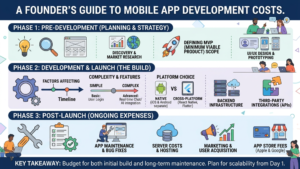


Strategic Financial Planning for Mobile App Projects
Successful mobile app initiatives require aligning technical foundations with long-term business goals. Rather than selecting a stack based on buzz, founders must weigh immediate development costs against the total cost of ownership. In the 2026 market, average costs for mid-range applications in the United States generally span from $50,000 to over $500,000, and failing to plan for post-launch maintenance, which accounts for 15% to 25% of the original budget annually, remains a leading cause of project failure.
Budget Impact of Development Strategy
The choice between native and cross-platform development acts as the most significant lever for managing early-stage runway. Choosing native development entails maintaining separate codebases for iOS and Android, which doubles the effort for feature updates and quality assurance. Alternatively, cross-platform frameworks like React Native or Flutter can reduce development costs by up to 40% because they allow teams to share a large portion of their code across platforms.
- Prioritize an MVP to limit initial investment while gathering user feedback on core functionality.
- Assess hardware requirements early, as complex AR, VR, or high-performance video processing often necessitate native development despite the higher price point.
- Factor in indirect costs, including app store fees, backend infrastructure, and external API subscriptions, which often exceed initial estimates by 10% to 18%.
Strategic planning involves more than just selecting a framework. Organizations can optimize their capital by leveraging managed backend solutions like Firebase or AWS Amplify, which can decrease infrastructure setup time by as much as 60%. By focusing on modular architecture, teams avoid the common pitfall of costly full-scale rewrites later in the product lifecycle. Defining this roadmap early ensures that your budget remains dedicated to growth rather than perpetual catch-up development.
Understanding the Three Pillars of App Development
Selecting the right technical foundation is the most significant decision a mobile app project will make, as it dictates development timelines, budget long-term maintenance, and hardware capability. Founders must weigh the balance between performance requirements and the speed to market provided by modern frameworks.
What are the core differences between native, cross-platform, and hybrid app development?
Native development involves building applications specifically for one platform using its unique programming languages, such as Swift for iOS or Kotlin for Android, to ensure maximum performance and seamless hardware integration. In contrast, cross-platform development allows you to use a single codebase to deploy an app across multiple operating systems, offering faster time-to-market and reduced maintenance costs. Hybrid development functions as a middle ground, wrapping web technologies like HTML5, CSS, and JavaScript inside a native container to grant them access to device hardware features. While native apps provide the most fluid user experience and security, cross-platform and hybrid solutions prioritize developer efficiency and broader reach. Choosing the right path depends on your project’s specific performance requirements, budget, and target audience needs.
Performance concerns often lead stakeholders toward native stacks when apps require complex data processing, real-time animation, or deep integration with AR/VR or specialized sensors. However, modern frameworks like React Native and Flutter have significantly narrowed the load-time gap, making them increasingly viable for production-grade consumer apps. By leveraging these cross-platform tools, teams can share between 60% and 95% of their codebase, which yields a substantial decrease in the overhead associated with managing two separate development streams.
Cost trade-offs remain a primary factor in the selection process. Native development generally commands a higher budget due to the requirement for platform-specific expertise and the logistical burden of maintaining dual codebases. Conversely, cross-platform approaches can reduce initial engineering investment by 35% to 50% compared to building two separate native applications. This efficiency often allows for a more robust MVP phase, where limited resources are better served by broader reach rather than platform-specific optimization.
| Model | Primary Pro | Best Use Case |
|---|---|---|
| Native | High Performance | AR, VR, or Fintech |
| Cross-Platform | Rapid Launch | Startups and MVPs |
| Hybrid | Lowest Complexity | Simple Information Apps |
The Realities of Development Expenditure and Cost Structures
Building a mobile app in 2026 typically requires a budget range of $15,000 to over $500,000, depending heavily on project complexity, feature set, and platform requirements. Development costs are primarily driven by your choice of hiring model, with professional agencies typically charging $75 to $250 per hour compared to $25 to $150 per hour for freelance talent. You must also account for hidden expenses, such as app store fees, compliance, and marketing, which often add an additional 25% to 35% to your total investment.
What is the typical cost breakdown for mobile app development?
To manage these costs effectively, consider an MVP-first approach, which allows you to prioritize core features and minimize burn rate during the initial launch phase. By opting for cross-platform development or using outsourced teams in regions like India or Eastern Europe, many founders find they can reduce total project expenditures by up to 60%.
Budget allocation remains a central pillar of financial planning. According to data from the Business of Apps, a standard project budget typically distributes spending as follows: 10% to 15% for the discovery phase, 20% to 25% for UI/UX design, 40% to 55% for core development, 15% to 20% for testing, and 5% to 10% for deployment and release.
| App Complexity | Typical Budget Range | Development Timeline |
|---|---|---|
| Simple | $15,000 to $50,000 | 2 to 4 months |
| Medium | $50,000 to $120,000 | 4 to 6 months |
| Complex | $120,000 to $500,000+ | 9 to 12+ months |
- Infrastructure and cloud hosting fees (AWS, Google Cloud).
- Ongoing annual maintenance (estimated at 15% to 25% of the original cost).
- Third-party API and SaaS subscription costs.
- Security compliance and regulatory audit fees.
Why React Native Remains a Startup Favorite
In 2026, React Native remains a leading choice for cross-platform development, primarily because it enables teams to maintain a single codebase while delivering a high-performance, native user experience on both iOS and Android. By utilizing JavaScript, founders can significantly reduce development timelines and costs without sacrificing the look and feel of platform-specific apps.
Is React Native still the preferred choice for cross-platform app development in 2026?
The framework’s continued dominance is fueled by its massive open-source ecosystem, the strength of the React library, and seamless integrations with tools like Expo that simplify everyday deployment. For startups and enterprises alike, the ability to minimize code duplication while ensuring UX consistency across platforms provides a clear competitive advantage. Ultimately,React Native stays relevant because it bridges the gap between rapid iteration and the high-quality, native performance that modern users expect.
Beyond the technical architecture, the JavaScript ecosystem offers a deep talent pool, allowing teams to hire developers who are already familiar with web standards. This reduces onboarding time, which is critical for early-stage companies operating under strict launch windows. While alternatives like Flutter exist, the long-standing stability of the React Native community ensures that libraries and modules are consistently updated to support the latest OS releases.
- Single codebase deployment across iOS and Android significantly cuts engineering overhead.
- JavaScript proficiency allows for easier recruiting compared to platform-specific languages like Swift or Kotlin.
- Toolkits like Expo simplify the lifecycle of building, testing, and pushing over-the-air updates to end users.
- Consistency in design language ensures that brand identity remains unified regardless of the underlying operating system.
Founders should note that the efficiency of this approach does not force a departure from native capabilities. Modern builds often incorporate platform-specific native modules when deep hardware integration is required, offering a flexible middle ground. For those starting their project, balancing speed and functionality is easier when the foundation is built on widely supported frameworks.
Mapping the Seven Stages of Development
The mobile app development process follows seven sequential stages to ensure a product is viable, functional, and scalable. It begins with selecting your development partner and conducting Product Discovery to define your goals and target audience. Next, the focus shifts to UX/UI design to determine the app’s look and feel, followed by a project kick-off to finalize technical setups. The core phase involves iterative development integrated with constant Quality Assurance to ensure code stability. Finally, the process moves to publishing the app on the Google Play and Apple App Stores, followed by a post-development phase for ongoing maintenance and updates.
Phased Milestones and Budget Allocation
Managing a project lifecycle requires a structured approach to budget allocation. Development resources are typically distributed across these stages: 10% to 15% for the discovery phase, 20% to 25% for design, 40% to 55% for actual development, 15% to 20% for testing protocols, and 5% to 10% for deployment and release management. Simple apps often reach completion within 2 to 4 months, while apps with more integration needs may take 9 to 12 months or longer.
Ensuring Quality and Scalability
Quality Assurance ensures code stability before market launch. Rather than viewing testing as a concluding event, teams integrate bug fixes and security patches throughout the development cycle to prevent accumulated issues. Following the initial release, post-launch maintenance becomes an ongoing expense, typically requiring 15% to 25% of the original development budget annually. This investment covers essential activities such as API compatibility monitoring, platform-specific OS updates, and performance optimizations.
| Development Stage | Target Focus | Key Deliverable |
|---|---|---|
| Discovery | Market Analysis | Project Roadmap |
| Design | UX UI Standards | Visual Prototypes |
| Development | Core Logic | Functional Build |
| QA Testing | Code Stability | Test Reports |
| Deployment | Store Launch | Public Version |
| Maintenance | System Updates | Performance Logs |
Hidden Expenses of App Ownership

Once your application is live, the financial commitment shifts from initial build costs to sustained operational overhead. Many founders mistakenly view the launch as the finish line, but securing long-term viability requires consistent investment in backend stability, security, and updates. Failing to account for these recurring obligations often leads to service degradation or technical debt that becomes prohibitively expensive to resolve.
What are the common recurring costs required to run and maintain a mobile app per month?
Running a mobile app successfully requires budgeting for several recurring operational costs that typically scale with your user base. The most significant monthly expenses include cloud hosting and server infrastructure, such as AWS or Google Cloud, which grow as your traffic increases. You must also account for third-party API subscriptions—such as payment gateways, mapping services, or push notification tools—that charge based on usage. Budgeting for ongoing app maintenance is equally critical, as you need to allocate 15 percent to 25 percent of the original development cost annually for bug fixes, performance monitoring, and ensuring compatibility with the latest iOS and Android operating system updates. Finally, don’t overlook marketing and analytics expenses, which are essential for tracking user retention and acquiring new downloads in a competitive market.
Regulatory Compliance and Security Maintenance
Beyond basic hosting, businesses must prioritize the hardening of their digital perimeter. If your platform processes sensitive data, periodic audits and compliance certifications are non-negotiable expenses. These security measures often include penetration testing, data encryption monitoring, and managing legal requirements like GDPR or CCPA, which demand active legal and technical oversight. Dedicated security maintenance ensures your app remains a trusted repository for user information, preventing the reputational damage caused by data breaches.
| Category | Estimated Monthly Impact | Primary Driver |
|---|---|---|
| Cloud Infrastructure | $200 to $5,000+ | Active user count |
| Third-Party APIs | Variable | Usage volume |
| Security Audits | Annual allocation | Regulatory requirements |
| Platform Upkeep | 15-25% of build | OS version releases |
Navigating Store Policies and Commission Structures
What are the standard platform fees for distributing apps on the Apple App Store and Google Play Store?
To distribute apps on the Apple App Store and Google Play, you must first pay upfront developer account fees: a $99 annual fee for Apple’s Developer Program and a one-time $25 registration fee for Google Play. Once your app is live, both stores charge a commission on paid app downloads and digital in-app purchases processed through their billing systems. While these service fees vary, 99% of developers eligible for a fee on Google Play pay 15% or less, and Apple similarly offers reduced rates for developers meeting specific revenue criteria or program requirements. Keep in mind that publishing a free app with no digital sales typically does not trigger these platform commissions. If your app only sells physical goods or services, it generally remains exempt from these store-specific service fees.
Managing Revenue Thresholds and In-App Billing
Beyond initial entry costs, founders must account for how store-mandated billing systems influence long-term profitability. Both platforms require the use of their proprietary payment gateways for digital content, which ensures security but locks providers into commission structures. For startups planning to scale, tracking revenue against the small business programs offered by Apple and Google is essential, as these can lower your service fee from 30% to 15% on early annual earnings.
To stay within budget, it is critical to separate your revenue streams. If your application provides a service like e-commerce for physical goods, ensure your architects prioritize third-party payment integrations early in the build. This avoids triggering the store commission requirements reserved for digital assets. For ongoing guidance on regional tax implications and compliance updates for your specific business model, you can reference the resources available at www.appstory.org to refine your financial roadmap.
Valuation and Profitability Metrics for Scaling
Moving from a functional product to a scalable business requires an analytical shift from development milestones to financial outcomes. Demonstrating value to stakeholders relies on tracking specific performance indicators that translate user activity into enterprise worth.
How can developers estimate the potential value or profitability of an app with 1,000 to 100,000 active users?
To estimate the value of an app with 1,000 to 100,000 active users, start by calculating your Monthly Recurring Revenue and yearly net profit, as these are the primary metrics investors use to determine market worth. Next, analyze your user engagement data, such as daily active users and retention rates, to demonstrate consistent user engagement and retention trends. Benchmarking your app against similar successful competitors provides a realistic multiple to apply to your earnings, which serves as a baseline for your valuation.
Beyond raw financials, factor in the moat of your app, including intellectual property, user ratings, and technical stability, which can significantly influence investor interest and acquisition price. Developers should document these assets as proof of competitive edge. Finally, leverage these combined metrics to build a clear, data-driven pitch that translates your current user activity into predictable future earnings.
- Monthly Recurring Revenue (MRR) and Average Revenue Per User (ARPU) are the baseline figures for any valuation.
- Customer Acquisition Cost (CAC) must be consistently lower than the Lifetime Value (LTV) of a user to ensure profitability at scale.
- Technical moats, such as proprietary algorithms or specialized data architectures, increase appraisal multiples by making the product harder to replicate.
- High user retention rates act as a stronger indicator of future health than simple vanity metrics like total downloads.
| Metric | Significance | Impact on Valuation |
|---|---|---|
| Retention Rate | User loyalty | Predicts long-term sustainability |
| CAC | Marketing cost | Affects net profit margins |
| Technical IP | Unique code | Creates higher entry barriers |
Selecting the Right Development Partner

How do you evaluate and select a suitable mobile app development company for your startup? Start by clearly defining your project goals, essential features, and target budget to ensure you are comparing like-for-like proposals. Research potential firms by reviewing their portfolios and case studies to confirm they have specific experience in your industry and the tech stack you require. Professional networks provide valuable referrals, while third-party review platforms help validate a firm’s reputation and long-term reliability.
Prioritize scheduling live meetings with your top candidates to evaluate their communication style and technical problem-solving approach. A competent agency should be able to explain complex trade-offs between native and cross-platform architectures in plain language without relying on jargon. Pay close attention to how they handle questions regarding project risks. If a partner avoids discussing potential challenges or offers pricing that sounds too good to be true, consider that a signal to proceed with caution.
Ensuring transparency and clear technical expectations
Transparency in quotes is essential for keeping your budget on track. Request a breakdown that separates costs for discovery, design, development, and quality assurance. Be wary of agencies that provide only a total lump-sum price, as this often masks scope-creep risks later in the build. Some teams will suggest modular development, allowing you to prioritize the most important features for your MVP while deferring secondary tasks until later phases.
- Demand a detailed roadmap that outlines specific delivery milestones and clear acceptance criteria for each phase.
- Inquire about their internal processes for code reviews, version control, and documentation practices.
- Ask how they handle unexpected issues, such as third-party API failures or sudden platform-specific policy changes.
- Ensure their assigned team includes a dedicated project manager to act as your primary liaison.
The right choice often comes down to finding a partner that demonstrates a deep understanding of your business objectives rather than just someone who executes code. Look for teams that ask insightful questions about your long-term roadmap and user growth strategies. A strong candidate provides more than just development hours; they offer technical guidance that can help ensure your architecture remains scalable as your user base grows.
Building for Long-Term Success and Scalability
The relationship between initial development investment and long-term financial health is often dictated by early technical choices. While choosing a cross-platform framework like React Native or Flutter can reduce upfront costs by up to 40% compared to native builds, the decision must align with your project’s longevity requirements. High-performance, hardware-intensive apps that rely on complex sensors or real-time processing often require a native foundation to avoid costly refactoring once the product gains traction.
Prioritizing iterative growth through the MVP approach
Founders should view product development as a series of phases rather than a single massive build. Launching a Minimum Viable Product serves as the most effective strategy to validate market demand while keeping initial expenditure within the $15,000 to $50,000 range for simple applications. By focusing on core functionality first, you defer non-essential feature development, which allows you to reinvest potential revenue into scaling your backend infrastructure or adding sophisticated features like AI integrations later.
Planning for maintenance is just as important as the initial build phase, as you must account for annual costs ranging from 15% to 25% of your original investment. Budgeting for these recurring updates, such as keeping pace with OS versions and maintaining third-party API stability, provides a buffer against financial strain. Building with modularity at the forefront ensures that individual components can be updated or replaced without the need for a full-scale rebuild.
- Audit your technical stack early to ensure it can support business logic growth over the next 3 to 5 years.
- Allocate at least 20% of your total budget toward long-term maintenance rather than just the initial launch.
- Prioritize developer experience and code maintainability, as clean code reduces the cost of future feature additions.
- Monitor key performance indicators like server infrastructure costs and API usage to catch and optimize inefficiencies before they inflate operating overhead.