

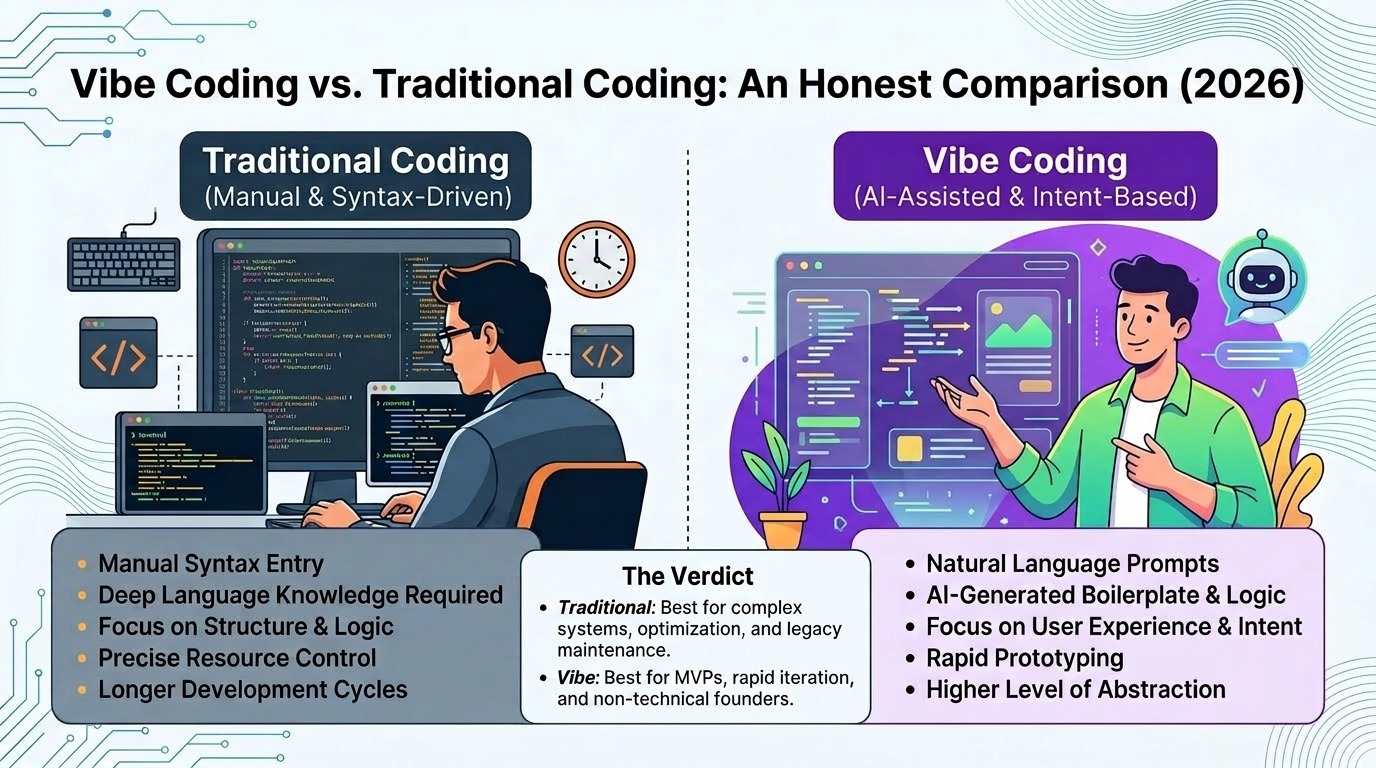
The software development world is splitting into two distinct philosophies in 2026. One is the classic, disciplined approach we’ve known for decades. The other is Vibe Coding — a faster, more intuitive, AI-native way of building software by describing the feeling, outcome, and purpose rather than writing every line of code.
This is not hype. This is the real comparison from someone who has spent years doing both at scale.
What is Traditional Coding?
Traditional coding is the manual craft of writing, debugging, and maintaining code in programming languages (TypeScript, Python, Go, Rust, etc.). It demands deep knowledge of syntax, architecture patterns, data structures, algorithms, testing, DevOps, and security.
Strengths:
- Maximum control and precision
- Superior performance optimization
- Better long-term maintainability (when done correctly)
- Mature ecosystem of tools, frameworks, and battle-tested patterns
Weaknesses:
- Extremely time-consuming
- High skill barrier
- Slow iteration cycles
- Developer burnout is common
What is Vibe Coding?
Vibe Coding is the practice of building software by describing the desired outcome and emotional tone in natural language, then letting advanced AI systems (agentic workflows, specialized coding models, and orchestration layers) generate, refine, test, and deploy the application.
You say things like:
“Build me a calm, minimalist habit tracker for neurodivergent users with gentle streaks, dark forest aesthetic, and seamless Apple Health integration.”
The AI understands the vibe and builds the full-stack application — frontend, backend, database, auth, analytics — often in minutes.
Vibe Coding vs Traditional Coding – Detailed Comparison (2026)
| Aspect | Traditional Coding | Vibe Coding (2026) | Winner |
|---|---|---|---|
| Speed to MVP | 2–8 weeks | 1–3 days | Vibe Coding |
| Learning Curve | 6–18 months | 2–6 weeks | Vibe Coding |
| Code Quality | High (if senior dev) | Very good to excellent (with review) | Slight edge Traditional |
| Customization Depth | Unlimited | Very high (improving rapidly) | Traditional |
| Technical Debt | Low–Medium (depends on dev) | Medium–High if not reviewed | Traditional |
| Cost (for startups) | High | 60-80% lower | Vibe Coding |
| Scalability & Performance | Excellent | Very good (with architecture prompts) | Traditional |
| Debugging Experience | Mature tools | AI-assisted + natural language | Vibe Coding |
| Maintainability (5 years) | Strong | Good if properly documented | Traditional |
| Team Size Required | Larger | Much smaller (1–3 people) | Vibe Coding |
Read More. : Explore the Top Messaging and Free Chatting Apps: Our Picks for Android and iOS in 2026
In-Depth Analysis
1. Productivity & Speed
Vibe Coding delivers 3–7x faster development cycles for most standard applications (SaaS tools, internal platforms, consumer apps, dashboards, mobile web apps). The gap is even bigger for non-technical founders and small teams.
2. Creativity & Innovation
Vibe Coding wins here. Because you’re not stuck in implementation details, you iterate on product feel and user experience much faster. Many teams now prototype 8–10 different “vibes” in a single day.
3. Code Quality Reality Check
This is where traditional developers get defensive — and they’re partially right. Raw AI output in 2025 was inconsistent. In 2026, with agentic systems, specialized fine-tunes, and proper review workflows, vibe-coded applications are reaching 85-90% of traditional quality out of the box. The remaining 10-15% is handled during human review.
4. Long-term Maintainability
Traditional coding still holds the advantage for mission-critical systems, large monoliths, or highly complex domains (fintech, healthtech, autonomous systems). However, new AI-powered documentation and refactoring agents are closing this gap faster than most expected.
5. Security & Compliance
Traditional coding is safer when you need strict control (SOC 2, HIPAA, PCI-DSS, GDPR). Vibe Coding requires strong governance layers — prompt guardrails, code scanning, human approval gates. The most mature teams use hybrid governance: AI builds, humans review security-critical paths.
Read more : Top 13 Things to Consider When Hiring Mobile App Developers in Houston
Who Should Use Which Approach in 2026?
Use Traditional Coding when:
- Building core infrastructure or performance-critical systems
- Working in heavily regulated industries
- Need maximum control and optimization
- Creating new programming languages, compilers, or complex algorithms
Use Vibe Coding when:
- Building MVPs and internal tools
- Startups and small teams
- Rapid experimentation and iteration
- Non-technical founders or domain experts
- Consumer-facing applications where speed and feel matter most
Best approach for most companies: Hybrid — Vibe Coding for 70-80% of the codebase, traditional/senior engineers for architecture, security, performance, and complex business logic.
The Future: Hybrid Intelligence (2026–2028)
By late 2026, the most successful engineering organizations won’t be “Vibe Coding teams” or “Traditional teams.” They’ll be Orchestration Teams — small groups of high-skill engineers who direct fleets of AI agents while maintaining deep system understanding.
The best engineers won’t be the ones who write the most code. They’ll be the ones who can best direct intent and maintain system coherence.
FAQ – Vibe Coding vs Traditional Coding 2026
Is Vibe Coding going to replace traditional coding?
No. It’s augmenting and partially replacing it for many use cases, but traditional coding skills remain essential for complex systems, architecture decisions, and quality control.
Can non-programmers actually build real products with Vibe Coding?
Yes. Many successful products in 2026 were built by founders with zero traditional coding experience using advanced vibe coding platforms and proper review processes.
Is Vibe Coding code any good in 2026?
Significantly better than 2024–2025. With current agentic workflows and specialized models, the code is production-viable after structured review. Many companies now ship directly to production with minimal changes.
Will traditional developers become obsolete?
No. The best traditional developers are becoming extremely valuable as “AI Conductors” — the people who understand systems deeply enough to guide AI effectively.
What are the best tools for Vibe Coding in 2026?
Leading platforms include advanced versions of Cursor, Claude Projects, custom agentic frameworks (like OpenAI Swarm successors), and specialized platforms like Vibe Coding-specific environments.
Final Verdict (2026)
Vibe Coding is not a fad. It represents a genuine paradigm shift in how software is created — moving from implementation to intention.
Traditional coding isn’t dying. It’s evolving into something more strategic and high-leverage.
The winners in 2026 aren’t choosing one or the other.
They’re mastering both and knowing exactly when to use each.
The question is no longer “Which is better?”
The question is: How intelligently are you combining both approaches?


![10 Benefits of the Internet of Things You Should Know [2027]](https://www.appstory.org/wp-content/uploads/2025/03/ATS-10-Benefits-of-the-Internet-of-Things-You-Should-Know-2025@2x-300x142.png)